Welcome to my world!

Backyard Birding in the Rio Grande Valley of South Texas:
Surrounded by great birding destinations, our favorite patch is still the backyard (or the front), where we've seen more than 270 species of birds. Sit awhile, and watch the river and yard with us!


Thursday, July 29, 2010

Dog Days of Summer


Our neighbor's metal roof looks way too hot for a perch, but this Black-crowned Night Heron doesn't seem to mind.  He perched there this morning, resting lazily on one foot,  as the sun crept higher and higher, hotter and hotter,  in the late July sky.  Taken through the window that overlooks the Arroyo, this photo of the night heron is one of the few I've snapped lately.  It's just too hot to wander around the yard.  If I go out early, camera in hand, the lens fogs up.  If I wait a while, the heat is stifling, the humidity is oppressive, and the mosquitoes are unbearable.

Looking out the window from an air conditioned house, though, the weather is just fine.  I've arranged furniture so that the most comfy seats face the views of the river and the bank beyond. Binoculars and scope are within reach.  A rocking chair sits right next to one of the two six-by-six windows.  From it I can peer down on feeders and baths and the butterfly garden.

Six tiny Black-crested Titmice (maybe the family that lived in the cow-skull nest cavity?) and three Carolina Wrens twitter in the Live Oak tree outside the window. Energetic and active, they flitter among leaves lit by the the sun, making me feel especially lazy and lethargic by contrast.  If I step out on the porch, I can hear a Chachalaca chorus, reminding me always of summer days, and two Inca Doves calling whirlpool! whirlpool! from opposite sides of the Arroyo.  (If I step outside on the porch, I remember the heat and return to my rocking chair!)
No wonder July has passed without my posting to my blog since the first day of the month--I have scarcely moved from the rocking chair!


These are indeed the Dog Days of Summer, those days so long and languorous.

The ancient Greeks called these long hot summer days "Dog Days," because that was when Sirius, the "Dog Star," rose in the sky each day just as the sun rose. Of course, we can't see Sirius presiding over the hours after sunrise, but the ancients felt the dog star influenced the days from July through August, bringing the scorching  weather.

Sirius, the brightest star we see in the sky (other than the sun), is part of one of the few constellations I can actually identify: Canis Majoris, the Big Dog.   It's near (well, in relative terms) my favorite constellation, the hunter Orion whose  three aligned stars form a very recognizable "belt."  Canis Major is the group of stars that  the belt of Orion seems to "point" to.  The photo at left above (not taken by me, borrowed from the the internet) is of Canis Majoris. Can you see a dog there?  I really can't either (the ancients had a better imagination, I guess) but I can certainly see Sirius. In the winter months, the dog constellations (there's also a Little Dog hunting with Orion) will be  in the night sky and can be seen easily.


Dog Days have arrived at the Arroyo Colorado in more than one way:   we've just adopted two canis minor of our own.  Rescued from puppy mills in Missouri and Arkansas, they needed a good home -- so we brought them home to Texas a couple of weeks ago.  We think they are perfectly adorable. 

That's where our July has gone, to the dogs!

Really, we've been out of town for at least half of the month. We visited our Missouri granddaughters who turned seven years old early in the month.  Then our five Texas grandchildren came here for a visit.  The three boys spent lots of time fishing. The girls, their mother, and I stayed inside, trying to stay cool.

The river was still quite muddy from upriver flooding caused by the hurricane rains in Mexico, so fishing from the dock was not successful.  But they caught lots of redfish in the bay.  Here's the group leaving from our dock early one morning. Notice how high the water is--no walking space for herons and egrets along the banks--and how green the unusually large amount of moisture has caused the bankside to be. 

Here's a very happy fisherman with his grandpop. Mitchell is the youngest of the three boys, but on this trip he was the champion fisherman. This is the smallest of the redfish he caught out in the bay.

The guys had a great time fishing in the Laguna Madre where water was deep (four feet is deep for the bay!) but relatively clear. One day they caught 172.5 inches of reds and a couple of small trout as well!

At high tide, wakes from boats splashed water over the dock or pushed it up from below so that it looked like the fountains of Bellagio!  Four weeks after the hurricane, we are still feeling its effects as flood water drains from a dam far upriver on the Rio Grande.

Here the fishermen jump over the fountains of water pushed up from beneath the dock. Water is still being released from Falcon dam on the Rio Grande, and as it makes its way to us (the arroyo is a floodway of the Rio Grande) it is very muddy and filled with debris--but fun for boys on vacation at Grammy and Papa's house. 

A birding highlight was a Great Horned Owl that flew from a palm tree at dusk after Grammy called "hoo hoo hu hoo." (A favorite children's book of my grandchildren is Jane Yolen's Owl Moon in which a child goes "owling" at night with his dad.)  During the day Green Jays and Cardinals brightened the window feeders. Out in the bay Roseate Spoonbills and Reddish Egrets winged their way from rookeries to feeding flats and back to rookeries again.

An eating highlight was Pirate's Landing in Port Isabel, with windows that overlook the causeway to South Padre Island.  Sadie and her siblings looked jaunty in their pirate hats.  Caleb, Spencer, and Mitchell ate fish that was good, but not as good as the redfish their dad would cook for them later, a delicious reminder of a great fishing day. 


We always have a great time with our family, but this visit may have been the best ever.

 Dog Days of summer on the Arroyo Colorado are days to remember.


Or to dream about for the rest of the year.

Thursday, July 1, 2010

After the Storm

I'll start out with the good news:  the storm is over and bird-watching along the river is good.   The storm surge made the river itself very full, especially at high tide.  With nowhere to stand,  wading birds flew by in a steady parade: Roseate Spoonbills, Green Herons, Great Blue Herons, White and Snowy Egrets, Tri-colored Herons, Reddish Egrets.  Black-crowned Night Herons perched in trees. Several kinds of terns cruised the river and sometimes swooped low to scoop up a fish:  Least, Caspian, Royal, Forster's, even a Black Tern or two. Brown Pelicans fished and Laughing Gulls stole their catch.    
But the Star of the day was a bird I had never seen from our yard--one I  see infrequently in the bay:  the magnificent Magnificent Frigate Bird. An adult female flew fairly low (for a frigate bird) over the river as I watched from the porch.  Strangely, I was expecting it.  I told myself I wanted to see one today, went out on the back porch, and twenty minutes later there it was!  (I've had these intuitions before:  see the post "No Sooner Said..." for one example.) 
The photo I managed was from far away (I was looking the other way when it first passed the yard and I had to run down the stairs for a clear shot), but it is clearly a magnificent bird, number 262 on our Yard List!

Hurricane Alex, after drawing a bull's-eye on us for a few hours Tuesday, moved its course to the south and went into Mexico instead of South Texas.  Outer bands of rain and wind hit us yesterday, but the wind never blew here stronger than 60 mph and the rain in our area was less than four inches.  I was relieved that there was no damage to our "nest"--but some of the birds were not so lucky.

The Brown-crested Flycatchers may have lost their chicks.  Early this morning I saw them near the nest site in the cottonwood stump, just sitting.  Not rushing in and out of the nest with bugs.  Not singing as they do when waiting for their mate to vacate the nest. Later I walked over to the old cottonwood and for the first time could see nest material hanging out of the stump as though they had pulled some of it out.  Though "hope is the thing with feathers," as Emily Dickinson says, I'm not too hopeful about the nestlings.

A neighbor told me that she found a Great-tailed Grackle's nest with two dead nestlings in her driveway.  This morning I looked at the retama tree where I had photographed a grackle nest a couple of weeks ago, but the nest was gone.  It was probably the one that blew into the driveway next door.

The Kiskadees were also unlucky. In the last post is a photo I took a few days ago of the nest in an ebony tree.  Today, it looks like this. The main part of the nest is half the size it was and the blown-away part is lodged in a fork of the tree a couple of feet below it.

The wind blew all day yesterday, first from the north as we were catching bands of the storm circling counterclockwise around the center of the hurricane, and then from the east as the outer bands north of the storm accompanied it to land.


The good news from the yard is that the little mockingbird I talked about in the last post apparently survived the gale.  I saw two juveniles near the nest today. I was so glad to see the survivors that  I snapped a picture though the light was not good enough to get a good photo.  Notice the speckled breast:  that's how I know this bird is a juvenile.

Watching the young mockingbird battle the storm as the hurricane's winds began on Tuesday, I kept thinking of Emily Dickinson's poem about hope and the storm.  (I didn't quote it in the last post because I suspected I might do too much of that, but now I'm thinking, why not?  I taught literature for over thirty years and old habits are hard to break!)

"Hope" is the thing with feathers—
That perches in the soul—
And sings the tune without the words—
And never stops—at all—

And sweetest—in the Gale—is heard—
And sore must be the storm—
That could abash the little Bird
That kept so many warm—

I've heard it in the chillest land—
And on the strangest Sea—
Yet, never, in Extremity,
It asked a crumb—of Me.

I keep disagreeing (at least in part) with Emily Dickinson even though I love her poetry.   She seems to say that hope doesn't ask anything of us.  If she means that hope exists in the world despite all the things we humans seem to do to defeat it, I guess she's got a point there.  But at the same time I think we need to sprinkle a few crumbs for that bird to eat!

I keep thinking of those birds in the eye of the man-made storm in the Gulf of Mexico.  We can't do anything about hurricanes but we can take care, as best we can, of the natural world. If hope is the thing with feathers what are we doing to deserve hope?

Tuesday, June 29, 2010

Hurricane Alex, Stay Away from My Nest!

This morning, as the first squall from approaching Hurricane Alex came through our yard, rain beating across the surface of  the arroyo and wind whistling at the windows, I watched a baby mockingbird, fresh out of its nest in the cenizo shrub, try to hold on to a branch as the wind whipped it to and fro.  A parent hovered close by.  I'm hoping the storm will not destroy nests and nestlings.  I'm hoping it won't destroy my own nest!

A couple of weeks ago I posted a sort of "state of the yard" piece, surveying the nesting activity around the house that week and comparing some of the birds to a restless wren questing for the perfect nest in a poem by Emily Dickinson (see "for every Bird a Nest").  My daughter Lori left a comment for me saying it reminded her of her favorite children's book, The Best Nest, by P.D. Eastman.

Now, Lori knows a lot about children and books, being both a teacher and a wonderful mother of five (my beautiful grandchildren who range in age from six months to fourteen years, birders all).  She pointed out that the mother bird of the book, who is unhappy with her nest,  learns in the end that it is not the location of the nest that matters, but the family in it. A good lesson for all of us, my wise daughter says.

I'd have to agree with her. She and her brother made our nest a very happy one before they fledged about twenty years ago.  We now visit their nests as often as we can (traveling to central Texas and Missouri), and in between those visits we continue to watch the  nests outside our own. So I guess you can say we don't suffer from "empty nest syndrome"--we've found a great way to take up our time, yard-watching!

Most of the backyard nesting this month has turned out well.  Bronzed Cowbirds still terrorize the neighborhood but even those parasitizing pests haven't prevented the baby boom.  Unwanted guests, they are nonetheless fascinating (and yes, beautiful) to watch.  If you had seen this guy with his ruffled mane and piercing red eye survey the sorghum field across the road, I think you'd be as stunned by his beauty as I was.

It's been a week of increase in the yard:   we have newly-fledged Green Jays eating from our feeders along with their parents,

Carolina Wrens flittering and singing everywhere,

and a family of Eastern Screech-owls screeching and trilling their strange songs as they perch in trees and on the outside stair railings at night.

I'm not sure where the little owls' nest was this year.  For years they chose a nest box in our yard, peeking out at us from the hole as we drove in the driveway.  But for the last two summers bees have taken up residence as soon as the owl family fledged--so we had to take the box down and we left it down this year. 

Brown-crested Flycatchers are very busy feeding chicks in their woodpecker-hole-nest-cavity nest in the dead cottonwood stump (they finally made the decision for the location of their second nest).  I love to hear their singing as they carry the insects to the hungry babies.  (Read "Let's Do Lunch" for a description of their first nest and "for every Bird a Nest" for photos of their search for this one.)

Here's a new nest and its inhabitant:  a White-winged Dove sitting on eggs in a flimsy nest in the small Brasil tree at the end of the driveway.  Isn't that blue-circled eye amazing?  I took this picture quickly as she was definitely eying me and my camera, even though I wasn't as close to her as my zoom lens makes it look.  I love to hear the incessant "who cooks for you?" queries of these beautiful doves. 

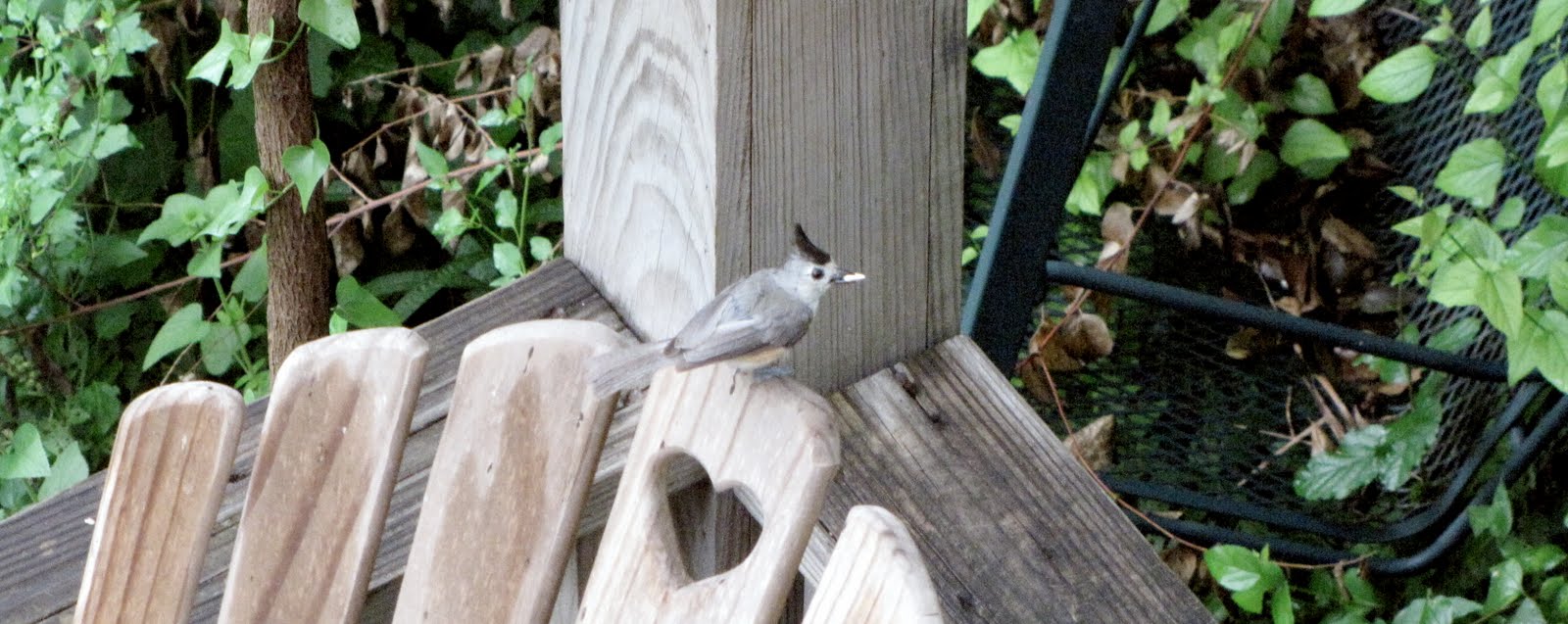
I discovered a very cleverly-placed nest last week in an unusual place: snuggled in the brain cavity of a cow's skull was a nest with several baby Black-crested Titmice!  Now if you are wondering where in the world the titmice would find such a nest site, remember this is Texas where citizens use dead animal heads as decor.  The skull, once bleached white in the Texas sun out in a Texas cow pasture, is now gracing (?) the wall of a neighbor's storage shed, clearly visible from our deck and an apparently enticing place for the titmouse family.

I've already mentioned the strange nesting habits of Black-crested Titmice in previous years when they nested inside the metal railings of our boat trailer and inside the metal arm of a satellite dish. This may just be the strangest place for a nest yet--though to Mrs. Titmouse it may be "The Best Nest" ever!  In P.D. Eastman's  The Best Nest,  the Wrens think they've found a great nest, a boot, until the foot it belongs to reclaims it.  That reminds me of the time one of my neighbors put on a pair of khaki pants he had hung to dry on the porch railing.  When he reached his hand in the pocket, he found a Carolina Wren's nest!


Kiskadees may have a second brood in their large spherical nest.  In this photo, you can clearly see the side entrance to the nest.  

I've seen only one more bird feeding a cowbird chick, a Northern Cardinal.  I don't know if it also raised cardinals. I hope so.  I'm just glad to see the pair of cardinals doing okay.  The female is one we saw at the feeders in the spring with a badly torn (or deformed) crest.  I didn't post this horrible photo then because I was afraid the bird had been attacked by one of the neighborhood cats and feared that it would not survive. Now the photo just reminds me of how resilient nature can be. That's something I want to hold on to with a hurricane bearing down on us so early in hurricane season and with oil still gushing in the gulf.   The bird is still strange looking, but she is seemingly healthy and has raised a brood of chicks.  Her image no longer horrifies me but gives me hope.

The Altamira Orioles have not returned to their nest, but I did hear them singing a few days ago.  I still have hopes that they will decide to use the beautifully constructed pendulous nest that they built and abandoned last March. 

Quick!  Is this an Altamira or a Hooded Oriole?  

You're right--it's the smaller but similar Hooded Oriole.  Hooded Orioles are still eating daily from the hummingbird nectar feeders and hanging out in the Washingtonian Palms.  I can't see their nests, but there appears to be one in a tree in the backyard and one in the front. 

I'm still frustrated that I can't find a Buff-bellied Hummingbird's nest.  I'm fairly certain there are new baby hummers among those at our feeders.  These are our resident hummers, quite beautiful birds. I like the photo above because the eponymous buff-colored belly shows clearly above those tiny feet.

Other birds whose numbers have increased greatly in the last two weeks are the Cave Swallows that nest under the roof of a neighbor's boat lift and the Purple Martins that live in another neighbor's martin house.  In this photo the young martin is the one with the grayish throat.


As I type this post, I am watching the Weather Channel.  We're playing that guessing game that people who live in hurricane land have to play.  Should we stay or should we leave?  Will the storm come straight up the arroyo  and the eye come over our house (as Hurricane Dolly did two years ago), or will we be lucky and get mostly just much-needed rain?  I hate to think that the storm will follow Dolly's path.  That storm was in August, past nesting time for the herons and spoonbills and pelicans on Green Island at the mouth of the Arroyo. This one, I'm reminded by the baby mockingbird clutching the cenizo shrub next to its nest, is early in the season when birds are still nesting.   Even the Best Nest doesn't offer protection when the very trees are in danger.

 Update on the storm:  So far, luck is with us.  The latest Tropical Update puts us at the top edge of the cone of danger in the hurricane's path instead of right in the middle as we were a few hours ago and it's saying the storm may be only a category one hurricane.

I think we'll be lucky.  And so will that little mockingbird whose parents built the Best Nest there in the cenizo bush.

Sunday, June 20, 2010

All Things Great and Small

The tragedy unfolding in the Gulf of Mexico, where oil is choking wildlife and killing bays and estuaries, sickens me and makes me angry.   I keep thinking  of Coleridge's albatross (in "The Rime of the Ancient Mariner") that was so wantonly destroyed by the unthinking mariner. When the mariner destroyed the innocent bird of the poem, the seas turned into a nightmare and it's that image I envision in the scene of oil and fire at the site of the fallen rig:
"About, about, in reel and rout
The death-fires danced at night;
The water, like a witch's oils,
Burnt green, and blue, and white."
Yesterday I posted a photo of a Great Egret we saw on its nest at dawn in the Everglades this spring.  In honor of the birds of the Gulf  Coast from here in South Texas (where thankfully we are not affected by the spill) to Florida I'll post some of the other pictures I took on that trip.


Here is the most fascinating bird of our trip: a Wurdemann's Heron, which is a hybrid of the white color morph ("Great White Heron") of a Great Blue Heron and a regular Great Blue Heron.

Can you see the Great Egret sitting on the nest just behind this nest?  If not, click to enlarge the photo.  It's like one of those "how many birds can you find?" drawings.  


The "Wurdemann's Heron" looks like a Great Blue but has a white head.  On our way to fish for tarpon the fishing guide took us by a mangrove island rookery where he knew a Wurdemann's Heron was building its nest.  We approached slowly, using only a trolling motor, and did not disturb any of the birds.  Of course these photos are taken with a zoom lens so we were not as close as it looks.

 In breeding plumage, all the birds were at their most beautiful, especially this Tri-colored Heron I photographed  when we were kayaking in the Everglade's "River of Grass."  I'm used to seeing these guys fly by in twos and threes along our Texas coastal river, but this one was so close I could admire its two-toned blue beak. 

This is the same Great Egret as the one in the photo of my last post.   Its plumes are not showing as well, but the green at the base of the bill is amazing. The color changes during spring breeding season are among nature's most beautiful miracles.
The red bill of the White Ibis is another amazing coloration.

The few American White Pelicans we saw were probably not breeding.  They for some reason had not migrated as the Florida white pelicans do.  We have a flock of white pelicans in our area in South Texas that remain for the summer also.  I see them in the bays sometimes when we are fishing.  I read last week a post on Texbirds that described one being hit by one of those large wind turbines that are along the coast north of us.   The fishing guide in Florida thought these two guys were probably too weak to have migrated.  I wonder if they will survive the summer.


It's the pictures of the Brown Pelicans covered with oil that are so heartbreaking in the news of the gulf oil spill.  As we saw this beautiful bird in breeding plumage on the mangrove islands of the everglades, we already knew that oil was spilling into the gulf and we were hoping that somehow the birds in Louisiana could be safe. 


Another bird we enjoyed seeing in Florida was the Osprey.  This one was nesting on an electrical pole near Chokoloskee Island.

Birds were not the only creatures we saw in the bays and rivers of South Florida.  Here a Kemp's Ridley Sea Turtle comes up for a breath and a peek at our boat.

Seeing a hooked tarpon jump was exciting, especially to my husband the fisherman. Click to enlarge this photo to see the fish  in more detail.


Our vacation to see the Florida Everglades, to fish among the islands and paddle through mangrove tunnels
and along the quiet and beautiful "river of grass,"  was a wonderful week of stunning landscapes and fascinating wildlife.  I cannot imagine oil covering and killing this beauty, but of course that is exactly what is happening in other parts of the Gulf of Mexico and it is because of the carelessness, and yes the greed, of humans.

I keep thinking of Coleridge's ancient mariner.  His story is of a man who took for granted the wonder of nature.  As he tells the story, the mariner finally learned a lesson:

"He prayeth best, who loveth best; 
All things great and small; 
For the dear God who loveth us;
He made and loveth all."

It was his punishment to wander from land to land telling the story of the death of a beautiful and innocent bird at the hands of a man who was not evil but who was thoughtless and unaware of his actions.  Coleridge tells us that the "wedding guest," to whom he recounted the story, woke up "sadder and wiser," but I wonder if he really did.  I wonder how many environmental disasters it will take for us to be any wiser.

Friday, June 18, 2010

Great Egret: Florida Everglades, May 9, 2010


This is my response to a challenge, "Wordless Wednesday (Saturday edition)."  I don't think anyone thinks I can be wordless.  But what words are needed here?