Welcome to my world!

Backyard Birding in the Rio Grande Valley of South Texas:
Surrounded by great birding destinations, our favorite patch is still the backyard (or the front), where we've seen more than 270 species of birds. Sit awhile, and watch the river and yard with us!


Showing posts with label Willow Flycatcher. Show all posts

Wednesday, September 1, 2010

Increase

Late summer is a time of abundance.  Where there were two or three Green Jays at the feeders, there are now six.  Where there were a few butterflies basking in the sun or flitting from lantana to plumbago,  there are now dozens.  Four Kiskadees have become eight; eight White-winged Doves have become sixteen. One or two Buff-bellied Hummingbirds at a feeder have become a swarm of Ruby-throated migrants buzzing like bees around any available nectar.


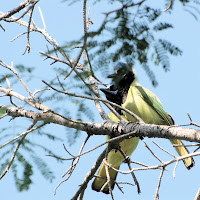
A few days ago I heard a distinctive Green Jay racket. Out on the fishing dock, a family of six of these bright, cheerful, and noisy natives of South Texas lined up on the railing. Four of them were probably newly fledged; all were excited.  Ruffling their feathers and bobbing up and down in a funny dance, they were belting out the  strangest clicks and whistles.

I love these birds and never tire of watching their noisy antics.  When they fly into a tree, they alight on a low branch and hop their way to the top.  Though I don't put out their seed at regular times, they always discover it within about five minutes. With the sudden increase from two to six jays, I'll have to increase my supply of corn, peanuts, and bird seed.

Migrants  that disappeared in late spring are back as fall migrants, bookending summer with bright color and enlivening what had become a very lazy time in the yard.


Black and White Warblers, Yellow Warblers, Prothonatary Warblers, Hooded Warblers, and Canada Warblers began visiting oak trees and bird baths last week.  Summer Tanagers and Indigo Buntings added a splash of color as did migrant Baltimore and Bullock's Orioles that joined the summering Hooded Orioles and native Altamira Orioles. Though not as brightly colored in fall as in spring, these are still pretty spectacular birds. 

A little empidonax flycatcher entertained me all one afternoon catching small insects above the driveway.  I usually don't presume to distinguish between Willow and Alder Flycatchers, identifying them all as just Traill's Flycatchers, the name these two almost identical birds used to be called, but this guy sang and called a number of times, giving me a definitive clue.  Consulting the voice recordings on the Ibird Explorer Pro app of my Iphone, I'm pretty sure this was a Willow Flycatcher.  Its mostly three-syllable song and whit call  was convincing to me, anyway.  For a while earlier in the day, I had wanted to say Yellow-bellied Flycatcher, but the lack of distinct eye ring made me decide this was a Traill's with a lot of color. 


Tropical Kingbirds have been singing in the backyard.  They fly from across the arroyo in the early mornings and announce their identity with song.  The otherwise identical Couch's Kingbirds are more often in the front yard where they nested earlier in the summer.  These look-alikes are native residents unlike the Eastern and Western Kingbirds that have been migrating through.  Great Crested Flycatchers (right) are similar to the Couch's/Tropical Kingbirds and in some ways to the  Brown-crested Flycatchers but with a deeper yellow belly and more rusty color on their tails.  There's an abundance of the latter this week, probably birds that nested farther north as well as our yard nesters.


Meanwhile, a little  Screech-owl sat unperturbed in the pine tree, enduring constant scolding by what seemed like a treeful of wrens and titmice.
I think even the person least inclined to anthropomorphism would call this a "wise old owl."  Or at least a curious and patient one.

Birds and bird activity are not the only increase in the yard.  Butterflies are thick among trees, shrubs and flowers; and blooms are abundant even as rain diminishes.  These three Giant Swallowtails were in a lineup of ten on a  fiddlewood shrub.  I would have needed a wide lens to get all the rest of them in the picture!


Another illustration of burgeoning life around the yard can be seen in the photos above of a Queen butterfly and a Queen caterpillar, both on milkweed plants.  Look closely--do you see what I am talking about? It's not the butterfly or the caterpillar.   That's right--the tiny round white specks are eggs! Click on the photos to enlarge them if you can't find the eggs. 

 I've cropped and enlarged this photo so that you can see the egg better.   The eggs are actually ridged, something my maturing eyes can't tell,  but the photo shows.  This one was on a yellow milkweed (butterfly weed) that is not native to south Texas but it grows well here and spreads easily from seeds that burst out of pods, and with the help of silky white filaments, float on the wind until they lodge in another garden or roadside. 

I have taken many, many butterfly photos in the last couple of weeks and then spent hours looking over guide books trying to identify them.  I used to classify butterflies in such categories as "yellow ones" "white ones" and "little skipperly things."  Now with the help of my camera and guide book (I like Kaufman's because of the maps and indication of size) I'm doing a better job, but my learning curve is slow.  A camera really helps me identify these guys, as it does with other insects and dragonflies.  I think my next blog will be devoted to the various butterflies and dragonflies I've been able to put a label on.


Speaking of increase (and also of insects), I have more photos of the spider I blogged about yesterday.  In the late afternoon sun, it is obvious why this spider is called a Silver Argiope. Notice that the little mate I worried about yesterday was back today, snuggled closer.  I laugh whenever I see this unlikely pair.   There I go anthropomorphizing again. 

Our population of Silver Argiopes has doubled:  today I found another one not far from the first.  Its web is also on the side of the house but separated from the other by a bump-out for the water heater.  This spider is only about half the size of the first one and not so spectacular.

But isn't the shadow cast by this smaller Argiope amazing?  Though the web's stabilimentum (zigzaggy web things) can't be seen well on the web, they are obvious in the shadow.

I'll keep watching these fascinating spiders and learning more about them.  And about the other creatures around the yard.  What's really increasing is my attention.   I'm sure the spiders have always been here.

Wednesday, April 28, 2010

Yard Watch

If I spend a lot of time outdoors--and who wouldn't with migration in full swing?--I don't have much time for adding to my blog.  But since I set up this blog to keep track of what's happening in the yard, I will write quickly tonight and show a few pictures. (If I'm tempted to tell stories or get too long-winded, I'll cut it short. Tonight it's just the news. )

First, you may have noticed that I changed the photograph  behind the blog's title above.  The Black-bellied Whistling Ducks are just so much fun to watch that I wanted them to look over the page. (See this earlier post for other photos.) Every morning they stand or sit on the railing of the deck by the river, waiting for the neighbors to put out seed.  Today while my husband fished on the dock, I walked  up the stairs to the deck where the ducks had  perched, to within  ten feet of them, and they didn't move -- until I started talking too loudly and they flew in their awkward way to the next dock.

I'll be happy to see the ducks bring their family along with them later in the summer.  I'm not sure where the nest is--they are still spending much of the day here, so they may not have a nest yet.  Last summer I thought maybe they had nested on top of a neighbor's old shed where they spent a lot of time.   
Other nesting news:  Northern Mockingbirds have completed a nest in a small Anacua tree in the yard just to the east.  Another pair of mockingbirds are close by, perhaps in the yard to the west.    Brown-crested Flycatchers still take dried grass into a small hanging bird house though its proximity to the garage makes them nervous. The Altamira Orioles, Hooded Orioles, and Kiskadees are relatively quiet, not much movement in and out of the nests.  That may mean  they are sitting on eggs.  Of course, cowbirds keep close watch on all and harass them continually.  Green Jays  today followed each other around the tree canopy over the driveway, ruffling up their feathers and almost snuggling.  I know of no nest yet, but there must be one close by.  A pair of Northern Cardinals are also eating at feeders in the yard off and on all day.  They are certainly nesting nearby also.  The Curved-bill Thrashers are probably sitting on eggs by now in their nest in the neighbor's yucca. 

Every morning, a large male Wild Turkey flies over from across the river to walk around (and gobble) in the yard .  Today he flew to an entry deck behind the house, not far from where Brad was fishing on the dock.   They gobbled at each other for a bit  (I wonder what the bird thought of the fisherman)  and then the turkey moved around the house to stroll the driveway.  Brad also saw bottlenose dolphins this morning feeding in the river.  I'm hoping to catch them in a photo soon.  The dolphins are  one of my favorite things about the river.

The last few days have been good  ones for watching spring migrants.  Six new species have been added to the 2010 Yard List since Monday.   (The list is to the right in the sidebar.  I always set the recent additions in red.)


A beautiful male Rose-breasted Grosbeak has been in the yard for a couple of days.  He's not eating the orange half that's in the photo, of course--that's for the five species of orioles, Great-tailed Grackles, Green Jays, and woodpeckers.  He's partial to the sunflower seeds.  That's a picture of a grosbeak female to the right. These birds are a little skittish and shy at first, but once they find a feeder with large striped sunflowers, they settle in and eat for as long as there's still seed.  I think their large seed-cracking beaks make them look comical.

Female and juvenile Rose-breasted Grosbeaks look similar to the male Black-headed Grosbeaks we sometimes have in the winter. (Look at this post for a photo of last January's first-year male.)

 (Yesterday was actually a two-grosbeak day when a Blue Grosbeak flew in very briefly.  Rust-red wing bars distinguish it from the very similar Indigo Bunting. ) 


The best migrant news is that the Painted Buntings are here.  Monday I saw a male fly out of the drive and across the road to  the patch of weeds beside the sorghum  field. I watched from the deck for awhile, and when it didn't appear again, I walked to the end of the drive and was lucky enough to get photos.  Not great photos --- since they were taken from across the road, but any picture of a Painted Bunting, even if fuzzy and small, is fun to look at--just like the birds.  So brightly colored with red breasts, blue heads and wings, red eye-rings and green backs, these birds do not look real but like they were drawn by a child with a brand new box of crayons. 

                                                                  
In the picture on the left, a second bunting hides behind another.  Until I downloaded the photo to my computer,  I thought I had seen  just one bird!  Arching above the birds in the picture is a seed-head of guinea grass that had grown up around a stand of century plants. An invasive plant that gardeners around here battle continually, guinea grass is tenacious and tough to pull up.  If you let it grow too long (if you're a lazy gardener like me) you have to dig the clumps out of the ground with a shovel.  I know I shouldn't,  but I let them go to seed when the buntings are migrating because that's where I always see the beautiful birds-- in the untidy clumps of grass in my yard.  (I guess pulling a few in my yard wouldn't help much anyway since across the road there's plenty of it. )

Yesterday was actually a two-grosbeak day when a Blue Grosbeak flew in very briefly.  Rust-red wing bars distinguish it from the very similar Indigo Bunting.  I hope I have a chance for a photo if it returns.


Not all the birds of the yard are as brightly colored as the Painted Bunting. But the eye of the Bronzed Cowbird is as red as the bunting's brightest feathers. Look at the ruff of feathers around this guy's neck that he can puff up when he really wants attention. (If it were not late as I write this, I'd talk more about this amazing ---but not beloved-- bird.  I'll put that off for another time when I'm not just giving a yard report.) 

Other new birds I've seen and added to the 2010 Year List since my last report :  Western Kingbirds perching at the top of the Royal Poinciana ; a  Swainson's Hawk soaring high above the fields; and a  Willow Flycatcher  making quick forays over the driveway to catch bugs from a perch in a mesquite.  (The flycatcher obligingly sang  as it flew away so that I could tell it was a Willow and not an Alder. Usually I have no idea which of those two little flycatchers I'm seeing.)

Well, that's the end of this installment of the backyard report.

To borrow from Garrison Keillor:  That's the news from  the Arroyo Colorado...where all the women are strong, all the men are good-looking and all the birds are above average.