Welcome to my world!

Backyard Birding in the Rio Grande Valley of South Texas:
Surrounded by great birding destinations, our favorite patch is still the backyard (or the front), where we've seen more than 270 species of birds. Sit awhile, and watch the river and yard with us!


Showing posts with label Indigo bunting. Show all posts

Tuesday, October 25, 2011

Autumn in South Texas

Sometimes I take a picture that isn't really good photographically-speaking, but that I like so much I keep looking at it.  This is one of those.  It's of a late-season warbler--Yellow, I suppose, but in autumn Peterson's references to "Confusing Fall Warblers" still paralyze me.

I was adjusting a hose that dripped into a new water feature I had pieced together out of spare parts when this little guy flittered into the water about six feet from me.  I sat down and watched, snapping pictures.

What I like about the photo above is what makes it less than perfect--the focus is fuzzy, especially on the wings.  But when the bird was in the water, my eyes certainly couldn't focus on such fast-moving, flittery wings.  One foot is focused and one is not: he was shifting his weight like an excited child playing in a fountain.  So that is the wallpaper on my laptop right now:  a warbler looking precisely like it did for a while to my aging eyes on a really nice autumn afternoon.


Although it is still hot in the afternoons, temperatures usually reaching 90 or above, the birds finally know it's autumn even if we have trouble remembering this far south what autumn means to most of the country.
Wintering warblers such as Yellow-throated, Orange-crowned, and Black-throated Green (above) have arrived.  An early (and rarer) Townsend's spent a couple of days.
Ruby-crowned Kinglets (cheerfully busy little winter birds that, like warblers, don't generally pose for  pictures) seemed to fill the oak trees after a mild front blew in last week.
Indigo Buntings (which have been a little late showing up, not even appearing for the Big Sit) are here in fairly large numbers.  Some will stay the winter but most are already moving on.

Wintering sparrows have returned as well. 


 A Lincoln's sparrow enjoyed the new solar fountain.

Another sign of autumn here in the Rio Grande Valley are migrating Monarch butterflies, a few of which are passing through now on their way to Mexico.  This picture, like the one of the Yellow Warbler in the bath, shows unfocused wings that are fluttering too fast for my point-and-shoot camera.  I like the way the motion shows in the photographs. 


But the surest sign of autumn is the music that filled the air early yesterday morning, and again today, a rolling, liquid sound that I could hear even inside, even when the windows were shut and the air-conditioner was on--Sandhill Cranes in the hundreds calling as they returned to the warmth of south Texas, calling me outside to enjoy our version of autumn.


 This photo is also less than perfect--much less--but that's okay. The sun was just lighting a perfect fall morning, south Texas style, and hundreds of Sandhills filled the skies in waves of V's that just kept coming.   We may not have autumn leaves or even cool temperatures, but we do have subtle changes that are just as cherished.

Postscript:  Next Morning-- Again the waves of Sandhills called me outside. This time I made a video.

Wednesday, June 1, 2011

Patchwork


Sometimes it's hard to know when spring migration is over, when the birds in the yard are staying for the summer and the visitors have flown north.  Take, for example, the Yellow-billed Cuckoo in the photo above.  Is it a late migrant lingering for a few days into June or a summer resident setting up housekeeping?  I'm pretty sure it's here to stay, but only time (a few more days) will tell. 


And the buntings that took shower baths in the sprinklers yesterday -- are they already nesting close-by?  Or are they the tail-end of the bunting parade that comes through the yard every spring?  


Painted Buntings are the patchwork quilt of the bird world.  Red, green, blue for the male and a lovely green female--I am as excited each time I spot one as I was the first time.  


When I first spotted yesterday's Indigo Bunting sitting in shadows in the persimmon tree, I thought it was a female Painted, and I thought just maybe they were a nesting pair.    But when I look at the photo I took, the coloring looks more like a female Indigo Bunting.  If so, I would guess these to be migrants though it's late in the season.  


Again, only time will tell.  Sometimes I see both of these species late in the summer.  According to my favorite local reference book, Tim Brush's Nesting Birds of the Tropical Frontier,  Painted Buntings are uncommon breeders in the Rio Grande Valley. 
I've observed young Painted Buntings coming to bird baths in late afternoons during July and August-- though I've never found a nest. Hopefully, these are here to stay for the summer,  but probably they just late migrants. Anytime I see a bunting in the yard I count it a special day.


I didn't turn on the sprinkler yesterday specifically to draw the birds in--but it certainly worked to do just that.  

I seldom see Brown-crested Flycatchers in the bird baths but they certainly enjoy a shower bath.  This one prefers to sit in the persimmon tree letting the sprinkles refresh him.  


Across the yard, a male Lesser Goldfinch catches a shower bath from his perch in the bottlebrush tree.


Drops of water from the sprinklers shine in the sun and wash the dust of drought from the butterfly garden.   Lesser Goldfinches can often be seen at the baths and sprinklers on hot days when the temps climb near 100.

A Carolina Wren sings from the top of a feeder just out of reach of the water.  Now that their young have fledged, they are singing more than ever, and will probably be nesting again soon.


This week, in two different contexts, I encountered a phrase I hadn't heard before: patch birding.   Though I hadn't  heard of patch birding,  I certainly understand the concept:  knowing one patch of land well, which birds are there and when to expect them, knowing their songs and their nests.  That's what I do-- I'm a patch birder.   Who knew there was a term out there that describes me to a "T "?  

My patch, of course,  is my yard.  I know it well and  am obsessed with knowing it better.  It's not large, probably less than a third of an acre, only fifty feet across and several  times as long, bordering the Arroyo Colorado on the back (and beyond that thorny scrub and then farmland) and a cotton/sorghum field across the "farm-to-market" road in the front.  I bird my patch every day, walking the drive, sitting in the yard or on a deck or on the dock, peering in the trees and shrubs to see what nests have been constructed when I wasn't looking.  (Those birds can be very sneaky about building a nest, even when a patch birder has been patrolling the patch.)


So what else (besides shower baths from the sprinkler in our rainless yard) is going on in my patch this week?


Northern Kiskadees are still in their nest in the Ebony tree, busily going back and forth feeding  young that are getting bigger and bigger.  A week or two ago I found two dead hatchlings under the nest.  They looked like cowbirds to me, not kiskadees. 
If so, I'm proud of the parent kiskadees for ejecting the parasites that can end up starving the rightful nesters. I see kiskadees chasing cowbirds all the time, but I've never seen an adult kiskadee feeding a just-fledged cowbird, so maybe the bothersome Bronzed and Brown-headed Cowbirds are seldom if ever successful at parasitism of kiskadee nests.  (I wish I could say the same for their parisitism of  Hooded Orioles and Cardinals.)


Look closely at the photo on the right and you will see the tasty morsel--a large caterpillar or fuzzy moth--that the parent Northern Kiskadee has for the hungry babies.  


The baby Kiskadees are already quite large.  I'm looking for first flight this weekend.


Bronzed Cowbirds can look downright demonic sometimes.  


Northern Mockingbirds are not any more friendly to cowbirds than kiskadees.  They are fussy with almost all birds, but cowbirds, owls, and hawks in the yard really incur their wrath.  Above an irate mocker divebombs a Crested Caracara that sits across the road in a cotton field.  


Ladder-backed Woodpecker
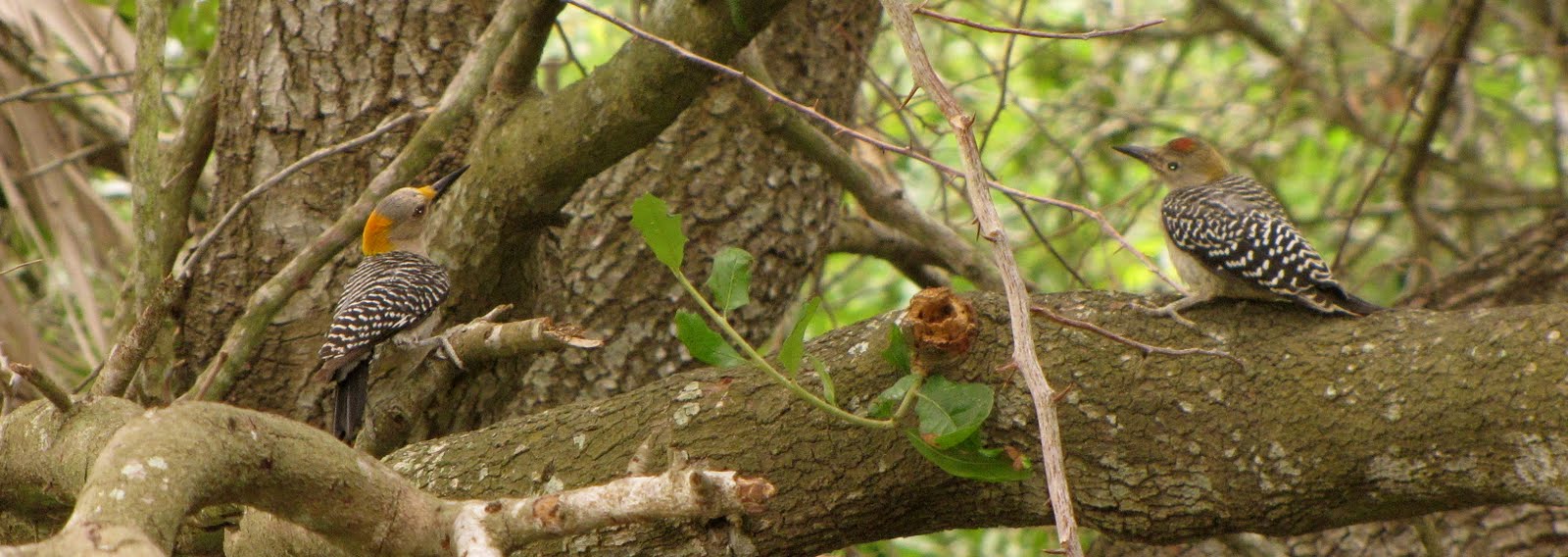
Another bird that is often scolded by other birds in the yard is the European Starling.  They are beautiful birds but their tendancy to chase off other cavity nesters when competing for nest sites doesn't endear them to me. When we moved here 15 years ago there were no starlings but now two pairs have already nested in the dead cottonwood trees in the vacant lot next  door.  But since we already have Golden-fronted Woodpeckers mating for a second time and Ladder-backed Woodpeckers checking dead branches of the Royal Poinciana for insects, I guess we still have cavities to spare.  The GF Woodpeckers are usually the excavators of the holes in dead trees and the starlings move in later. 


Golden-fronted Woodpeckers


The yard is not large, but it's big enough for me.   I could never get to know a larger patch as well as I want to know this one.  


I'm reminded of what William Faulkner once said:   "I discovered that my own little postage stamp of native soil was worth writing about and that I would never live long enough to exhaust it."  Postage stamp or patch, my yard is small but filled with drama.  It's a patchwork quilt of color, a crazy quilt of drama.  


Friday, May 6, 2011

Spring Fling


On spring nights, thousands and thousands of songbirds are aloft, streaming north as we sleep, miraculously migrating long distances from wintering forests, streams, and grasslands of Central and South America to their summer homes in North America. Most of these tiny travelers pass on by in the night without our ever seeing them.  I've heard that if you look at the full moon with binoculars you can sometimes see them.  And a few years ago an ornithologist put microphones on the roof of the local high school to record the flight calls of migrating dickcissels. But most people are unaware of the magnitude of life passing not that far above our heads as we lie in our beds.  

If you are lucky enough to live in South Texas, you might wake up one morning after strong south winds have changed to the north, and find your yard alive with tired but hungry migrants that didn't just fly on by.   Hundreds of warblers, buntings, tanagers, grosbeaks, and thrushes are sometimes grounded because of adverse weather.  We call these occasions, when north winds or rain stop the migrating birds, "fallouts." 

I don't exactly wish for fallouts, or "drop days," because their very existence mean  that thousands of birds have been so stressed they must stop their travels until conditions are more favorable.  But  I love the visitors that drop into my yard.  Early this week the wind changed, temperatures dropped to a reasonable coolness, and the migrants dropped in.  

Suddenly I could find Baltimore Orioles, Rose-breasted Grosbeaks, and Scarlet Tanagers bathing all together at the saucers.  Without a fallout, I would find migrants in April and May, but not in such lovely, colorful, amazing numbers, each beautiful spot of color bringing out the  beauty of the others.

Early Tuesday and Wednesday mornings my birding friends headed for the World Birding Center and "warbler lots" on South Padre Island, where the birder-to-bird ratio is about twenty to one.  I just walked out to the front yard and sat under a cedar elm tree.

At first I sat in my camouflaged chair-blind, but soon I realized that the birds were not at all shy and I could sit back by the shrubbery in a regular lawn chair and survey more of the yard and the birds that were flying, bathing, and feeding in it.

In the photo to the left, a resident Northern Cardinal looks slightly askance at the crowd of visitors invading his yard.  On the top saucer is a Summer Tanager, probably a first year male.  Splashing vigorously at mid-level are a female Baltimore Oriole and female Indigo Bunting.  At the bottom a green female Painted Bunting finds shallow water.

Don't you love photos of splashing bathers?  Here's a clearer view of the submerged two:

[For good measure, I'll add another image of a seriously intense solo bather,  another spring migrant.  Can you tell what it is?]

Right!  It's a male Indigo Bunting that stopped by the yard in April. The color is gorgeous. (I'm tempted to get out my Color Snap app.  See this post for some more coloring fun. ) I don't know if the bunting's lighter tint is because it's earlier in the season or if the lighting makes it look different.  Usually Indigo Buntings look darker blue to me.  I have read that the color of Indigo Buntings is a function of light refraction  on black feathers rather than the pigmentation of the feathers themselves. In other words, the feathers are not really blue but black.  (I just looked this up to make sure what  I was saying was right and found an article that explains it clearly here.)

All buntings are beautiful, even the less colorful females and young males.  But it's the Painted Bunting that makes many people, birders or not,  catch their breath. Whenever someone starts to say,  "The bird I'd really like to see is...", I can usually complete the sentence for them:  Painted Bunting.  Like Indigo Buntings, they are mostly spring migrants here, though they occasionally breed in south Texas.  (A female Painted Bunting and a brown Indigo Bunting also spent the winter with us this year. I've seen a Varied Bunting in the yard just once, in 2002 on the day of the Big Sit in October.)


Buntings are not the only Spring stunners that visited us in large numbers this week. When I think of a fallout, I think of warblers.  A five-warbler day I consider exciting, but on  Tuesday alone we had twelve warbler species bathing and flittering around the front yard.  (Since the wind was strong and cool from the north, most birds and I avoided the back yard. )

The stunning bird at the top of this post is a Bay-breasted Warbler.  I don't see them every spring, but this week we had several, bathing and drinking at the baths and eating  berries of the fiddlewood and brasil trees.   I like these inquisitive-looking little guys.


The most flittery of the warblers are American Redstarts.  Their color and movement remind me of butterflies.  The tail pattern makes these guys unmistakable whether its the black and red male or the more subtle yellow and brown female. 


I have more warbler photos to show but I think I'll go ahead and post these.  I'll add a postscript tomorrow morning--unless the spring migration show continues into the weekend.  In that case, I'll be sitting in the yard.

Thursday, March 18, 2010

Command Performance

This was another "no sooner said than done" day.  I've written about them before:   I get up in the morning, announce what birds I want to see in the yard--and before the day is over, there they are!   When I said this morning that today we'd have buntings and Hooded Orioles, my husband just rolled his eyes. But before the day was over, that's exactly what we had. 
 
First thing this morning, I walked up the drive to start the  drippers on the bird baths.  We've been out of town for the last week, so I knew I needed to complete that task early.   Moving water is our number one bird magnet.

In the backyard, the river's brackish water attracts egrets, herons, kingfishers, gulls, terns, pelicans, whistling ducks and myriad other water-loving birds.

In the front yard, water drips continually from a quarter-inch black hose into one of the baths, the deepest one where we've seen hawks, Chachalacas, and even a Wild Turkey bathing.   (Last week I  put an adjustable valve on the hose, which hangs above the bath from a shepherd's hook, so that I wouldn't have to crawl through thorny brush  every time I needed to  turn it off and on.)  In another bath across the drive,  water drips from a plastic bottle (actually from a big plastic container that once held kitty litter!).   This shallow bath is favored by smaller birds like the Lesser Goldfinches and Painted Buntings that are especially drawn to dripping water on hot summer afternoons. There are two other baths that we fill daily from a garden hose, but that's okay because it gives me a chance to walk the drive and see what  birds hide in the brush, not visible from the deck unless they dart out to the driveway.

On the walk up the drive this morning, I saw a Yellow-rumped (Myrtle) Warbler and a Blue-headed Vireo, both in a Live Oak tree.  Green Jays, Altamira Orioles, and Kiskadees  flew noisily through the yard, calling out as they checked out feeders and baths.  A Ladder-backed Woodpecker squeaked like a dog toy as it climbed up and down the oak trees. A Couch's  Kingbird  flew its up-and-then-down-again dance from the tiptop of an Ash tree and sang out loudly in the still morning, a song that distinguishes it from the otherwise identical Tropical Kingbird.

When my neighbor called "Come here! Hurry!"  I rushed over to her drive in time to watch a 4- to 5-foot Indigo Snake slither away into the grass and then under a fence to another yard.  It was a deep blue-black in the morning sun, a really beautiful snake.   Though classified as threatened, they seem to do well in our area which has lots of native plants and patches of thick brush.  We have had them living in our yard every year and see them often around dripping water faucets and the neighbor's sprinkler. ( I didn't have my camera outside with me, but I'm determined to get a good picture soon. When I do, I'll write a little more about these beautiful snakes.)

And that's not the only Indigo I saw today:  the asked-for Indigo Bunting made its first-of-season appearance in the late afternoon.  I saw it on the bird bath  that's made from a down-turned terra cotta planter and an up-turned saucer, but it was there only  for a moment.  Just after I spotted the deep blue bird through binoculars, and  juggled them awkwardly as I tried to quickly raise my camera, the bunting  flew away, spooked by another bird making a command performance at the same bath---the brightly-colored male Hooded Oriole!  (You can see from the understandably fuzzy picture above that the Hooded Oriole is similar to the Altamira. One  distinction is the lack of the gold/orange epaulet or shoulder patch at the top of the Hooded's wing. I'll get a clearer picture on another day and post a side-by-side comparison for those who are not familiar with both birds. )

Today was also a great day for hummingbirds.  We had at least three Rufous Hummingbirds --two bright males were  at the same feeder at once and at least one other female was there off and on all day.  More and more Ruby-throated hummers are coming each day.  We had the first adult male of the season show up last week.
My favorite hummingbird of the day was a resident Buff-bellied Hummingbird that perched in a fiddlewood shrub and sang.  I could see its throat moving as it sang a short but rather complex song of descending notes. I'd never been lucky enough to hear that song before. Its usual calls are buzzing clicks and ticks, some possibly made with its tail, but this was a definite and surprising little song.

We had put several orange-halves out to attract orioles and weren't disappointed.  The Baltimore Oriole hasn't shown for a couple of weeks now,  but the Altamira pair were here all day and finally, at about five this evening, the male aforementioned Hooded Oriole flew in--just what I'd asked for!  We have had as many as three pairs of these orioles nesting in various Palm trees at the same time (not the same tree, of course).  They weave lovely little purse-like nests on the undersides of the palm fronds. Once a pair nested in a neighbor's potted ficus tree on a second story porch.

Perhaps this fellow will stay and nest. I know the same Hooded Orioles return year after year because we used to have one that had a very distinctive broken beak allowing us to identify him as he returned to our yard in the spring.  The lower mandible, bent and pointed straight down, was ugly and looked disfunctional.  I worried the first year I saw him that he would not be able to survive, but he did for at least two more seasons, and I watched him eat, build nests, and feed young even with that handicap.  I was always thrilled to see him return in the spring. (There's no way for me to know what caused the disfigured bill.  One oriole had slammed into a window that spring, hitting very hard and being stunned for some time.  Maybe it was that oriole.  Or maybe it was just a birth defect.) 

Also eating an orange half in the yard was a Gray Catbird, one of my favorite birds, and an Orange-crowned Warbler.  The eponymous orange crown was actually visible on this particular bird though it is usually hidden.  I think the only other times I've been able to see the crown was when one was wet in a bird bath and once when I was helping a bander.  The photo here is fuzzy, but I think you'll be able to see the orange on the  crown.  (For other photos of Orange-crowned Warblers, read this post and this one.)

So all-in-all, it was a good day for watching birds in our yard on the Arroyo Colorado.  New yard birds for 2010 were the Hooded Warbler, Indigo Bunting, and Cedar Waxwings that zigzagged past in the late afternoon. I'll add them to the list I'm keeping in this  blog's sidebar.   A weak front is expected to cross the valley tomorrow and it may stop some migrants for a visit. The wind may gust to 50 mph the weatherman says.  I'll keep you posted!

I'm always thrilled when readers leave comments--hope you'll tell me what  you are seeing  in your yards.  Or what you want to see.  (Just make the announcement first thing in the morning.  It works for me!)