Welcome to my world!

Backyard Birding in the Rio Grande Valley of South Texas:
Surrounded by great birding destinations, our favorite patch is still the backyard (or the front), where we've seen more than 270 species of birds. Sit awhile, and watch the river and yard with us!


Showing posts with label Altamira Oriole nest. Show all posts

Friday, June 17, 2011

Beyond the Patch: a Boat Trip


I don't spend every day hanging around my yard.  Some days we leave our patch of birds on the banks of the Arroyo and take the boat out on the river to the Laguna Madre. At dawn we leave the dock and  ride for about 20 minutes until we get to the bay.


On the way out, we see Roseate Spoonbills, Tricolored Herons, Reddish Egrets and Brown Pelicans flying from rookeries on small islands to their feeding grounds in inlets and along the shores. We smell salty air and meet fishermen returning from overnight trips. Dolphins jump in front of our boat or ride in our wake.

Leaving the mouth of the Arroyo Colorado and crossing the Intercoastal Waterway, we enter shallow water, hoping to find red fish tailing in the "skinny" waters.  When we get close to herons stalking prey in water below their bellies, we know it's time to stop the boat and wade.  Or at least Brad wades and I stay in the boat unless I've brought my kayak along.


When the sun is still low over the horizon, its brilliant red reminds me of lines from Coleridge's Rime of the Ancient Mariner:  "nor dim, nor red, like God's own head, the glorious sun uprist."

On this day we saw no fish in the shallow waters, or at least we didn't catch any, but the beauty of the sunrise made the trip worth it.  After exploring other fishing holes briefly, we decided to return to the Arroyo and go upriver looking for tarpon and snook.

I love a sunrise in the Laguna Madre, but the Arroyo is home.  If my birding "patch" is my yard, the Arroyo is an extended patch.  We boated back toward the west, past Adolph Thomae park, past Arroyo City, past our house.


Roseate Spoonbills flew above us.


Willets fished along the edge of the Arroyo.


A Crested Caracara looked on from his perch in a dead mesquite.


Passing by our house and all the other houses that line the south side of the river, we reach an area where houses disappear and both sides are lined with habitat referred to as "Arroyo Colorado Brush"  where dominant trees are Ebony, Coma, and Adelia and brush is thick and thorny. It is really only remnants of such habitat, however, as the land has been cleared for agriculture just beyond the brush along the banks.


But I like boating along the river and imagining a land where nothing has been cleared.   The state of Texas protects a portion of it as the Las Palomas Wildlife Management Area where native brush  is relatively undisturbed.

The bank pictured above shows fairly thick vegetation, but you can tell it has once been cleared because of the mesquite trees that are typical of disturbed land.  Nonetheless, it is perfect habitat for one of my favorite birds. We slow down when we get to this spot and use the trolling motor to move by quietly.


Can you see the excavation in the bank?  Perhaps the cavity is an enlarged  kingfisher hole. Or perhaps it is a hole made from collapsing dirt around tree roots.


A closer look reveals a ghostly face.


Binoculars (or a zoomed-in camera lens) reveal that tucked into the hole, high up in the bank, is a  family of Barn Owls!  I can see two down-covered chicks in front of the female in this nest. Others are probably there as well.  Barn Owls can have large broods and the mother does a good job of herding her brood back into the cave behind her.  

I've seen Barn Owls nesting in boat houses, nest boxes,  and barns near the river, but I see them most frequently in these cavities in the banks.  Pale and ghostly, they are hard to spot unless you know where to look. 


Sometimes I see them fly at night along the river on strong silent wings.  The males are lighter in color than the females and their almost white underparts make them look especially like ghosts in the night.  
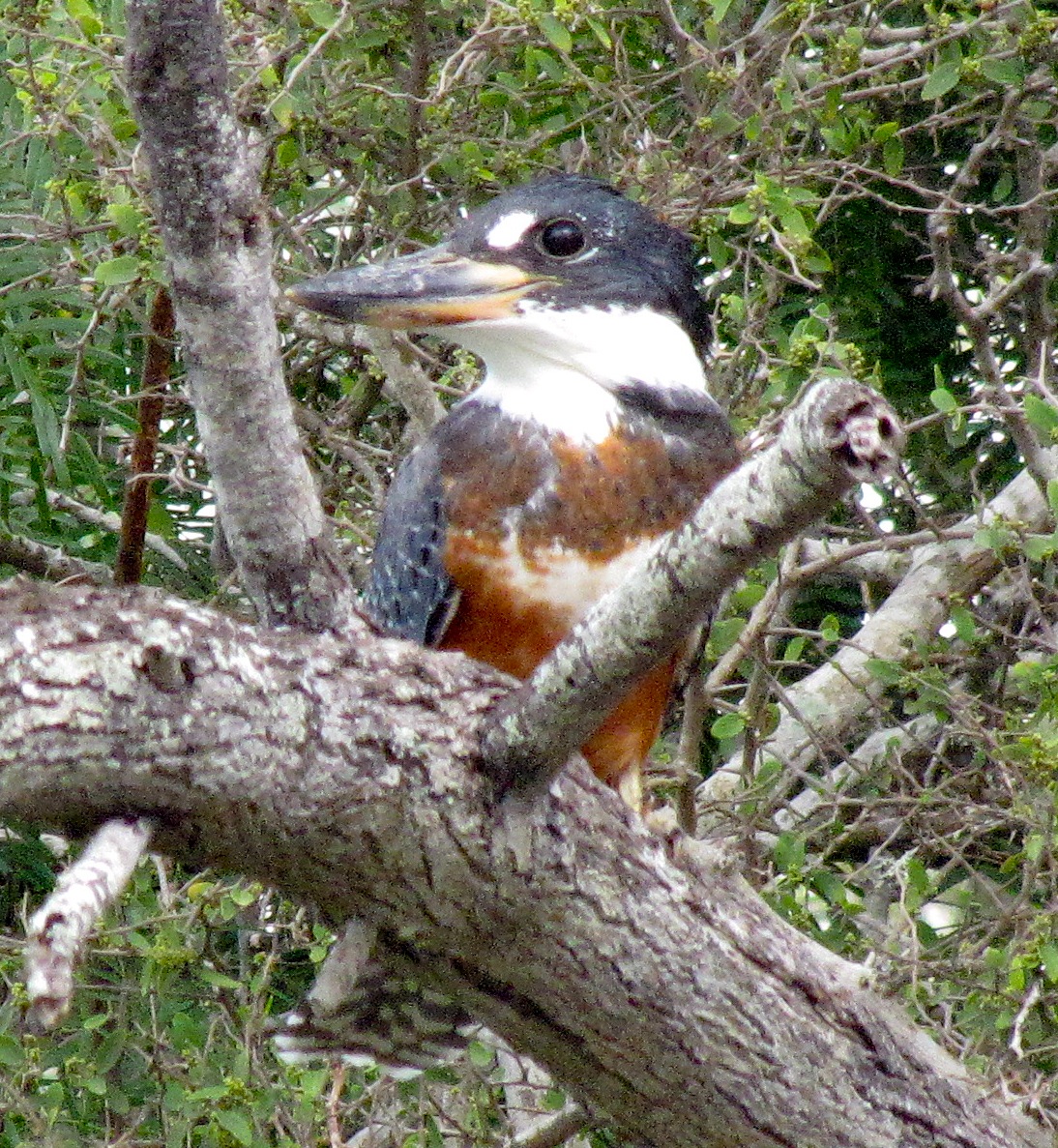

         Barn Owls are not the only bank dwellers we saw on the trip upriver.  Another favorite pair of river birds announced their presence with loud machine-gun rattling and insistent bobbing up and down from branches overhanging the water:  a pair of Ringed Kingfishers courted near their nest holes on the opposite bank.  


This photo shows the kingfisher with mouth open and tail cocked, loudly answering the equally loud rattling of  its mate perched about 50 feet upriver.   Ringed Kingfishers are one of three species of kingfishers here in the Rio Grande Valley.  Green Kingfishers, also here year-round, are much smaller and green.  The Belted Kingfishers that winter here (the only kingfisher in most of the US) look similar except that they are about three inches smaller and their beaks are not nearly as large.  


I wasn't able to figure out for sure which of several holes in the bank belonged to the kingfishers.  They seem to like to make extras.


Groove-billed Anis sang in a mesquite tree along the river. Below is a photo of an ani that was banded  a week ago  in the Las Palomas WMA that borders the Arroyo near where the owl and kingfishers nest. I have volunteered to help with the banding a few times.


At first glance, anis look like grackles, but the beak of course is distinctive, as is their posture and their two-note call.  We've been seeing anis on the fence across the arroyo.  In years past I've watched them ride on the backs of deer, eating ticks.  (I know:  yuck!  But such interesting things to be seen from the window overlooking the river is the reason my spotting scope never leaves its spot at the back window.)


Another highlight of the trip upriver was a good look at the longest Altamira Oriole nest I have ever seen. It seemed twice as long as the nest Altamira Orioles built this year in our oak tree.  Comparing the nest in this photo to the ten-inch oriole that is peering inside, I'm guessing the nest is a minimum of two feet long.

All in all, our boat trip was successful even without catching fish. We love living here on the Arroyo Colorado where a short boat ride extends our backyard beyond its narrow borders.

****************
This is an experiment:  I've never posted a video before but I did take one of the Ringed Kingfishers.  You can see only one bird in this wobbly movie, but you can hear both of them calling back and forth.  Apologies for the poor camera work--but it's so much fun to watch these birds bobbing up and down and to listen to their loud rattling calls that I am posting it anyway.  Or at least trying to.  Lets hope it works.


Thursday, May 27, 2010

Is Anybirdy Home?


I skulked around the yard yesterday, spying on nests and any tree or shrub that looked like it could contain a nest.  I found quite a few, some unoccupied.  What prompted me was the three fledgling kiskadees in the photo above,  noisily perched in an oak tree across the driveway from their nest.  The nest, a big round blob in an ebony tree, is one of the most interesting nests in the yard.  Its side entrance is unusual (not for a kiskadee nest, but for nests in general) and it is so conspicuously placed in an exposed fork of an ebony tree that I figure the birds won't mind if I walk around under it.

The nest is the one I wrote about in early April  (here and here).  I can't be sure when the babies hatched, but the adults have been busy feeding them in the nest for the last ten days at least (since we returned from Florida).  Now three hungry fledglings clamor  for handouts from trees within about a 30 yard radius of the nest.

The Brown-crested Flycatcher nest is also empty.  On Sunday the parents were still carrying in bugs and flies (see last  Sunday's blog),  but by Monday afternoon all was quiet, nobody home.  I watched from the deck yesterday but saw no sign of flycatchers, young or old.  I knew from previous years that the flycatchers did not stay particularly close to the nest just after fledging.  Only once have I seen a young one make its first flight, poking its head up out of the vertical railroad tie a couple of times and then flying to the oak tree.  But I thought I would see them this time since they were so close to the deck I spend so much time on. I looked for the flycatcher family yesterday but never saw any birds that looked like fledglings.

Today I did.  Unfortunately, what I saw was a flycatcher interacting with a fledgling Bronzed Cowbird.  Cowbird  parasitism affects not just flycatchers but cardinals and especially hooded orioles, at least by my observations.  I hope that the one cowbird chick I saw was not the only young bird the flycatchers raised in their house beside our house.  I'll be watching for signs of successful nesting.

The Northern Mockingbirds have been frantically singing all day and into the night.  We have more than just one pair, so I don't know if the loudest most persistent singer is the same one that has a nest in the neighbor's small Anacua tree.  I suspect the singer is an unmated male that is trying to find a mate.  It's been over a month since the mated pair build their nest of thorny twigs about 4 feet off the ground in the anacua.  At least one fairly good sized chick is in the nest.  I hope it's not a cowbird.  I looked very quickly when the adults were out of sight but not close enough to take a picture or examine the nestling.  I felt bad enough about the quick peek.

In the nest photo you can see the rough sandpapery leaves of the Anacua, a wonderful native tree.  Some call it "sandpaper tree."  You know it's a favorite of berry-loving birds such as Mockingbirds and Kiskadees because they accidentally "plant" so many seeds beneath their favorite perches. (Not an accident, of course in nature's design.)

And speaking further of Anacuas, their green/gold  berries are turning brighter gold and a few already orange.  The nest tree is too small for berries yet, which is probably fortunate for the birds since when  anacua berries ripen, the tree is a magnet for kingbirds, kiskadees, mockingbirds, thrashers, green jays and woodpeckers.  I noticed yesterday in my ramble around the yard that a few of the gold berries are ripening to orange.  If you look really close at the picture of the fledgling Kiskadees at the top of this post, you can see that one has a berry in its beak.  I first thought it was a red berry of the fiddlewood but then decided it was a bright orange anacua berry because the fiddlewood berries are black when ripe (thus the alternate name negrito).  I wouldn't think an adult Kiskadee would feed its young unripe fruit!   Regardless, the young bird didn't seem to know what to do with the berry ripe or not.  It clutched it in its beak for the longest time.

The Altamira Oriole nest in the Live Oak tree to the west of the driveway is also unoccupied.  I have not seen any orioles at the nest since we came home.  I wonder if that, too, is caused by the cowbirds.  The orioles are nearby but are not in our yard as much as they were in April.  There's not been enough time since the nest was built in mid April for birds to have completed nesting, and I think I would see them going in and out of the large pendulous nest if they were still there. Although I did not see any contentious acts on the part of the Kiskadees, whose nest was about 15 or 20 feet away, perhaps the orioles considered them noisy neighbors and went elsewhere.  I have seen Kiskadees land on the nest a few times.  Another possibility I hope is not true is the issue of cats--we have too many in the neighborhood that are hunters.  But Altamira Orioles do not perch low enough to fall victim easily.  I have seen only one oriole at a time since we returned from Florida and never on the nest.  I'm certainly hoping to see a family in the yard soon.

In addition to the three noisy, hungry Northern Kiskadees, I know that Starlings and Great-tailed Grackles and Golden-fronted Woodpeckers already have successfully nested. I'll keep reporting on what I find in my front-yard spying. Perhaps my reluctance to get too close to nesting areas means I miss some clues.   I'm just disappointed that  such a beautiful Altamira Oriole nest isn't being used. Something happened when we were away from home, but I don't really know what --and there's no reason to think the orioles aren't elsewhere in the neighborhood or across the river.


Thursday, April 15, 2010

Home Sweet Home

Look who's building a home at our home!  It's the Altamira Orioles. (Click here for another post about these champion nest-builders.) Over the years I've seen their amazing pendulous nests in the area, but this is the first nest that will actually be completed in a tree in our yard.   Sure that the Hooded Orioles had decided on homes in our trees, I was concentrating on that and  had really given up on  being lucky enough to host the Altamira Orioles.  

But yesterday morning,  walking  past the Ebony tree where the Kiskadees are nesting , I found the nest quite by accident.  Scanning the Ash and Live Oak trees along the side of our yard, I looked up and there it was, construction well under way! I'd been in the yard off and on all day Tuesday but somehow had missed the very obvious nest swinging from the northwest side of a 20-foot Live Oak tree that overhangs the neighbor's drive. (I've never seen an Altamira nest that wasn't on the northwest of a tree on a branch that hangs down and sways in our strong winds.) 

Here's a closer view of the nest.  See how the orioles begin construction at the top and work their way down?  I'm sure you've spotted the oriole inside the nest in the photo, bottom left.  Click to enlarge it.  I want you to get a good look at the strip of something blue on the bottom right. 
If you read an earlier post about Altamira Oriole nests (or clicked the link at the top of this post), you recall that they have helped themselves to the garden twine from a neighbor's greenhouse.  This time they  scavenged some kind of plastic and recycled it into their home. What resourceful birds!

I don't know exactly what it is,  but I've seen bits of that blue plastic in the yard for months.  I even photographed a piece of it on the ground in December!  (It was interesting and kept sort of moving from place to place around the front yard.  I should have picked up the scrap and thrown it away--but instead I took a picture!)  

You may be sensing both what kind of yardskeeper I am (messy) and  also something about my artistic sensibility (I have no idea what adjective would describe that or why I took a photo of torn bits of plastic in the yard).  As soon as I uploaded the photos from camera to computer and looked closely at the blue plastic streamer in the nest, I recognized it and located the other photo taken months ago. (I think the strip of blue plastic may be from a woven tarp that was torn off of a shed or something in Hurricane Dolly.  Or maybe it's part of an old lawn chair. Longer strips of it are still somewhere around because the orioles found them and began their nest by weaving them around the top, letting the ends fall down the sides of their amazing nest-in-progress. The little scrap I took a picture of is still somewhere in the yard.  Maybe I'll continue photographing it as I find it.) 

This morning the nest is quite a bit bulkier than it was a day ago.  I am restraining myself from watching it all the time.  The Bronzed Cowbirds are doing enough of that.  Yesterday, while one oriole was inside of the nest, a cowbird flew across the yard to the nest and circled it quickly without landing.  The other oriole,  just as quickly, chased the cowbird back across the yard.

I've noticed that male Hooded Orioles also stand guard while the female builds their nest, and continue to do so all during the nesting process, chasing cowbirds that get too close.    It's a constant battle for them to fend off the parasitizing pests.  I have not seen Altamiras feeding fledgling cowbirds, but I see Hooded Orioles doing so almost as often as I see them feeding young orioles.  (Perhaps that's why the Hooded Orioles raise as many as three broods each summer, to make up for the heavy parasitizing of their nests by the Bronzed Cowbirds.)

You can see by this photo how interesting the cowbirds look.  Their eyes are demon-red and their mating ritual is fascinating to watch.  The males puff up their neck feathers in a mane (some call them "lion birds") and hover two or three feet off the ground, going straight up and down like little helicopters in an attempt to attract a mate.  If it were not for their habit of laying their eggs in the nests of other birds, sometimes even displacing the eggs laid by the bird whose nest it is, they would be welcome in our yard.  These home-wreckers, however,  are not welcome!

Other pairs of birds are playing musical chairs with nesting sites.    Remember the little Black-crested Titmice that were inspecting various nesting sites in the side and back yards, the male trying to entice a female with food offerings by the nest? (If not, here's a link to the post about them.)  I thought they had  leased the hole in the cottonwood stump (the one on which the titmouse had perched with his caterpillar),  but  as I watched yesterday, a female Golden-fronted Woodpecker emerged from the hole.  It was the woodpecker, after all, that had made the cavity,  so it's only fair for it to use the home if it wants it. 

Look at the beak of the woodpecker in the photo.  It's easy to see how such a strong sharp instrument could quickly excavate a hole in a dead tree.  (Or in the siding on my house.)

Meanwhile, the  titmice have been inspecting yet another nest box, this one hanging from a tree in the front yard.  It has had nest material protruding from the hole.  I don't know what birds have nested there previously.  For days, a House Wren has sung incessantly  close by.  One year I saw the family of some kind of mouse (large with snow-white  breast and belly) in the house.


The 2010 Yard List continues to grow quickly with migrants making brief stops or flyovers.  (I'm a couple of days behind but I think when I add to the list it will be over 130 for the year.) Indigo Buntings and Hooded Warblers (pictured below)  flitted around the yard yesterday and today.  Three kinds of Vireos ( White-eyed, Yellow-throated, and best of all Warbling Vireos) have been in the front yard this week as well as three kinds of wrens (Carolina, House, Bewick's). A Bullock's Oriole came to the nectar feeder midmorning.


We are still waiting on some of our summer-only nesting birds.  Beside the driveway there's a nest box that Brown-crested Flycatchers  have used every year for a decade.  Before that they nested in  old railroad ties that stand on end near the road.  Cavities had rotted out at the ends (the tops) which made nice little nesting places.  When bouganvillea and esperanza (yellow bells) overgrew the raillroad ties, the flycatchers moved to the nest box.  We don't usually see them back home until May.  That's also the month that the Yellow-billed Cuckoos return.  I don't know where they nest,  but it's somewhere close.  They fly through the yard daily, black and white tails streaming, and call from the trees.  My mother always called cuckoos "rain crows," an old-fashioned name for them. Their guttural  kluck-kluck-kluck-kluck-kluck in the stillness that sometimes precedes summer rains reminds me of my childhood home in Oklahoma.

We moved into our house exactly 14 years ago this week.  The yard looks a lot different  than it did then.  Then you could see the house from the road; now it is obscured by trees and shrubs.  Then it had a lawn of "carpet grass"; now there are only small patches that we mow with a push mower.  Then it was landscaped with tropical plants by the previous owners; now it is landscaped by the birds who drop seeds that spread fiddlewood (negrito), chili pequin,  pigeonberry, turk's cap and other native plants.  I love our yard because I love the birds that make their home here.  They share their space with us