
I don't spend every day hanging around my yard. Some days we leave our patch of birds on the banks of the Arroyo and take the boat out on the river to the Laguna Madre. At dawn we leave the dock and ride for about 20 minutes until we get to the bay.
On the way out, we see Roseate Spoonbills, Tricolored Herons, Reddish Egrets and Brown Pelicans flying from rookeries on small islands to their feeding grounds in inlets and along the shores. We smell salty air and meet fishermen returning from overnight trips. Dolphins jump in front of our boat or ride in our wake.
 Leaving the mouth of the Arroyo Colorado and crossing the Intercoastal Waterway, we enter shallow water, hoping to find red fish tailing in the "skinny" waters. When we get close to herons stalking prey in water below their bellies, we know it's time to stop the boat and wade. Or at least Brad wades and I stay in the boat unless I've brought my kayak along.

When the sun is still low over the horizon, its brilliant red reminds me of lines from Coleridge's Rime of the Ancient Mariner: "nor dim, nor red, like God's own head, the glorious sun uprist."
On this day we saw no fish in the shallow waters, or at least we didn't catch any, but the beauty of the sunrise made the trip worth it. After exploring other fishing holes briefly, we decided to return to the Arroyo and go upriver looking for tarpon and snook.
I love a sunrise in the Laguna Madre, but the Arroyo is home. If my birding "patch" is my yard, the Arroyo is an extended patch. We boated back toward the west, past Adolph Thomae park, past Arroyo City, past our house.

Roseate Spoonbills flew above us.


Willets fished along the edge of the Arroyo.

A Crested Caracara looked on from his perch in a dead mesquite.

Passing by our house and all the other houses that line the south side of the river, we reach an area where houses disappear and both sides are lined with habitat referred to as "Arroyo Colorado Brush" where dominant trees are Ebony, Coma, and Adelia and brush is thick and thorny. It is really only remnants of such habitat, however, as the land has been cleared for agriculture just beyond the brush along the banks.

But I like boating along the river and imagining a land where nothing has been cleared. The state of Texas protects a portion of it as the Las Palomas Wildlife Management Area where native brush is relatively undisturbed.
The bank pictured above shows fairly thick vegetation, but you can tell it has once been cleared because of the mesquite trees that are typical of disturbed land. Nonetheless, it is perfect habitat for one of my favorite birds. We slow down when we get to this spot and use the trolling motor to move by quietly.

Can you see the excavation in the bank? Perhaps the cavity is an enlarged kingfisher hole. Or perhaps it is a hole made from collapsing dirt around tree roots.

A closer look reveals a ghostly face.

Binoculars (or a zoomed-in camera lens) reveal that tucked into the hole, high up in the bank, is a family of Barn Owls! I can see two down-covered chicks in front of the female in this nest. Others are probably there as well. Barn Owls can have large broods and the mother does a good job of herding her brood back into the cave behind her.
I've seen Barn Owls nesting in boat houses, nest boxes, and barns near the river, but I see them most frequently in these cavities in the banks. Pale and ghostly, they are hard to spot unless you know where to look.
Sometimes I see them fly at night along the river on strong silent wings. The males are lighter in color than the females and their almost white underparts make them look especially like ghosts in the night.
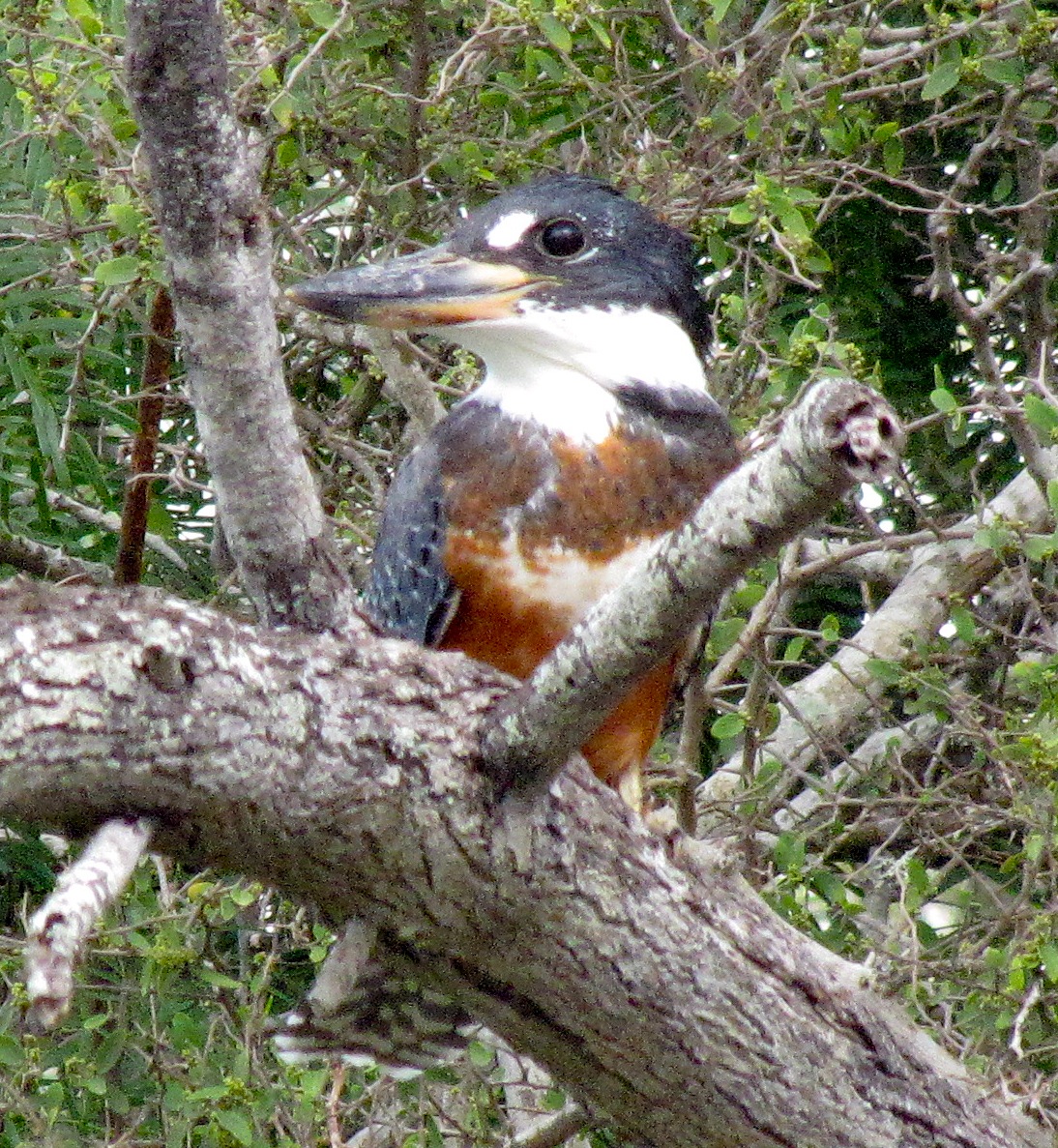 Barn Owls are not the only bank dwellers we saw on the trip upriver. Another favorite pair of river birds announced their presence with loud machine-gun rattling and insistent bobbing up and down from branches overhanging the water: a pair of Ringed Kingfishers courted near their nest holes on the opposite bank.
This photo shows the kingfisher with mouth open and tail cocked, loudly answering the equally loud rattling of its mate perched about 50 feet upriver. Ringed Kingfishers are one of three species of kingfishers here in the Rio Grande Valley. Green Kingfishers, also here year-round, are much smaller and green. The Belted Kingfishers that winter here (the only kingfisher in most of the US) look similar except that they are about three inches smaller and their beaks are not nearly as large.
 I wasn't able to figure out for sure which of several holes in the bank belonged to the kingfishers. They seem to like to make extras.
Groove-billed Anis sang in a mesquite tree along the river. Below is a photo of an ani that was banded a week ago in the Las Palomas WMA that borders the Arroyo near where the owl and kingfishers nest. I have volunteered to help with the banding a few times.

At first glance, anis look like grackles, but the beak of course is distinctive, as is their posture and their two-note call. We've been seeing anis on the fence across the arroyo. In years past I've watched them ride on the backs of deer, eating ticks. (I know: yuck! But such interesting things to be seen from the window overlooking the river is the reason my spotting scope never leaves its spot at the back window.)

Another highlight of the trip upriver was a good look at the longest Altamira Oriole nest I have ever seen. It seemed twice as long as the nest Altamira Orioles built this year in our oak tree. Comparing the nest in this photo to the ten-inch oriole that is peering inside, I'm guessing the nest is a minimum of two feet long.
All in all, our boat trip was successful even without catching fish. We love living here on the Arroyo Colorado where a short boat ride extends our backyard beyond its narrow borders.
****************
This is an experiment: I've never posted a video before but I did take one of the Ringed Kingfishers. You can see only one bird in this wobbly movie, but you can hear both of them calling back and forth. Apologies for the poor camera work--but it's so much fun to watch these birds bobbing up and down and to listen to their loud rattling calls that I am posting it anyway. Or at least trying to. Lets hope it works.


