Welcome to my world!

Backyard Birding in the Rio Grande Valley of South Texas:
Surrounded by great birding destinations, our favorite patch is still the backyard (or the front), where we've seen more than 270 species of birds. Sit awhile, and watch the river and yard with us!


Sunday, August 7, 2011

Home and Family

I feel as if I, like this Green Jay, have been more or less hiding out for the last month or two.  She is nesting less than twenty feet from my front deck but so stealthily I didn't even notice the nest until a few days ago--and by then  at least two hungry nestlings were stretching their necks out of a nest of intertwined thorny twigs. 
The nest is much more flimsy than I would have expected.  When looking at it against the late afternoon sun, you can see all the way through it, but it supports at least two chicks and the mother is in it part of the time.  I'm not worried that it will fall apart, though, because it is constructed of twigs from native thornscrub that can't be easily dislodged.   I've read that Green Jays make rather bulky nests, but this one certainly isn't.  I wonder if the thin construction has anything to do with the heat.

The morning before I discovered the nest, these two jays were bobbing up and down on a nearby branch, behaving as young Green Jays often do (though adults do, too--it's just sort of their dance of joy).  Two other Green Jays  were also flying around in the yard, probably juveniles from an earlier brood. I'm pretty sure the new nest is the summer's second.  It was May when I observed nest-building activity with birds carrying twigs toward the neighbor's yard.

Green Jays never seem to do anything quietly, which is why I was surprised to see them nesting undetected so close to the house.  I am reminded of the last stanza of an Emily Dickinson poem about robins that sing so insistently in March and April and then seem to disappear on the nest:

The Robin is the One
That interrupt the Morn
With hurried -- few -- express Reports
When March is scarcely on --

The Robin is the One
That overflow the Noon
With her cherubic quantity --
An April but begun --

The Robin is the One
That speechless from her Nest
Submit that Home -- and Certainty
And Sanctity, are best


I took a break from blogging for the last month or so while we were busy with family.  We've had a great time with children and grandchildren. The whole family was together at our son's in Missouri in late June and early July, which seems to me kind of like the extended Green Jay family hanging out together. After that about half the family came here for some fishing and trips to the beach.  Finally, we headed north again to do a little babysitting with the Texas portion of the clan. Though we weren't watching the arroyo during the time we were away from home, watching our flock was not so different from our usual pursuits.
To stay cool in the summer heat, for example, these two families of grandchildren were  as attracted to our son's pool
as this summer's Black-crested Titmice are to the front yard bird bath at home.
A  grassy lawn welcomed children playing badminton

and juvenile American Robins,
 and a young Cottontail Rabbit.


 Watching the antics of the youngest chick was fun for us all.  Jacey Joy, with her red hair and bright bathing suit,  is at least as colorful as a young Green Jay--and a plastic starfish on her head makes a pretty good  crest.

 When she tired of badminton,
she could always look through  grammy's binoculars.

American Robin

Gray Catbird
(She's not quite able to find a bird through binocs but she's close.)

I especially liked watching Gray Catbirds and American Robins in Missouri when I wasn't watching kids on the lawn or in the pool -- a special treat since those are winter birds for us in South Texas.  

Right behind the house we stay in (a hundred-year-old former dairy barn that's been renovated for a guest house) is a lovely patch of native dogwoods and redbuds,  a perfect nursery  for the just-fledged birds.


It takes a lot to lure us away from home and birds in south Texas, but you can see from these pictures that our grandchildren are an effective lure.  We are lucky to have five of them only about six hours away in south central Texas.  (They have interesting birds, too.  We babysat there for a few days and watched Mississippi Kites soar over the house.  I tried to photograph them but never got more than a gray blur.)

Returning home, having to leave children and grandchildren behind in their own nests, is hard on a grandparent.  But returning to find a thorny bowl of new Green Jays in our own yard is a treat. I'll watch those little chicks grow each day and think of a great summer visit with my own chicks.

Friday, June 17, 2011

Beyond the Patch: a Boat Trip


I don't spend every day hanging around my yard.  Some days we leave our patch of birds on the banks of the Arroyo and take the boat out on the river to the Laguna Madre. At dawn we leave the dock and  ride for about 20 minutes until we get to the bay.


On the way out, we see Roseate Spoonbills, Tricolored Herons, Reddish Egrets and Brown Pelicans flying from rookeries on small islands to their feeding grounds in inlets and along the shores. We smell salty air and meet fishermen returning from overnight trips. Dolphins jump in front of our boat or ride in our wake.

Leaving the mouth of the Arroyo Colorado and crossing the Intercoastal Waterway, we enter shallow water, hoping to find red fish tailing in the "skinny" waters.  When we get close to herons stalking prey in water below their bellies, we know it's time to stop the boat and wade.  Or at least Brad wades and I stay in the boat unless I've brought my kayak along.


When the sun is still low over the horizon, its brilliant red reminds me of lines from Coleridge's Rime of the Ancient Mariner:  "nor dim, nor red, like God's own head, the glorious sun uprist."

On this day we saw no fish in the shallow waters, or at least we didn't catch any, but the beauty of the sunrise made the trip worth it.  After exploring other fishing holes briefly, we decided to return to the Arroyo and go upriver looking for tarpon and snook.

I love a sunrise in the Laguna Madre, but the Arroyo is home.  If my birding "patch" is my yard, the Arroyo is an extended patch.  We boated back toward the west, past Adolph Thomae park, past Arroyo City, past our house.


Roseate Spoonbills flew above us.


Willets fished along the edge of the Arroyo.


A Crested Caracara looked on from his perch in a dead mesquite.


Passing by our house and all the other houses that line the south side of the river, we reach an area where houses disappear and both sides are lined with habitat referred to as "Arroyo Colorado Brush"  where dominant trees are Ebony, Coma, and Adelia and brush is thick and thorny. It is really only remnants of such habitat, however, as the land has been cleared for agriculture just beyond the brush along the banks.


But I like boating along the river and imagining a land where nothing has been cleared.   The state of Texas protects a portion of it as the Las Palomas Wildlife Management Area where native brush  is relatively undisturbed.

The bank pictured above shows fairly thick vegetation, but you can tell it has once been cleared because of the mesquite trees that are typical of disturbed land.  Nonetheless, it is perfect habitat for one of my favorite birds. We slow down when we get to this spot and use the trolling motor to move by quietly.


Can you see the excavation in the bank?  Perhaps the cavity is an enlarged  kingfisher hole. Or perhaps it is a hole made from collapsing dirt around tree roots.


A closer look reveals a ghostly face.


Binoculars (or a zoomed-in camera lens) reveal that tucked into the hole, high up in the bank, is a  family of Barn Owls!  I can see two down-covered chicks in front of the female in this nest. Others are probably there as well.  Barn Owls can have large broods and the mother does a good job of herding her brood back into the cave behind her.  

I've seen Barn Owls nesting in boat houses, nest boxes,  and barns near the river, but I see them most frequently in these cavities in the banks.  Pale and ghostly, they are hard to spot unless you know where to look. 


Sometimes I see them fly at night along the river on strong silent wings.  The males are lighter in color than the females and their almost white underparts make them look especially like ghosts in the night.  


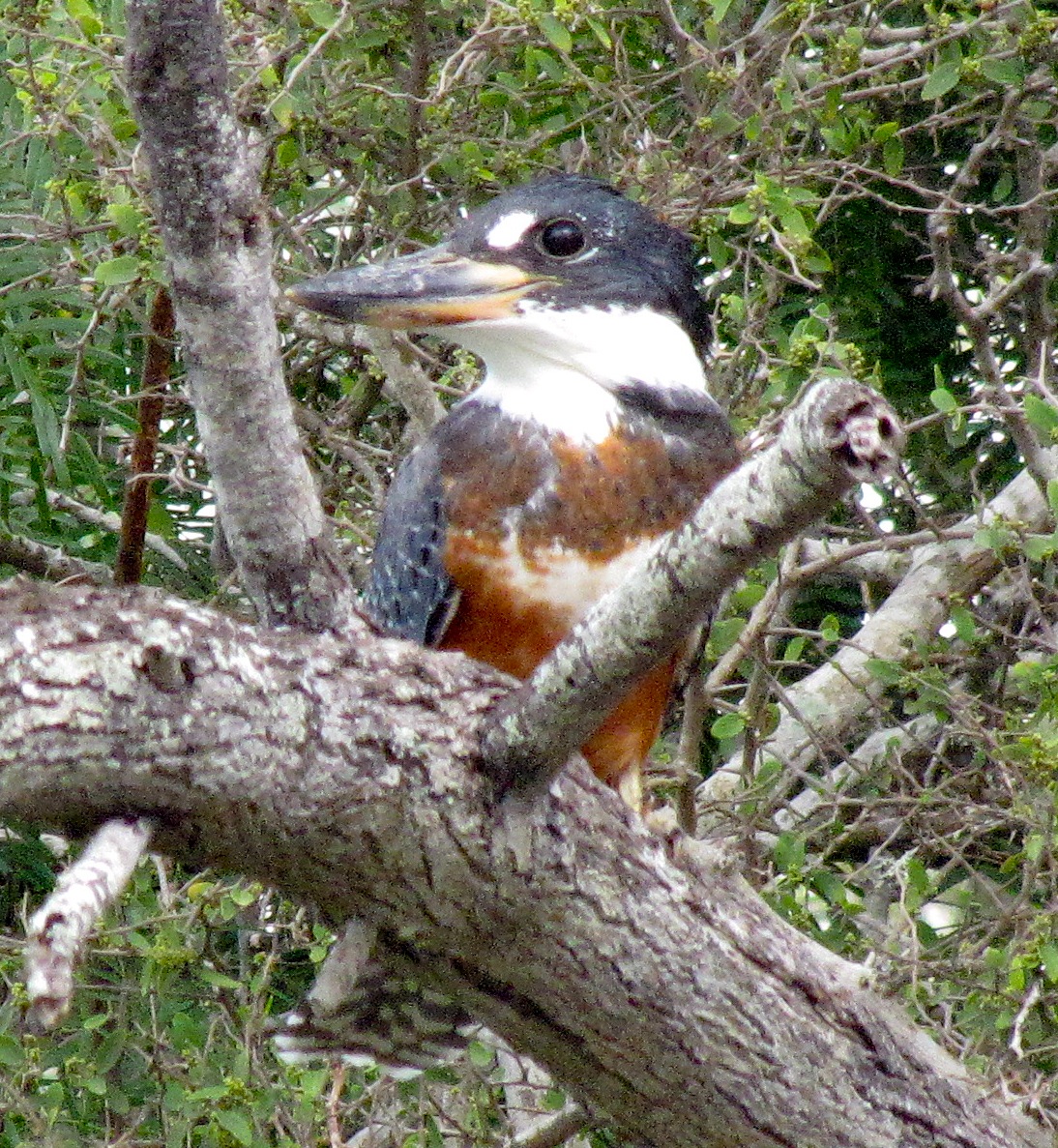
         Barn Owls are not the only bank dwellers we saw on the trip upriver.  Another favorite pair of river birds announced their presence with loud machine-gun rattling and insistent bobbing up and down from branches overhanging the water:  a pair of Ringed Kingfishers courted near their nest holes on the opposite bank.  


This photo shows the kingfisher with mouth open and tail cocked, loudly answering the equally loud rattling of  its mate perched about 50 feet upriver.   Ringed Kingfishers are one of three species of kingfishers here in the Rio Grande Valley.  Green Kingfishers, also here year-round, are much smaller and green.  The Belted Kingfishers that winter here (the only kingfisher in most of the US) look similar except that they are about three inches smaller and their beaks are not nearly as large.  


I wasn't able to figure out for sure which of several holes in the bank belonged to the kingfishers.  They seem to like to make extras.


Groove-billed Anis sang in a mesquite tree along the river. Below is a photo of an ani that was banded  a week ago  in the Las Palomas WMA that borders the Arroyo near where the owl and kingfishers nest. I have volunteered to help with the banding a few times.


At first glance, anis look like grackles, but the beak of course is distinctive, as is their posture and their two-note call.  We've been seeing anis on the fence across the arroyo.  In years past I've watched them ride on the backs of deer, eating ticks.  (I know:  yuck!  But such interesting things to be seen from the window overlooking the river is the reason my spotting scope never leaves its spot at the back window.)


Another highlight of the trip upriver was a good look at the longest Altamira Oriole nest I have ever seen. It seemed twice as long as the nest Altamira Orioles built this year in our oak tree.  Comparing the nest in this photo to the ten-inch oriole that is peering inside, I'm guessing the nest is a minimum of two feet long.

All in all, our boat trip was successful even without catching fish. We love living here on the Arroyo Colorado where a short boat ride extends our backyard beyond its narrow borders.

****************
This is an experiment:  I've never posted a video before but I did take one of the Ringed Kingfishers.  You can see only one bird in this wobbly movie, but you can hear both of them calling back and forth.  Apologies for the poor camera work--but it's so much fun to watch these birds bobbing up and down and to listen to their loud rattling calls that I am posting it anyway.  Or at least trying to.  Lets hope it works.


Wednesday, June 1, 2011

Patchwork


Sometimes it's hard to know when spring migration is over, when the birds in the yard are staying for the summer and the visitors have flown north.  Take, for example, the Yellow-billed Cuckoo in the photo above.  Is it a late migrant lingering for a few days into June or a summer resident setting up housekeeping?  I'm pretty sure it's here to stay, but only time (a few more days) will tell. 


And the buntings that took shower baths in the sprinklers yesterday -- are they already nesting close-by?  Or are they the tail-end of the bunting parade that comes through the yard every spring?  


Painted Buntings are the patchwork quilt of the bird world.  Red, green, blue for the male and a lovely green female--I am as excited each time I spot one as I was the first time.  


When I first spotted yesterday's Indigo Bunting sitting in shadows in the persimmon tree, I thought it was a female Painted, and I thought just maybe they were a nesting pair.    But when I look at the photo I took, the coloring looks more like a female Indigo Bunting.  If so, I would guess these to be migrants though it's late in the season.  


Again, only time will tell.  Sometimes I see both of these species late in the summer.  According to my favorite local reference book, Tim Brush's Nesting Birds of the Tropical Frontier,  Painted Buntings are uncommon breeders in the Rio Grande Valley. 
I've observed young Painted Buntings coming to bird baths in late afternoons during July and August-- though I've never found a nest. Hopefully, these are here to stay for the summer,  but probably they just late migrants. Anytime I see a bunting in the yard I count it a special day.


I didn't turn on the sprinkler yesterday specifically to draw the birds in--but it certainly worked to do just that.  

I seldom see Brown-crested Flycatchers in the bird baths but they certainly enjoy a shower bath.  This one prefers to sit in the persimmon tree letting the sprinkles refresh him.  


Across the yard, a male Lesser Goldfinch catches a shower bath from his perch in the bottlebrush tree.


Drops of water from the sprinklers shine in the sun and wash the dust of drought from the butterfly garden.   Lesser Goldfinches can often be seen at the baths and sprinklers on hot days when the temps climb near 100.

A Carolina Wren sings from the top of a feeder just out of reach of the water.  Now that their young have fledged, they are singing more than ever, and will probably be nesting again soon.


This week, in two different contexts, I encountered a phrase I hadn't heard before: patch birding.   Though I hadn't  heard of patch birding,  I certainly understand the concept:  knowing one patch of land well, which birds are there and when to expect them, knowing their songs and their nests.  That's what I do-- I'm a patch birder.   Who knew there was a term out there that describes me to a "T "?  

My patch, of course,  is my yard.  I know it well and  am obsessed with knowing it better.  It's not large, probably less than a third of an acre, only fifty feet across and several  times as long, bordering the Arroyo Colorado on the back (and beyond that thorny scrub and then farmland) and a cotton/sorghum field across the "farm-to-market" road in the front.  I bird my patch every day, walking the drive, sitting in the yard or on a deck or on the dock, peering in the trees and shrubs to see what nests have been constructed when I wasn't looking.  (Those birds can be very sneaky about building a nest, even when a patch birder has been patrolling the patch.)


So what else (besides shower baths from the sprinkler in our rainless yard) is going on in my patch this week?


Northern Kiskadees are still in their nest in the Ebony tree, busily going back and forth feeding  young that are getting bigger and bigger.  A week or two ago I found two dead hatchlings under the nest.  They looked like cowbirds to me, not kiskadees. 
If so, I'm proud of the parent kiskadees for ejecting the parasites that can end up starving the rightful nesters. I see kiskadees chasing cowbirds all the time, but I've never seen an adult kiskadee feeding a just-fledged cowbird, so maybe the bothersome Bronzed and Brown-headed Cowbirds are seldom if ever successful at parasitism of kiskadee nests.  (I wish I could say the same for their parisitism of  Hooded Orioles and Cardinals.)


Look closely at the photo on the right and you will see the tasty morsel--a large caterpillar or fuzzy moth--that the parent Northern Kiskadee has for the hungry babies.  


The baby Kiskadees are already quite large.  I'm looking for first flight this weekend.


Bronzed Cowbirds can look downright demonic sometimes.  


Northern Mockingbirds are not any more friendly to cowbirds than kiskadees.  They are fussy with almost all birds, but cowbirds, owls, and hawks in the yard really incur their wrath.  Above an irate mocker divebombs a Crested Caracara that sits across the road in a cotton field.  


Ladder-backed Woodpecker
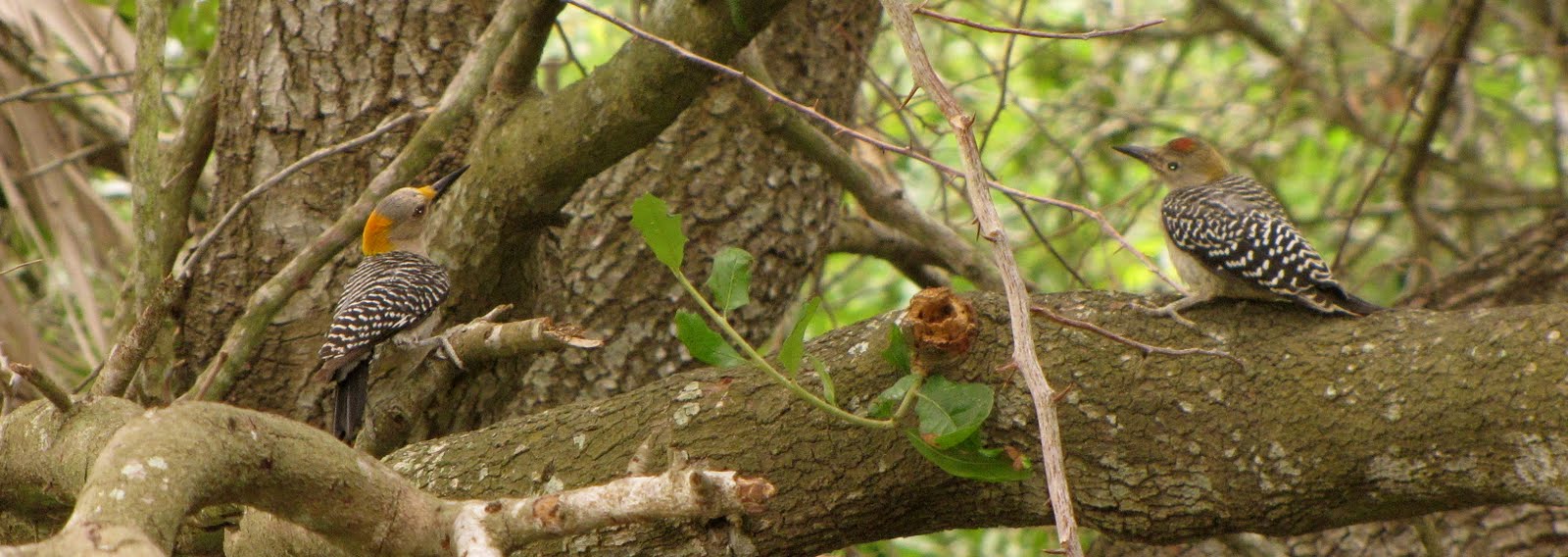
Another bird that is often scolded by other birds in the yard is the European Starling.  They are beautiful birds but their tendancy to chase off other cavity nesters when competing for nest sites doesn't endear them to me. When we moved here 15 years ago there were no starlings but now two pairs have already nested in the dead cottonwood trees in the vacant lot next  door.  But since we already have Golden-fronted Woodpeckers mating for a second time and Ladder-backed Woodpeckers checking dead branches of the Royal Poinciana for insects, I guess we still have cavities to spare.  The GF Woodpeckers are usually the excavators of the holes in dead trees and the starlings move in later. 


Golden-fronted Woodpeckers


The yard is not large, but it's big enough for me.   I could never get to know a larger patch as well as I want to know this one.  


I'm reminded of what William Faulkner once said:   "I discovered that my own little postage stamp of native soil was worth writing about and that I would never live long enough to exhaust it."  Postage stamp or patch, my yard is small but filled with drama.  It's a patchwork quilt of color, a crazy quilt of drama.