
Sometimes it's hard to know when spring migration is over, when the birds in the yard are staying for the summer and the visitors have flown north. Take, for example, the Yellow-billed Cuckoo in the photo above. Is it a late migrant lingering for a few days into June or a summer resident setting up housekeeping? I'm pretty sure it's here to stay, but only time (a few more days) will tell.

Painted Buntings are the patchwork quilt of the bird world. Red, green, blue for the male and a lovely green female--I am as excited each time I spot one as I was the first time.

Again, only time will tell. Sometimes I see both of these species late in the summer. According to my favorite local reference book, Tim Brush's Nesting Birds of the Tropical Frontier, Painted Buntings are uncommon breeders in the Rio Grande Valley.
I've observed young Painted Buntings coming to bird baths in late afternoons during July and August-- though I've never found a nest. Hopefully, these are here to stay for the summer, but probably they just late migrants. Anytime I see a bunting in the yard I count it a special day.
I didn't turn on the sprinkler yesterday specifically to draw the birds in--but it certainly worked to do just that.

I seldom see Brown-crested Flycatchers in the bird baths but they certainly enjoy a shower bath. This one prefers to sit in the persimmon tree letting the sprinkles refresh him.

Across the yard, a male Lesser Goldfinch catches a shower bath from his perch in the bottlebrush tree.

Drops of water from the sprinklers shine in the sun and wash the dust of drought from the butterfly garden. Lesser Goldfinches can often be seen at the baths and sprinklers on hot days when the temps climb near 100.

This week, in two different contexts, I encountered a phrase I hadn't heard before: patch birding. Though I hadn't heard of patch birding, I certainly understand the concept: knowing one patch of land well, which birds are there and when to expect them, knowing their songs and their nests. That's what I do-- I'm a patch birder. Who knew there was a term out there that describes me to a "T "?
My patch, of course, is my yard. I know it well and am obsessed with knowing it better. It's not large, probably less than a third of an acre, only fifty feet across and several times as long, bordering the Arroyo Colorado on the back (and beyond that thorny scrub and then farmland) and a cotton/sorghum field across the "farm-to-market" road in the front. I bird my patch every day, walking the drive, sitting in the yard or on a deck or on the dock, peering in the trees and shrubs to see what nests have been constructed when I wasn't looking. (Those birds can be very sneaky about building a nest, even when a patch birder has been patrolling the patch.)
So what else (besides shower baths from the sprinkler in our rainless yard) is going on in my patch this week?

 Northern Kiskadees are still in their nest in the Ebony tree, busily going back and forth feeding young that are getting bigger and bigger. A week or two ago I found two dead hatchlings under the nest. They looked like cowbirds to me, not kiskadees.
If so, I'm proud of the parent kiskadees for ejecting the parasites that can end up starving the rightful nesters. I see kiskadees chasing cowbirds all the time, but I've never seen an adult kiskadee feeding a just-fledged cowbird, so maybe the bothersome Bronzed and Brown-headed Cowbirds are seldom if ever successful at parasitism of kiskadee nests. (I wish I could say the same for their parisitism of Hooded Orioles and Cardinals.)


Look closely at the photo on the right and you will see the tasty morsel--a large caterpillar or fuzzy moth--that the parent Northern Kiskadee has for the hungry babies.
The baby Kiskadees are already quite large. I'm looking for first flight this weekend.


Northern Mockingbirds are not any more friendly to cowbirds than kiskadees. They are fussy with almost all birds, but cowbirds, owls, and hawks in the yard really incur their wrath. Above an irate mocker divebombs a Crested Caracara that sits across the road in a cotton field.

Another bird that is often scolded by other birds in the yard is the European Starling. They are beautiful birds but their tendancy to chase off other cavity nesters when competing for nest sites doesn't endear them to me. When we moved here 15 years ago there were no starlings but now two pairs have already nested in the dead cottonwood trees in the vacant lot next door. But since we already have Golden-fronted Woodpeckers mating for a second time and Ladder-backed Woodpeckers checking dead branches of the Royal Poinciana for insects, I guess we still have cavities to spare. The GF Woodpeckers are usually the excavators of the holes in dead trees and the starlings move in later.


If so, I'm proud of the parent kiskadees for ejecting the parasites that can end up starving the rightful nesters. I see kiskadees chasing cowbirds all the time, but I've never seen an adult kiskadee feeding a just-fledged cowbird, so maybe the bothersome Bronzed and Brown-headed Cowbirds are seldom if ever successful at parasitism of kiskadee nests. (I wish I could say the same for their parisitism of Hooded Orioles and Cardinals.)


Look closely at the photo on the right and you will see the tasty morsel--a large caterpillar or fuzzy moth--that the parent Northern Kiskadee has for the hungry babies.
The baby Kiskadees are already quite large. I'm looking for first flight this weekend.

Bronzed Cowbirds can look downright demonic sometimes.

Northern Mockingbirds are not any more friendly to cowbirds than kiskadees. They are fussy with almost all birds, but cowbirds, owls, and hawks in the yard really incur their wrath. Above an irate mocker divebombs a Crested Caracara that sits across the road in a cotton field.

 |
| Ladder-backed Woodpecker |
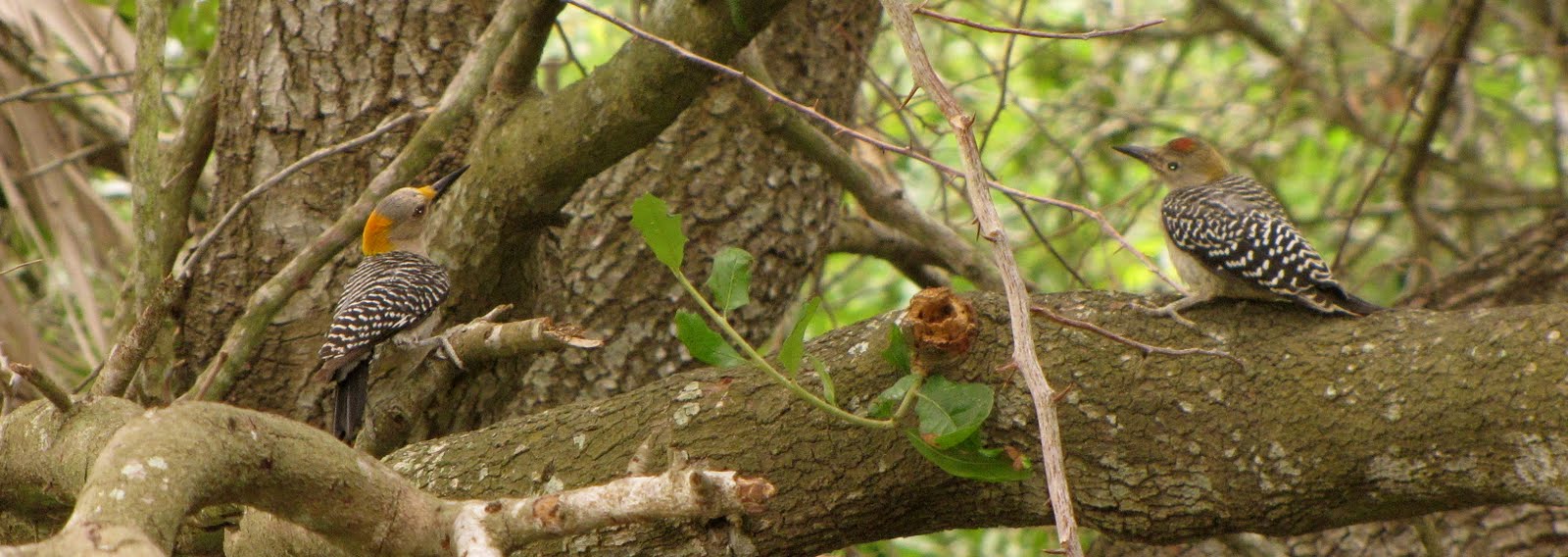 |
| Golden-fronted Woodpeckers |
The yard is not large, but it's big enough for me. I could never get to know a larger patch as well as I want to know this one.
I'm reminded of what William Faulkner once said: "I discovered that my own little postage stamp of native soil was worth writing about and that I would never live long enough to exhaust it." Postage stamp or patch, my yard is small but filled with drama. It's a patchwork quilt of color, a crazy quilt of drama.


