Welcome to my world!

Backyard Birding in the Rio Grande Valley of South Texas:
Surrounded by great birding destinations, our favorite patch is still the backyard (or the front), where we've seen more than 270 species of birds. Sit awhile, and watch the river and yard with us!


Showing posts with label Brown-crested Flycatcher. Show all posts

Wednesday, June 1, 2011

Patchwork


Sometimes it's hard to know when spring migration is over, when the birds in the yard are staying for the summer and the visitors have flown north.  Take, for example, the Yellow-billed Cuckoo in the photo above.  Is it a late migrant lingering for a few days into June or a summer resident setting up housekeeping?  I'm pretty sure it's here to stay, but only time (a few more days) will tell. 


And the buntings that took shower baths in the sprinklers yesterday -- are they already nesting close-by?  Or are they the tail-end of the bunting parade that comes through the yard every spring?  


Painted Buntings are the patchwork quilt of the bird world.  Red, green, blue for the male and a lovely green female--I am as excited each time I spot one as I was the first time.  


When I first spotted yesterday's Indigo Bunting sitting in shadows in the persimmon tree, I thought it was a female Painted, and I thought just maybe they were a nesting pair.    But when I look at the photo I took, the coloring looks more like a female Indigo Bunting.  If so, I would guess these to be migrants though it's late in the season.  


Again, only time will tell.  Sometimes I see both of these species late in the summer.  According to my favorite local reference book, Tim Brush's Nesting Birds of the Tropical Frontier,  Painted Buntings are uncommon breeders in the Rio Grande Valley. 
I've observed young Painted Buntings coming to bird baths in late afternoons during July and August-- though I've never found a nest. Hopefully, these are here to stay for the summer,  but probably they just late migrants. Anytime I see a bunting in the yard I count it a special day.


I didn't turn on the sprinkler yesterday specifically to draw the birds in--but it certainly worked to do just that.  

I seldom see Brown-crested Flycatchers in the bird baths but they certainly enjoy a shower bath.  This one prefers to sit in the persimmon tree letting the sprinkles refresh him.  


Across the yard, a male Lesser Goldfinch catches a shower bath from his perch in the bottlebrush tree.


Drops of water from the sprinklers shine in the sun and wash the dust of drought from the butterfly garden.   Lesser Goldfinches can often be seen at the baths and sprinklers on hot days when the temps climb near 100.

A Carolina Wren sings from the top of a feeder just out of reach of the water.  Now that their young have fledged, they are singing more than ever, and will probably be nesting again soon.


This week, in two different contexts, I encountered a phrase I hadn't heard before: patch birding.   Though I hadn't  heard of patch birding,  I certainly understand the concept:  knowing one patch of land well, which birds are there and when to expect them, knowing their songs and their nests.  That's what I do-- I'm a patch birder.   Who knew there was a term out there that describes me to a "T "?  

My patch, of course,  is my yard.  I know it well and  am obsessed with knowing it better.  It's not large, probably less than a third of an acre, only fifty feet across and several  times as long, bordering the Arroyo Colorado on the back (and beyond that thorny scrub and then farmland) and a cotton/sorghum field across the "farm-to-market" road in the front.  I bird my patch every day, walking the drive, sitting in the yard or on a deck or on the dock, peering in the trees and shrubs to see what nests have been constructed when I wasn't looking.  (Those birds can be very sneaky about building a nest, even when a patch birder has been patrolling the patch.)


So what else (besides shower baths from the sprinkler in our rainless yard) is going on in my patch this week?


Northern Kiskadees are still in their nest in the Ebony tree, busily going back and forth feeding  young that are getting bigger and bigger.  A week or two ago I found two dead hatchlings under the nest.  They looked like cowbirds to me, not kiskadees. 
If so, I'm proud of the parent kiskadees for ejecting the parasites that can end up starving the rightful nesters. I see kiskadees chasing cowbirds all the time, but I've never seen an adult kiskadee feeding a just-fledged cowbird, so maybe the bothersome Bronzed and Brown-headed Cowbirds are seldom if ever successful at parasitism of kiskadee nests.  (I wish I could say the same for their parisitism of  Hooded Orioles and Cardinals.)


Look closely at the photo on the right and you will see the tasty morsel--a large caterpillar or fuzzy moth--that the parent Northern Kiskadee has for the hungry babies.  


The baby Kiskadees are already quite large.  I'm looking for first flight this weekend.


Bronzed Cowbirds can look downright demonic sometimes.  


Northern Mockingbirds are not any more friendly to cowbirds than kiskadees.  They are fussy with almost all birds, but cowbirds, owls, and hawks in the yard really incur their wrath.  Above an irate mocker divebombs a Crested Caracara that sits across the road in a cotton field.  


Ladder-backed Woodpecker
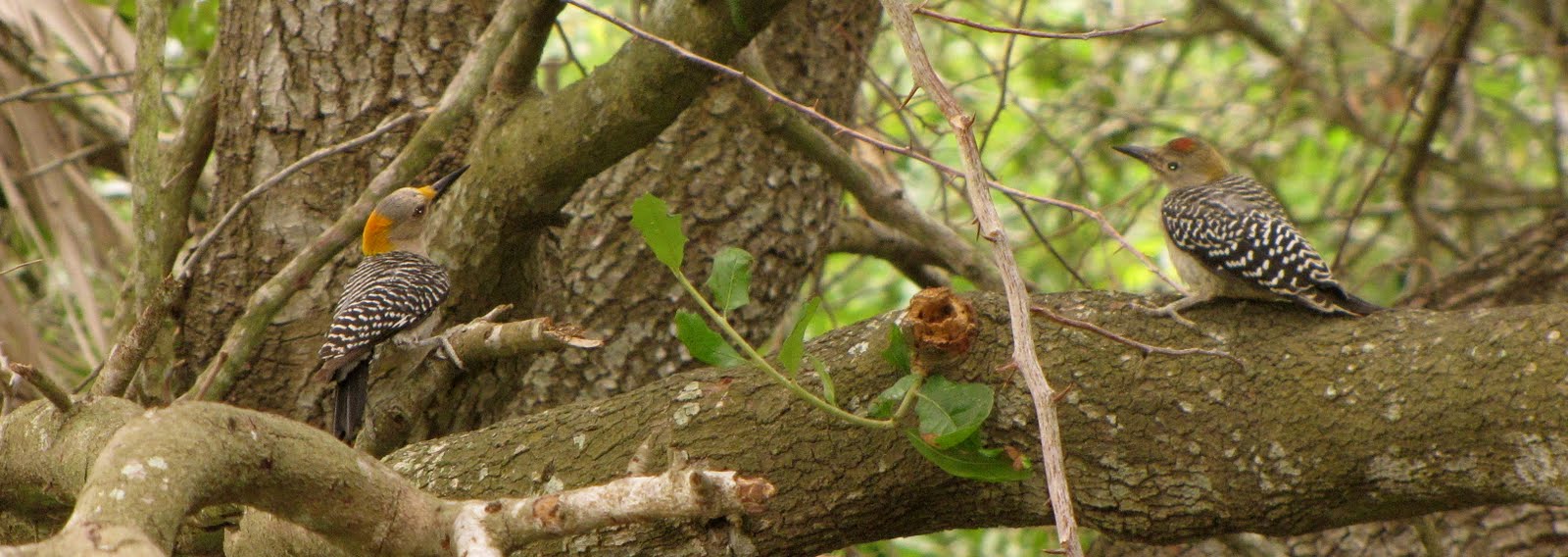
Another bird that is often scolded by other birds in the yard is the European Starling.  They are beautiful birds but their tendancy to chase off other cavity nesters when competing for nest sites doesn't endear them to me. When we moved here 15 years ago there were no starlings but now two pairs have already nested in the dead cottonwood trees in the vacant lot next  door.  But since we already have Golden-fronted Woodpeckers mating for a second time and Ladder-backed Woodpeckers checking dead branches of the Royal Poinciana for insects, I guess we still have cavities to spare.  The GF Woodpeckers are usually the excavators of the holes in dead trees and the starlings move in later. 


Golden-fronted Woodpeckers


The yard is not large, but it's big enough for me.   I could never get to know a larger patch as well as I want to know this one.  


I'm reminded of what William Faulkner once said:   "I discovered that my own little postage stamp of native soil was worth writing about and that I would never live long enough to exhaust it."  Postage stamp or patch, my yard is small but filled with drama.  It's a patchwork quilt of color, a crazy quilt of drama.  


Saturday, May 21, 2011

and the winner is....


May is not only a month of migration in the yard, but also a bustling, interesting time to observe the "ordinary" year-round residents and summer nesters that are easily overlooked when so many warblers and tanagers and other bright migrants distract us. 

Of course, these birds are not really ordinary at all.  For example, nothing beats a Buff-bellied Hummingbird for beauty and spunk. This one, perched in a patch of sunlight, is as lovely as any bird could be.  We are so lucky to have multiple buff-bellieds living here in ourTexas Rio Grande Valley yard.   I've been looking for their nest--I'm certain there's one in the yard --but the nests are so tiny, I haven't found it yet.   

an unfinished Altamira Oriole nest
Some of our yard nests are more obvious than others.  The Altamira Orioles, for example,  build a nest that cannot be ignored.  It hangs down, sometimes two feet long,  from a branch high on the northwest side of an oak or ash or cedar elm tree.  A busy pair of the orioles might build one nest and then, because of nervousness about the Bronzed Cowbirds that wait for a chance to lay eggs in the nest, or just fickleness about where they want to live, abandon it and build another. 

 That's what happened again this year.  A pair worked for several days and defended their nest from the cowbirds and even other Altamiras--and then left it to be blown apart by the wind.  I don't know where the new nest is, but it's somewhere close by--maybe in the neighbor's Tepehuaje tree or maybe across the Arroyo.  I haven't gone looking for it yet.  The orioles still eat oranges and seed from the feeders many times a day, but I'm disappointed that they abandoned the nest they built in one of our oak trees.

The last day I saw the birds at their abandoned nest was the day I took the picture on the right.  It was a spat between a first-year bird and one of the two older (more orange) Altamiras that had built the nest.  These are not usually fussy or aggressive birds (though they do join in on the mobbing of the screech-owls), so I was surprised to see them tumbling onto the neighbor's driveway below the nest.


Brown-crested Flycatchers started a nest in a birdhouse in the butterfly garden.  They put a large gray feather in the box that can be seen in the entry hole.  Not all cavity-nesting birds put nesting materials in their nest cavities (the screech-owls don't; I don't think our Golden-fronted woodpeckers do--both just lay eggs on the floor that is sprinkled with wood shavings or sawdust from the excavation, if it's a natural cavity, or that we have put in there if it's a man-made box). 
BC Flycatchers put all kinds of things in their nests:  feathers, snakeskins, grass, bark.  They usually have three broods, building a new nest in a different location each time.  At least that's what they've done in our yard. 


Brown-crested Flycatcher nest:  note the extra-large feather!

Brown-crested Flycatchers are not year-round residents here.  They arrive in March or April and raise several broods.  Unfortunately, some of the eggs hatch baby cowbirds.  See this post for photos of last year's feeding frenzy when they had hungry young ones.  


Carolina Wrens are year-round residents.  This one is grooming itself while taking a break from its nestlings that were snuggled in a hanging artificial plant on my neighbor's porch.  Wrens love to nest in man-made things: pots, plants, even one time the pocket of a pair of pants another neighbor had hung on his porch railing!  


My daughter's neighbors may wonder why she still has Easter decorations beside the front door.  It's because behind the bunny's ears is a nest containing five newly-hatched Carolina Wrens!


I don't know where the Black-crested Titmice built their first nest this year, but four just-fledged titmice had lots of fun with their parents at the bird baths this morning.

The young ones have crests that are more gray than black, making them look like the closely-related Tufted Titmice that live further north.  

These guys win the prize for strange nesting places.  Last year they nested in a cow's skull that decorates the neighbor's storage house.  Other times they have nested inside  metal posts on the boat trailer and the satellite dish.  Wherever these little guys nested this time, they are now out of the nest and all over the yard.  I think they win the award for cutest babies in the yard so far this year.


A few years ago the cute baby award went hands-down to the Plain Chachalaca chicks.  Precocial, they are out of the nest on the day they are born and soon are chasing around after the adults.  (If a bird is altricial, it is born naked and helpless and stays in the nest for a while.  By the time it is out of the nest, it's hard to tell an adult bird from a young one.)


adult Plain Chachalaca in a Wild Olive tree
I've been hearing  a Chachalaca chorus every morning for a week or so,  but  I'm sure they won't nest in our yard since neighbors on both sides have outdoor cats that are too much of a danger to the little chicks. Before cats lived so close,  these interesting birds nested in the Anacua tree beside the driveway.  

Clay-colored Thrush

Award for the most exciting bird in the yard today goes to the Clay-colored Thrush that sang all morning long from the tops of several trees.   We have never had a nesting pair, though we occasionally see them in the winter.  Until a few years ago (when they were called Clay-colored Robins) they were very rare in the US.   Now they nest in several locations in the Rio Grande Valley--but until now not in our neighborhood.  The song is beautiful (similar in tone to an American Robin) and I would love to have these birds be summer nesting residents.  

As long as we're handing out awards, Cutest Couple would definitely go to the Inca Doves, one of six species of doves that nest in the neighborhood.  (Other doves that are year-round residents are Mourning, White-winged, White-tipped, Common Ground Dove, and Eurasian Collared-dove.)


The most endearing thing Inca Doves do while courting (in addition to snuggling, grooming, and cooing a soft whirl-pool, whirl-pool) is raise their wings to show the soft pink underneath.  This guy raises his left wing; 

whereupon his mate raises her right.


No spring migrating warbler, tanager, nor even Painted Bunting can rival one of our resident birds for sheer beauty:  the Green Jay wins Most Beautiful no matter what the competition.  


Green Jays are not building their nest in our yard this year, but they are gathering nesting material here. 


Look closely (or enlarge with a click) and you'll see this Green Jay has a twig grasped in his feet.  He seems to be shaping it so that it will fit the nest he is building close by.


He holds it with his feet and shapes it with his beak.


When it's to his liking he takes it in his beak and flies away to the west where his nest is. A pair of Green Jays spent one afternoon flying back and forth from our yard to one a few yards over where I presume they are building the nest in a native tree or shrub.  I can't wait until they fledge a family of lively jays that will decorate the yard later in the summer.  Last year's Green Jay family was unrivaled in beauty and joyous antics.  (See this post from last summer for the jay family doing the Green Jay dance.)


Spring migration, which was certainly spectacular this year, is drawing to a close.  The colorful parade of birds that thrill us because of the brief time we have with them may be over for the year, but the fun of watching our yard will continue as it does every summer.  I can't imagine living in a better place for backyard birdwatching.  Living here makes me feel as though I've won first place in the birders' sweepstakes.


Tuesday, June 29, 2010

Hurricane Alex, Stay Away from My Nest!

This morning, as the first squall from approaching Hurricane Alex came through our yard, rain beating across the surface of  the arroyo and wind whistling at the windows, I watched a baby mockingbird, fresh out of its nest in the cenizo shrub, try to hold on to a branch as the wind whipped it to and fro.  A parent hovered close by.  I'm hoping the storm will not destroy nests and nestlings.  I'm hoping it won't destroy my own nest!

A couple of weeks ago I posted a sort of "state of the yard" piece, surveying the nesting activity around the house that week and comparing some of the birds to a restless wren questing for the perfect nest in a poem by Emily Dickinson (see "for every Bird a Nest").  My daughter Lori left a comment for me saying it reminded her of her favorite children's book, The Best Nest, by P.D. Eastman.

Now, Lori knows a lot about children and books, being both a teacher and a wonderful mother of five (my beautiful grandchildren who range in age from six months to fourteen years, birders all).  She pointed out that the mother bird of the book, who is unhappy with her nest,  learns in the end that it is not the location of the nest that matters, but the family in it. A good lesson for all of us, my wise daughter says.

I'd have to agree with her. She and her brother made our nest a very happy one before they fledged about twenty years ago.  We now visit their nests as often as we can (traveling to central Texas and Missouri), and in between those visits we continue to watch the  nests outside our own. So I guess you can say we don't suffer from "empty nest syndrome"--we've found a great way to take up our time, yard-watching!

Most of the backyard nesting this month has turned out well.  Bronzed Cowbirds still terrorize the neighborhood but even those parasitizing pests haven't prevented the baby boom.  Unwanted guests, they are nonetheless fascinating (and yes, beautiful) to watch.  If you had seen this guy with his ruffled mane and piercing red eye survey the sorghum field across the road, I think you'd be as stunned by his beauty as I was.

It's been a week of increase in the yard:   we have newly-fledged Green Jays eating from our feeders along with their parents,

Carolina Wrens flittering and singing everywhere,

and a family of Eastern Screech-owls screeching and trilling their strange songs as they perch in trees and on the outside stair railings at night.

I'm not sure where the little owls' nest was this year.  For years they chose a nest box in our yard, peeking out at us from the hole as we drove in the driveway.  But for the last two summers bees have taken up residence as soon as the owl family fledged--so we had to take the box down and we left it down this year. 

Brown-crested Flycatchers are very busy feeding chicks in their woodpecker-hole-nest-cavity nest in the dead cottonwood stump (they finally made the decision for the location of their second nest).  I love to hear their singing as they carry the insects to the hungry babies.  (Read "Let's Do Lunch" for a description of their first nest and "for every Bird a Nest" for photos of their search for this one.)

Here's a new nest and its inhabitant:  a White-winged Dove sitting on eggs in a flimsy nest in the small Brasil tree at the end of the driveway.  Isn't that blue-circled eye amazing?  I took this picture quickly as she was definitely eying me and my camera, even though I wasn't as close to her as my zoom lens makes it look.  I love to hear the incessant "who cooks for you?" queries of these beautiful doves. 

I discovered a very cleverly-placed nest last week in an unusual place: snuggled in the brain cavity of a cow's skull was a nest with several baby Black-crested Titmice!  Now if you are wondering where in the world the titmice would find such a nest site, remember this is Texas where citizens use dead animal heads as decor.  The skull, once bleached white in the Texas sun out in a Texas cow pasture, is now gracing (?) the wall of a neighbor's storage shed, clearly visible from our deck and an apparently enticing place for the titmouse family.

I've already mentioned the strange nesting habits of Black-crested Titmice in previous years when they nested inside the metal railings of our boat trailer and inside the metal arm of a satellite dish. This may just be the strangest place for a nest yet--though to Mrs. Titmouse it may be "The Best Nest" ever!  In P.D. Eastman's  The Best Nest,  the Wrens think they've found a great nest, a boot, until the foot it belongs to reclaims it.  That reminds me of the time one of my neighbors put on a pair of khaki pants he had hung to dry on the porch railing.  When he reached his hand in the pocket, he found a Carolina Wren's nest!


Kiskadees may have a second brood in their large spherical nest.  In this photo, you can clearly see the side entrance to the nest.  

I've seen only one more bird feeding a cowbird chick, a Northern Cardinal.  I don't know if it also raised cardinals. I hope so.  I'm just glad to see the pair of cardinals doing okay.  The female is one we saw at the feeders in the spring with a badly torn (or deformed) crest.  I didn't post this horrible photo then because I was afraid the bird had been attacked by one of the neighborhood cats and feared that it would not survive. Now the photo just reminds me of how resilient nature can be. That's something I want to hold on to with a hurricane bearing down on us so early in hurricane season and with oil still gushing in the gulf.   The bird is still strange looking, but she is seemingly healthy and has raised a brood of chicks.  Her image no longer horrifies me but gives me hope.

The Altamira Orioles have not returned to their nest, but I did hear them singing a few days ago.  I still have hopes that they will decide to use the beautifully constructed pendulous nest that they built and abandoned last March. 

Quick!  Is this an Altamira or a Hooded Oriole?  

You're right--it's the smaller but similar Hooded Oriole.  Hooded Orioles are still eating daily from the hummingbird nectar feeders and hanging out in the Washingtonian Palms.  I can't see their nests, but there appears to be one in a tree in the backyard and one in the front. 

I'm still frustrated that I can't find a Buff-bellied Hummingbird's nest.  I'm fairly certain there are new baby hummers among those at our feeders.  These are our resident hummers, quite beautiful birds. I like the photo above because the eponymous buff-colored belly shows clearly above those tiny feet.

Other birds whose numbers have increased greatly in the last two weeks are the Cave Swallows that nest under the roof of a neighbor's boat lift and the Purple Martins that live in another neighbor's martin house.  In this photo the young martin is the one with the grayish throat.


As I type this post, I am watching the Weather Channel.  We're playing that guessing game that people who live in hurricane land have to play.  Should we stay or should we leave?  Will the storm come straight up the arroyo  and the eye come over our house (as Hurricane Dolly did two years ago), or will we be lucky and get mostly just much-needed rain?  I hate to think that the storm will follow Dolly's path.  That storm was in August, past nesting time for the herons and spoonbills and pelicans on Green Island at the mouth of the Arroyo. This one, I'm reminded by the baby mockingbird clutching the cenizo shrub next to its nest, is early in the season when birds are still nesting.   Even the Best Nest doesn't offer protection when the very trees are in danger.

 Update on the storm:  So far, luck is with us.  The latest Tropical Update puts us at the top edge of the cone of danger in the hurricane's path instead of right in the middle as we were a few hours ago and it's saying the storm may be only a category one hurricane.

I think we'll be lucky.  And so will that little mockingbird whose parents built the Best Nest there in the cenizo bush.

Wednesday, June 16, 2010

"for every Bird a Nest"


The story of the yard in June is always a story of nesting.  I haven't been outside as much in the last two weeks as I was during migration (the heat index is over a hundred by late morning) but I have been looking out the windows, and even from limited views the nesters can be seen going to and fro or overlooking their nests from a high branch.

Some of these busy nesters remind me of a poem by Emily Dickinson in which she wonders why ("wherefore" in her archaic 19th century English) a little wren continues its search for the perfect nest spot, even though there's one in every tree:


For every Bird a Nest --
Wherefore in timid quest
Some little Wren goes seeking round --

Wherefore when boughs are free --
Households in every tree --
Pilgrim be found?   
. . . .

(click the link above for the whole poem)

Watching a pair of Brown-crested Flycatchers, I'm thinking the same thing.  Why continue the exhausting quest in search of the perfect spot (as though on some sort of pilgrimage) when there are perfectly fine nesting spots everywhere and every bird seems to be guaranteed one.  Why all the fuss, just build the nest! get on with it already!!

Really, I'm just kidding.  I love watching birds search all around for the best place to build.  They seem so human.  I can just imagine what they could be thinking.  

I'm fairly certain this is the same pair of flycatchers that so steadfastly built and tended a nest in April and May,  even though they disappointingly (at least for me) seem to have raised Bronzed Cowbirds instead of flycatchers.  Watching from the front deck for a few days last week was entertaining.  Here (photo on right) one looks over the dead cottonwood stump that has already this spring proved a successful home for European Starlings (though, really, who needs more of those to compete with our native cavity-nesters?) and Golden-fronted Woodpeckers.  (The woodpeckers had chiseled out quite a few holes in the two old cottonwoods during the winter--a few in our house, too! Golden-fronted wp's are the contractors who provide housing for several species.)

Here (left) the lively brown flycatchers  flutter excitedly over the birdhouse that's already been used by Brown-crested Flycatchers for many years.  Though not a great photo, it does capture the flurry of activity as they "quest" for that perfect spot. 


Flycatchers are not the only birds on a quest for the perfect nest in our June yard. These Black-bellied Whistling Ducks, if not still searching out nesting places, are certainly searching for something.

In tall Washingtonian Palm trees they look high...

they look low....


Once called Tree Ducks, these guys favor the palms and sometimes even sit on the electrical lines.  Every day we watch them on our dock, preening and sunning themselves.  And early in the morning, before the heat is oppressive, we watch their pilgrimage.  Emily would certainly be wondering the whys and wherefores of their constant search.

The Northern Mockingbird nest in the neighbor's small Anacua tree that a few weeks ago contained a single nestling (see posts from May) was empty by early June without my seeing any newly fledged Mockingbirds. The quick glimpse I had one day of a nestling with dark feathers was too brief to say for sure it was a cowbird. 

[I'll repeat again my disclaimer about bothering nests.  It is something I am super careful about.  I don't want to  move branches to get closer looks or disturb the nesters.] 

Two weeks ago the neighbors discovered a mockingbird going in and out of the Cenizo shrub that is less than ten feet from the Anacua where the first mockingbird nest was. (Cenizo is the native "purple sage" that blooms so beautifully across the river a few days after a summer rain.  Its ashy-green foliage and soft purple blooms  decorate the wild thorny brush along the Arroyo Colorado and are often used in landscaping.)

I think this second nest, fastened like the first to  forking branches about four feet above the ground, may have been built by the mockingbird that sang day and night during the time the other pair were nesting. (See this post for a picture of that nest site.)

It surprises me that the nests are so close together.  The neighborhood gossip in me is starting to speculate.  Did the pair, to make up for the first possibly cowbird-infested nest, start a new one nearby before the cowbird had left home?  Or is this a case of Big Love (one of my favorite television shows) where one male has actually two adjacent homes and two ladies?   Hmmmm.   (I read an interesting article the other day, while throwing out old birding magazines, that cited DNA studies showing supposedly monogamous nesters sometimes having multiple mates.  Some males father broods with more than one female and sometimes eggs in one nest have more than one male parent. )

Whatever the parentage, nestled in the cup of coarse twigs, lined with finer vines and palm tree fibers, were six eggs, four of them light blue blotched with reddish brown.  According to my nest book  (Nests, Eggs, and Nestlings of North American Birds by Paul J. Baicich and Colin Harrison) those are indeed mockingbird eggs.  Hooray!  Unfortunately,  two more eggs were the pale blue-white of the Bronzed Cowbird. (No adult mockers were in sight, so my neighbor removed the two interloper eggs which, being tall,  he could do without touching the nest or the branches.)

A couple of days ago the eggs began hatching. The state bird of Texas, once again, is increasing in number!   And the neighborhood cats are running for cover as the Northern Mockingbirds begin their assault.  My hope is that the intense heat as well as the protective instincts of the birds will keep the cats indoors where domestic cats belong. 


I've been promising a photo of a Hooded Oriole nest and finally have one.  Woven of the finest materials, soft gold fibers from the palm tree, this is a nest I think Emily would call "of twig so fine," an achievement she guesses the wren aspires to.

On a frond of a Washingtonian (non-native) Palm tree, this nest is in the usual kind of tree for a Hooded Oriole but is not typical because it is on the top, not the underneath, side of a dried, not a green, palm frond.  The day following our discovery of the nest, high winds twisted the leaf so that the lovely little woven nest is now out of sight.  I was concerned that the winds would blow down the dried frond, but luckily it's still there, more hidden now from the marauding Bronzed Cowbirds. Woven of fibers pulled from the leaves and bark of the tree, the nest is perfectly camouflaged. 

Hooded Orioles, like Emily's nest-questers, seem always to be in search of a more perfect "household" even though every palm tree looks to my un-oriole eyes to be a perfectly good place. At least twenty palms are in--or within a short distance of--our yard, and at least two pairs of the little orioles continually fly from palm to palm.  I suspect the building of superfluous nests is a reaction to the overabundance of Bronzed Cowbirds.


I'll note just a few more of the active nests:

Another of our common nesters, Great-tailed Grackles, typically build large nests of twigs and weeds, sometimes several in the same tree or nearby trees. The one in the photo above is in our lovely blooming Retama tree.  Others are in an Ash tree and several are in two Live Oaks. The nests are usually pretty high in the trees and are apparently vulnerable to large birds of prey that fly over the yard, judging by both the fact that  Harris's Hawks have already raided a nest of young birds this spring,  and also by the reaction of adult grackles when vultures, hawks, and even gulls fly over the trees.  

The Turkey Vulture being chased by the grackle here was followed closely by a Black Vulture that was likewise harassed by the protective parents.  Male grackles don't seem to help build or sit on nests, but they do keep watch and go into action when necessary!


Curve-billed Thrashers have fledged already from the nest in the native Spanish Dagger Yucca.  You can tell this is a young bird because its spots are smaller, its bill slightly shorter, and its eye pale yellow rather than orange.  Curve-billed Thrashers have always nested in our yard and have had as many as three broods per year.  I've found their nests in several kinds of native trees including Negrito, Esperanza, and even one year in a metal Purple Martin house.  The house was no longer occupied by martins because it had become overgrown by small trees.


The last photo is of one of the Couches' Kingbirds that are nesting in a Live Oak tree. Their dawn song, longer and slower than their other calls and songs is one of my favorite sounds of a spring morning.

Our small Rio Grande Valley yard is filling up with more and more nests.  In such a place where "boughs are free --- / Households in every tree," our spring birds could indeed be described as a " throng -- /  Dancing around the sun."