Welcome to my world!

Backyard Birding in the Rio Grande Valley of South Texas:
Surrounded by great birding destinations, our favorite patch is still the backyard (or the front), where we've seen more than 270 species of birds. Sit awhile, and watch the river and yard with us!


Showing posts with label altamira oriole. Show all posts

Friday, June 17, 2011

Beyond the Patch: a Boat Trip


I don't spend every day hanging around my yard.  Some days we leave our patch of birds on the banks of the Arroyo and take the boat out on the river to the Laguna Madre. At dawn we leave the dock and  ride for about 20 minutes until we get to the bay.


On the way out, we see Roseate Spoonbills, Tricolored Herons, Reddish Egrets and Brown Pelicans flying from rookeries on small islands to their feeding grounds in inlets and along the shores. We smell salty air and meet fishermen returning from overnight trips. Dolphins jump in front of our boat or ride in our wake.

Leaving the mouth of the Arroyo Colorado and crossing the Intercoastal Waterway, we enter shallow water, hoping to find red fish tailing in the "skinny" waters.  When we get close to herons stalking prey in water below their bellies, we know it's time to stop the boat and wade.  Or at least Brad wades and I stay in the boat unless I've brought my kayak along.


When the sun is still low over the horizon, its brilliant red reminds me of lines from Coleridge's Rime of the Ancient Mariner:  "nor dim, nor red, like God's own head, the glorious sun uprist."

On this day we saw no fish in the shallow waters, or at least we didn't catch any, but the beauty of the sunrise made the trip worth it.  After exploring other fishing holes briefly, we decided to return to the Arroyo and go upriver looking for tarpon and snook.

I love a sunrise in the Laguna Madre, but the Arroyo is home.  If my birding "patch" is my yard, the Arroyo is an extended patch.  We boated back toward the west, past Adolph Thomae park, past Arroyo City, past our house.


Roseate Spoonbills flew above us.


Willets fished along the edge of the Arroyo.


A Crested Caracara looked on from his perch in a dead mesquite.


Passing by our house and all the other houses that line the south side of the river, we reach an area where houses disappear and both sides are lined with habitat referred to as "Arroyo Colorado Brush"  where dominant trees are Ebony, Coma, and Adelia and brush is thick and thorny. It is really only remnants of such habitat, however, as the land has been cleared for agriculture just beyond the brush along the banks.


But I like boating along the river and imagining a land where nothing has been cleared.   The state of Texas protects a portion of it as the Las Palomas Wildlife Management Area where native brush  is relatively undisturbed.

The bank pictured above shows fairly thick vegetation, but you can tell it has once been cleared because of the mesquite trees that are typical of disturbed land.  Nonetheless, it is perfect habitat for one of my favorite birds. We slow down when we get to this spot and use the trolling motor to move by quietly.


Can you see the excavation in the bank?  Perhaps the cavity is an enlarged  kingfisher hole. Or perhaps it is a hole made from collapsing dirt around tree roots.


A closer look reveals a ghostly face.


Binoculars (or a zoomed-in camera lens) reveal that tucked into the hole, high up in the bank, is a  family of Barn Owls!  I can see two down-covered chicks in front of the female in this nest. Others are probably there as well.  Barn Owls can have large broods and the mother does a good job of herding her brood back into the cave behind her.  

I've seen Barn Owls nesting in boat houses, nest boxes,  and barns near the river, but I see them most frequently in these cavities in the banks.  Pale and ghostly, they are hard to spot unless you know where to look. 


Sometimes I see them fly at night along the river on strong silent wings.  The males are lighter in color than the females and their almost white underparts make them look especially like ghosts in the night.  
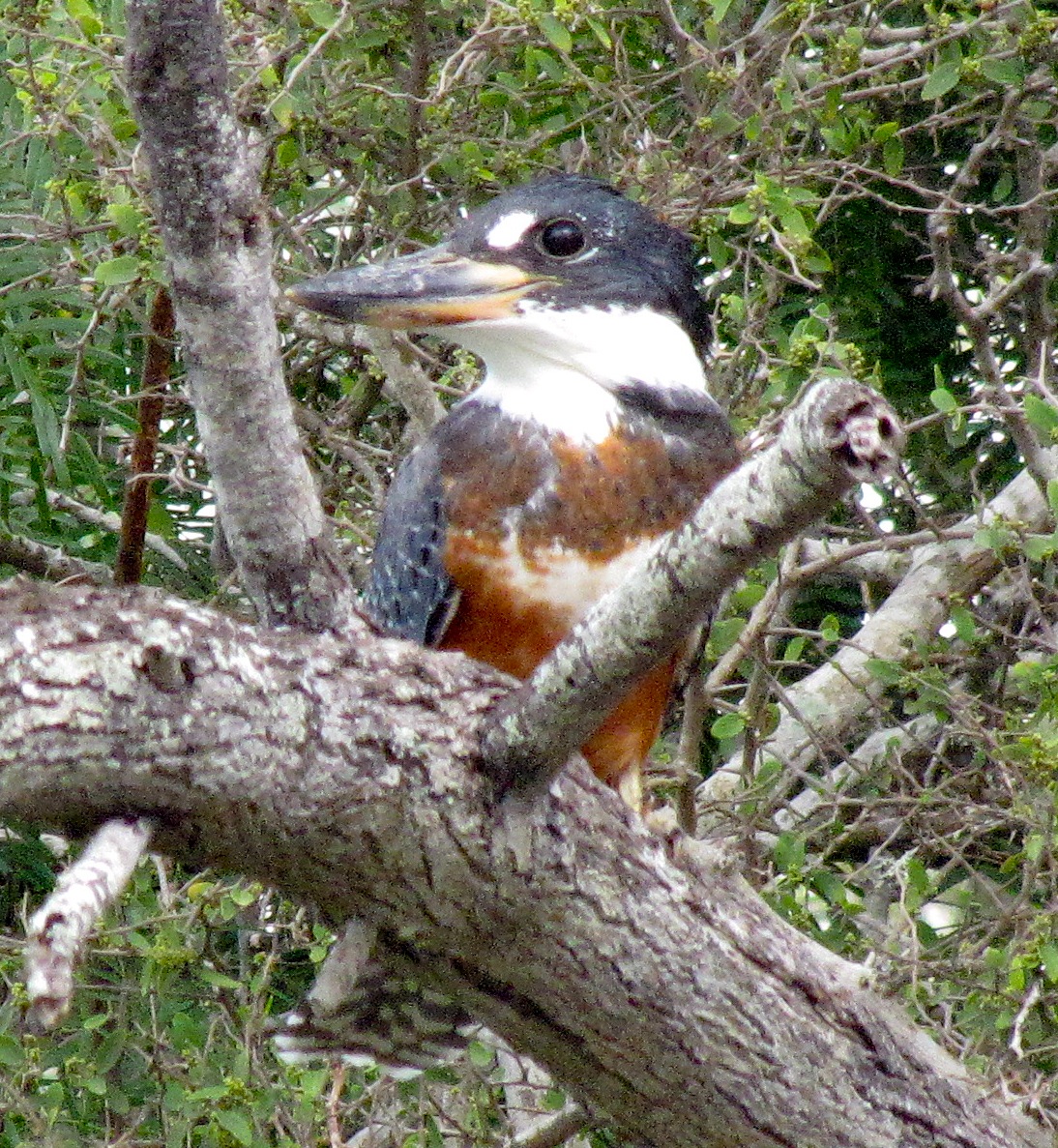

         Barn Owls are not the only bank dwellers we saw on the trip upriver.  Another favorite pair of river birds announced their presence with loud machine-gun rattling and insistent bobbing up and down from branches overhanging the water:  a pair of Ringed Kingfishers courted near their nest holes on the opposite bank.  


This photo shows the kingfisher with mouth open and tail cocked, loudly answering the equally loud rattling of  its mate perched about 50 feet upriver.   Ringed Kingfishers are one of three species of kingfishers here in the Rio Grande Valley.  Green Kingfishers, also here year-round, are much smaller and green.  The Belted Kingfishers that winter here (the only kingfisher in most of the US) look similar except that they are about three inches smaller and their beaks are not nearly as large.  


I wasn't able to figure out for sure which of several holes in the bank belonged to the kingfishers.  They seem to like to make extras.


Groove-billed Anis sang in a mesquite tree along the river. Below is a photo of an ani that was banded  a week ago  in the Las Palomas WMA that borders the Arroyo near where the owl and kingfishers nest. I have volunteered to help with the banding a few times.


At first glance, anis look like grackles, but the beak of course is distinctive, as is their posture and their two-note call.  We've been seeing anis on the fence across the arroyo.  In years past I've watched them ride on the backs of deer, eating ticks.  (I know:  yuck!  But such interesting things to be seen from the window overlooking the river is the reason my spotting scope never leaves its spot at the back window.)


Another highlight of the trip upriver was a good look at the longest Altamira Oriole nest I have ever seen. It seemed twice as long as the nest Altamira Orioles built this year in our oak tree.  Comparing the nest in this photo to the ten-inch oriole that is peering inside, I'm guessing the nest is a minimum of two feet long.

All in all, our boat trip was successful even without catching fish. We love living here on the Arroyo Colorado where a short boat ride extends our backyard beyond its narrow borders.

****************
This is an experiment:  I've never posted a video before but I did take one of the Ringed Kingfishers.  You can see only one bird in this wobbly movie, but you can hear both of them calling back and forth.  Apologies for the poor camera work--but it's so much fun to watch these birds bobbing up and down and to listen to their loud rattling calls that I am posting it anyway.  Or at least trying to.  Lets hope it works.


Saturday, May 21, 2011

and the winner is....


May is not only a month of migration in the yard, but also a bustling, interesting time to observe the "ordinary" year-round residents and summer nesters that are easily overlooked when so many warblers and tanagers and other bright migrants distract us. 

Of course, these birds are not really ordinary at all.  For example, nothing beats a Buff-bellied Hummingbird for beauty and spunk. This one, perched in a patch of sunlight, is as lovely as any bird could be.  We are so lucky to have multiple buff-bellieds living here in ourTexas Rio Grande Valley yard.   I've been looking for their nest--I'm certain there's one in the yard --but the nests are so tiny, I haven't found it yet.   

an unfinished Altamira Oriole nest
Some of our yard nests are more obvious than others.  The Altamira Orioles, for example,  build a nest that cannot be ignored.  It hangs down, sometimes two feet long,  from a branch high on the northwest side of an oak or ash or cedar elm tree.  A busy pair of the orioles might build one nest and then, because of nervousness about the Bronzed Cowbirds that wait for a chance to lay eggs in the nest, or just fickleness about where they want to live, abandon it and build another. 

 That's what happened again this year.  A pair worked for several days and defended their nest from the cowbirds and even other Altamiras--and then left it to be blown apart by the wind.  I don't know where the new nest is, but it's somewhere close by--maybe in the neighbor's Tepehuaje tree or maybe across the Arroyo.  I haven't gone looking for it yet.  The orioles still eat oranges and seed from the feeders many times a day, but I'm disappointed that they abandoned the nest they built in one of our oak trees.

The last day I saw the birds at their abandoned nest was the day I took the picture on the right.  It was a spat between a first-year bird and one of the two older (more orange) Altamiras that had built the nest.  These are not usually fussy or aggressive birds (though they do join in on the mobbing of the screech-owls), so I was surprised to see them tumbling onto the neighbor's driveway below the nest.


Brown-crested Flycatchers started a nest in a birdhouse in the butterfly garden.  They put a large gray feather in the box that can be seen in the entry hole.  Not all cavity-nesting birds put nesting materials in their nest cavities (the screech-owls don't; I don't think our Golden-fronted woodpeckers do--both just lay eggs on the floor that is sprinkled with wood shavings or sawdust from the excavation, if it's a natural cavity, or that we have put in there if it's a man-made box). 
BC Flycatchers put all kinds of things in their nests:  feathers, snakeskins, grass, bark.  They usually have three broods, building a new nest in a different location each time.  At least that's what they've done in our yard. 


Brown-crested Flycatcher nest:  note the extra-large feather!

Brown-crested Flycatchers are not year-round residents here.  They arrive in March or April and raise several broods.  Unfortunately, some of the eggs hatch baby cowbirds.  See this post for photos of last year's feeding frenzy when they had hungry young ones.  


Carolina Wrens are year-round residents.  This one is grooming itself while taking a break from its nestlings that were snuggled in a hanging artificial plant on my neighbor's porch.  Wrens love to nest in man-made things: pots, plants, even one time the pocket of a pair of pants another neighbor had hung on his porch railing!  


My daughter's neighbors may wonder why she still has Easter decorations beside the front door.  It's because behind the bunny's ears is a nest containing five newly-hatched Carolina Wrens!


I don't know where the Black-crested Titmice built their first nest this year, but four just-fledged titmice had lots of fun with their parents at the bird baths this morning.

The young ones have crests that are more gray than black, making them look like the closely-related Tufted Titmice that live further north.  

These guys win the prize for strange nesting places.  Last year they nested in a cow's skull that decorates the neighbor's storage house.  Other times they have nested inside  metal posts on the boat trailer and the satellite dish.  Wherever these little guys nested this time, they are now out of the nest and all over the yard.  I think they win the award for cutest babies in the yard so far this year.


A few years ago the cute baby award went hands-down to the Plain Chachalaca chicks.  Precocial, they are out of the nest on the day they are born and soon are chasing around after the adults.  (If a bird is altricial, it is born naked and helpless and stays in the nest for a while.  By the time it is out of the nest, it's hard to tell an adult bird from a young one.)


adult Plain Chachalaca in a Wild Olive tree
I've been hearing  a Chachalaca chorus every morning for a week or so,  but  I'm sure they won't nest in our yard since neighbors on both sides have outdoor cats that are too much of a danger to the little chicks. Before cats lived so close,  these interesting birds nested in the Anacua tree beside the driveway.  

Clay-colored Thrush

Award for the most exciting bird in the yard today goes to the Clay-colored Thrush that sang all morning long from the tops of several trees.   We have never had a nesting pair, though we occasionally see them in the winter.  Until a few years ago (when they were called Clay-colored Robins) they were very rare in the US.   Now they nest in several locations in the Rio Grande Valley--but until now not in our neighborhood.  The song is beautiful (similar in tone to an American Robin) and I would love to have these birds be summer nesting residents.  

As long as we're handing out awards, Cutest Couple would definitely go to the Inca Doves, one of six species of doves that nest in the neighborhood.  (Other doves that are year-round residents are Mourning, White-winged, White-tipped, Common Ground Dove, and Eurasian Collared-dove.)


The most endearing thing Inca Doves do while courting (in addition to snuggling, grooming, and cooing a soft whirl-pool, whirl-pool) is raise their wings to show the soft pink underneath.  This guy raises his left wing; 

whereupon his mate raises her right.


No spring migrating warbler, tanager, nor even Painted Bunting can rival one of our resident birds for sheer beauty:  the Green Jay wins Most Beautiful no matter what the competition.  


Green Jays are not building their nest in our yard this year, but they are gathering nesting material here. 


Look closely (or enlarge with a click) and you'll see this Green Jay has a twig grasped in his feet.  He seems to be shaping it so that it will fit the nest he is building close by.


He holds it with his feet and shapes it with his beak.


When it's to his liking he takes it in his beak and flies away to the west where his nest is. A pair of Green Jays spent one afternoon flying back and forth from our yard to one a few yards over where I presume they are building the nest in a native tree or shrub.  I can't wait until they fledge a family of lively jays that will decorate the yard later in the summer.  Last year's Green Jay family was unrivaled in beauty and joyous antics.  (See this post from last summer for the jay family doing the Green Jay dance.)


Spring migration, which was certainly spectacular this year, is drawing to a close.  The colorful parade of birds that thrill us because of the brief time we have with them may be over for the year, but the fun of watching our yard will continue as it does every summer.  I can't imagine living in a better place for backyard birdwatching.  Living here makes me feel as though I've won first place in the birders' sweepstakes.


Friday, March 25, 2011

Homecomings and Homebuilding


I was almost right about the Hooded Oriole's return.  He came "home"  just one day later than last year.  Here he is in one of the palm trees in the backyard, not far from where a pair of the birds nested last summer.  Actually several pairs nested last year, as every year, in our palms and those of yards nearby.  Their small beautiful nests are made of long palm fibers, like little golden purses, that are usually nestled under a palm frond. So far this spring I've seen only one male at a time and no females.  It appeared first late in the day at a front yard bath, just as it did last year, and was in the Bottlebrush tree early the next morning.

Below is a photo of a similarly-colored  Altamira Oriole in the Bottlebrush.  Here in Texas, Hooded Orioles are orange like the Altamiras, though I think they are more yellow or gold in other locations.   The two species are sometimes confused by casual observers. Note the difference in the shape of the black on the head--more like a mask on the Altamira Oriole and coming straight down just behind the eye of the Hooded, forming the orange "hood." In addition, the Altamira Oriole has an orange wing patch high on the shoulder and the Hooded does not.


When the male Hooded Orioles arrive home, they seem most interested at first in bathing and eating.  When the females follow in a few days (this is the usual pattern), oriole-watching gets more interesting as the males crisscross the yard and show off from every tree. Home-building quickly follows their homecoming as they pair up and start finding nesting sites.

 My favorite oriole photo from last spring is this one in which a male is spreading his tail almost as if imitating the palm frond on which he's perched (and where his mate will build a nest after his antics successfully get her attention).


Tail-fanning seems to be a popular way of attracting attention in the bird world.  Here's a photo of a Long-billed Thrasher showing off to his mate a few weeks ago.  I had taken a picture of what I thought was just one thrasher in the Bottlebrush tree.  I hadn't even seen the dancer with the fancy tail, but there it was when I reviewed the photo.  I love photos I just shoot randomly that turn out later to be really interesting.

Long-billed Thrashers

Curve-billed Thrasher
We have two species of thrashers that live year-round in the yard,  both virtuoso singers.  Long-billed thrashers are more musical, their phrases a little slower,  but I find the Curve-billed Thrasher's song extremely interesting.  The male that lives in our yard all year began singing in January, very quietly but constantly as though practicing for the "real" full-throated singing that began in February.  I've written about this "whisper song" before.  (I've also written about Buff-bellied Hummingbirds and Altamira Orioles singing so quietly you have to be very close to hear them.) When the thrasher sings his quiet song, he doesn't open his beak much, if at all, but his throat moves. I'll hear a song that sounds as if a singing bird is far away, and then find the persistent singer in a nearby Hackberry tree. His usual song is like the whisper song in quality and phrasing but is very much louder.


Curve-billed Thrashers seem always to be doing something interesting.  

Here one is taking a sun bath on a  sun-warmed stepping stone.


Here one bends low to sip water spraying from a dripper hose.


And here he looks especially distinctive perched on a post.  

Curved-bill thrashers have more rounded markings on their breasts than Long-billed, and of course their color is a more muted brown.  Both have a distinctive long, dark bill,  and orange eyes.  Our yard, a messy one with unraked leaves and brushy unkempt tangles of native shrubs, is a perfect place for them to thrash around in, throwing leaf litter and dirt all around. 

Yesterday I thought perhaps a Brown Thrasher had stopped by our yard.  Once one spent a whole winter with us.  Yesterday's bird appeared redder than the usual dark brown of the very similar Long-billed.   But closer looks showed me the gray face and darker bill of the Long-billed after all,  looking especially bright and reddish in the sun. 


Both pairs of thrashers are beginning nest-building activities,  though neither has settled on a specific location.   I think the Long-billed pair will nest in a Cedar Elm in the front yard and the Curved-billed couple are experimenting by sticking  thorny twigs  in various locations in the back.  Curve-billed Thrashers seem to not need such brushy locations.  They have built in past years in just about every medium sized tree in the yard.  Last year their first nest was in a Yucca and the second in a Brasil.  One year they even built a nest in a Purple Martin house that the martins no longer liked because trees had grown too near it. 

Starlings are already nesting in a cavity in the dead cottonwood.  I don't begrudge these invaders a spot since there are about a half-dozen other cavities for the woodpeckers and titmice to choose from.   A Screech-owl is at least roosting if not nesting in a new owl box by the drive.  We put the box up just a couple of weeks ago to replace one bees had taken over last summer.  It's probably too late for this guy to nest, but he sure likes sitting in the box. 


He doesn't, however, like me to walk past his door.  That's what my granddaughters call the stink eye.  


I've added to the year's bird list (see sidebar) but I'm not sure it's accurate yet. I'm still tweeting new year birds on Twitter, but I don't always remember to tweet every one.  I'll work on my list tomorrow and then keep adding more as migrants return home or pass through.  I think the list is a little behind last year's at this time.

 Two days ago I was very excited to see an Aplamado Falcon fly over the house. Typically, I didn't have my camera with me.   This is only the second time I've seen the falcon in (or over) the yard.  The first time was about ten years ago when two perched on an electric pole in September.  (We live not too far from Laguna Atascosa NWR where several pairs have nested successfully after a reintroduction program by the Peregrine Fund.)


Spring arrived officially a few days ago.   The moon over the arroyo on the first night of spring was a Supermoon, named because it was nearer the earth than it had been in 18 years.  A moon rising over the water is always breathtaking, but this one was especially ... well, super.  I wish I could have captured a picture of the Great Blue Heron that flew along the river across the moon's light.  

I'll try to blog often to report on our  homecomings and nest-building.   Spring is super everyday in the Rio Grande Valley. 


Thursday, March 17, 2011

On Catching Up (and Looking Back)

Sometimes I feel like the osprey in this photo--not the one with the fish, but the one chasing ineffectually.  I'm not flying as gracefully as this bird, of course, but I'm trying to catch up. The last time I posted was the day before St. Valentine's Day and here it is St. Patrick's Day!  This post won't have a real theme--it'll just be catch-up time.

When I started blogging at the beginning of 2010, my objective was to write something that would help me keep track of a year in the life of the yard.  I had already tried that with various journals and lists, but found they were too easy to misplace--and you can't keep track of details if the list you keep them on is lost.    Even though I don't post as often as I had intended, my blog is always "there" (somewhere in cyberspace) and  I'm finding it really fun to look  back over last year's posts.  Today, as I read over last year's posts for February and March, I was reminded of some interesting observations and found myself comparing them to this year's.

For example, a couple of weeks ago, I took a photo of pelicans  fishing out back in the Arroyo. One of them was the red-pouched form of the Brown Pelican, a subspecies usually found in California.  As I browsed the blog's posts from  a year ago,  I  saw that I was speculating then about how many of our Texas pelicans are this form,  but I couldn't find an answer anywhere.  Trying to figure it out for myself, I counted pelicans as we took a boat trip up the river.  Today I read in the TOS Handbook of Texas Birds (a book I didn't have last year) that about 10-15 percent have the red gular pouch.  I think that's an overestimation as far as the birds here on the South Texas coast--or at least in the Arroyo--are concerned.  Last year's effort to count pelicans and note the ones with the red rather than the grayish pouch made me conclude that more like 2% were the California subspecies. 

Another  thing I noticed after looking at last year's posts (see the links here and here) is that there are not nearly as many Brown Pelicans on the river as there were a year ago.  I hope that has nothing to do with the oil spill in the gulf.  The TOS handbook says Brown Pelicans are not known to breed along the lower Texas Coast.  I think they actually do breed on some of the spoil banks in the Laguna Madre.  If it's not windy tomorrow maybe we can retrace the boat trip we took looking for and counting pelicans last March.  It isn't scientific, but  it is interesting to compare one year's observations with another, and thanks to my Arroyo Colorado Riverblog, it's easy to do that.

Continuing with my catch-up post:  I'm on the lookout for our migrant Hooded Orioles.  Checking the blog for the date of last year's first appearance, I see it's March 18--that's tomorrow.  I can't wait!  The bottlebrush tree is starting to bloom, ready for the nectar-loving birds.  Today three Altamira Orioles flew across the yard and into the tree. For a second I thought maybe the Hoodeds were back.  By non-scientific observation, I know that the same birds migrate back to our yard year-after-year: we once had a male Hooded Oriole with a deformed beak, easy to recognize as it returned for at least three summers.  (I was especially glad to see it each spring, as I feared the deformity would make survival difficult-- but apparently it didn't, or at least not for those three years.)  

A Fuertes's Oriole ( formerly Ochre Oriole) also returned to the yard two summers.  I'm sure it was the same bird since it had  been seen in the United States only once before (late 1800s)--and what are the chances two different Fuertes Orioles would show up in the same yard two years in a row?    Every spring I look for the beautiful Ochre Oriole, but it did not return for a third year and hasn't been seen north of the Mexican border since.  This year, though, I have something almost as good--a lovely watercolor by bird artist F.P. (Tony) Bennett, who  saw it in our yard and has painted it for us. We just got the watercolor back from the framer's today.  Tony's depiction does the bird justice--a really beautiful creature. (To see some of Tony's other paintings, see this link: http://www.fpbennett.com/ )
Speaking of orioles, I'm  looking forward to the Altamira Oriole's yearly magnificent feat of nest-building. Looking back over the blog, I see  it was mid April of last year that they built their first nest.  Unfortunately, they abandoned that one in our Oak tree and built another in a Tepeguahee tree three doors to the west of us.  That nesting was apparently successful--two first-year Altamiras joined two adults all winter in the yard, eating oranges, sipping hummingbird nectar, feeding on aloe blooms, and even eating seeds from the feeders.  Above is one of the young birds.  Note the pale back and tail, and contrast it with the black of the adult below.  Male and female look similar in this species of oriole, unlike the Hooded Orioles whose female is much like the female Ochre Oriole in Tony's watercolor.  

Since I'm trying to catch up with a whole month of yard activities, I've got lots more to show and tell. I also want to tell about a couple of really neat experiences I had away from the yard.  But for now I'll close this post and continue writing tomorrow.  I want to get up early in the morning for some backyard birding.

Will the Hooded Orioles show up tomorrow?  I'll be watching.