Welcome to my world!

Backyard Birding in the Rio Grande Valley of South Texas:
Surrounded by great birding destinations, our favorite patch is still the backyard (or the front), where we've seen more than 270 species of birds. Sit awhile, and watch the river and yard with us!


Friday, May 6, 2011

Spring Fling


On spring nights, thousands and thousands of songbirds are aloft, streaming north as we sleep, miraculously migrating long distances from wintering forests, streams, and grasslands of Central and South America to their summer homes in North America. Most of these tiny travelers pass on by in the night without our ever seeing them.  I've heard that if you look at the full moon with binoculars you can sometimes see them.  And a few years ago an ornithologist put microphones on the roof of the local high school to record the flight calls of migrating dickcissels. But most people are unaware of the magnitude of life passing not that far above our heads as we lie in our beds.  

If you are lucky enough to live in South Texas, you might wake up one morning after strong south winds have changed to the north, and find your yard alive with tired but hungry migrants that didn't just fly on by.   Hundreds of warblers, buntings, tanagers, grosbeaks, and thrushes are sometimes grounded because of adverse weather.  We call these occasions, when north winds or rain stop the migrating birds, "fallouts." 

I don't exactly wish for fallouts, or "drop days," because their very existence mean  that thousands of birds have been so stressed they must stop their travels until conditions are more favorable.  But  I love the visitors that drop into my yard.  Early this week the wind changed, temperatures dropped to a reasonable coolness, and the migrants dropped in.  

Suddenly I could find Baltimore Orioles, Rose-breasted Grosbeaks, and Scarlet Tanagers bathing all together at the saucers.  Without a fallout, I would find migrants in April and May, but not in such lovely, colorful, amazing numbers, each beautiful spot of color bringing out the  beauty of the others.

Early Tuesday and Wednesday mornings my birding friends headed for the World Birding Center and "warbler lots" on South Padre Island, where the birder-to-bird ratio is about twenty to one.  I just walked out to the front yard and sat under a cedar elm tree.

At first I sat in my camouflaged chair-blind, but soon I realized that the birds were not at all shy and I could sit back by the shrubbery in a regular lawn chair and survey more of the yard and the birds that were flying, bathing, and feeding in it.

In the photo to the left, a resident Northern Cardinal looks slightly askance at the crowd of visitors invading his yard.  On the top saucer is a Summer Tanager, probably a first year male.  Splashing vigorously at mid-level are a female Baltimore Oriole and female Indigo Bunting.  At the bottom a green female Painted Bunting finds shallow water.

Don't you love photos of splashing bathers?  Here's a clearer view of the submerged two:

[For good measure, I'll add another image of a seriously intense solo bather,  another spring migrant.  Can you tell what it is?]

Right!  It's a male Indigo Bunting that stopped by the yard in April. The color is gorgeous. (I'm tempted to get out my Color Snap app.  See this post for some more coloring fun. ) I don't know if the bunting's lighter tint is because it's earlier in the season or if the lighting makes it look different.  Usually Indigo Buntings look darker blue to me.  I have read that the color of Indigo Buntings is a function of light refraction  on black feathers rather than the pigmentation of the feathers themselves. In other words, the feathers are not really blue but black.  (I just looked this up to make sure what  I was saying was right and found an article that explains it clearly here.)

All buntings are beautiful, even the less colorful females and young males.  But it's the Painted Bunting that makes many people, birders or not,  catch their breath. Whenever someone starts to say,  "The bird I'd really like to see is...", I can usually complete the sentence for them:  Painted Bunting.  Like Indigo Buntings, they are mostly spring migrants here, though they occasionally breed in south Texas.  (A female Painted Bunting and a brown Indigo Bunting also spent the winter with us this year. I've seen a Varied Bunting in the yard just once, in 2002 on the day of the Big Sit in October.)


Buntings are not the only Spring stunners that visited us in large numbers this week. When I think of a fallout, I think of warblers.  A five-warbler day I consider exciting, but on  Tuesday alone we had twelve warbler species bathing and flittering around the front yard.  (Since the wind was strong and cool from the north, most birds and I avoided the back yard. )

The stunning bird at the top of this post is a Bay-breasted Warbler.  I don't see them every spring, but this week we had several, bathing and drinking at the baths and eating  berries of the fiddlewood and brasil trees.   I like these inquisitive-looking little guys.


The most flittery of the warblers are American Redstarts.  Their color and movement remind me of butterflies.  The tail pattern makes these guys unmistakable whether its the black and red male or the more subtle yellow and brown female. 


I have more warbler photos to show but I think I'll go ahead and post these.  I'll add a postscript tomorrow morning--unless the spring migration show continues into the weekend.  In that case, I'll be sitting in the yard.

Sunday, May 1, 2011

Ducks in a Row


I'm not particularly organized and seldom pay attention to detail, being a big-picture type of person--but no one can say I don't have my ducks in a row!

I know I said I'd get photos posted of  those tanagers and grosbeaks and buntings (oh, my!), but these Black-bellied Whistling Ducks are just too cute to not post them first.  Every evening they line up on the deck above our boat lift, waiting for a neighbor to put out their seed, whistling in their  Black-bellied-Whistling-Duck way.  I think they are adorable.  They seem to be paired up now and may be looking for nesting sites again in neighborhood washingtonian palms.

 I meant to put up a duck box for them this year but I just never got that done.  I did buy a  new screech-owl box, though, and it's occupied, though no sign yet of hatchlings.  And this evening a Brown-crested Flycatcher fluttered around a new birdhouse in the backyard. So that's two new avian houses I managed to to put up in time for this spring.

I'll keep reporting on our whistling duck activities as the season goes on and I get myself better organized.  That is, when I get my ducks in a row.

Saturday, April 30, 2011

Christmas in April

Yesterday, and again today, migrating birds decorated the yard as though for Christmas. The weather could not have been worse for people or birds (hot, dry, windy), but trees were adorned with the most colorful of spring migrants:  orioles, buntings (like the bright male Painted Bunting above), grosbeaks, tanagers, warblers--we had multiple species of them all.

All day yesterday I walked the driveway snapping pictures and hid behind bushes to get closer to bird baths.  I took so many photos I  may never get them all posted.   (I think I took almost as many pictures of birds yesterday morning as I take of my grandchildren at Christmas.)

Most photos, of course, were taken at the watering places around the yard: at drippers, baths, saucers, and fountains. The most decorated trees were ones near the water where birds in the sunshine looked like sparkling ornaments adorning branches.


Hidden among bright berries of the ripening fiddlewood at left are a Scarlet Tanager and a Rose-breasted Grosbeak.  Just as I snapped the photo, a Baltimore Oriole moved out of view, dropping down to a feeder to take a bite of orange!     I wish I could have gotten the trio together, but the two who remained illustrate my comparison to a Christmas tree with bright ornaments.

Stay tuned:  over the next few days I'll be proving my claims with my photos--not always the best photographically speaking, but exciting for me as they recall how in awe I've been this April at the beauty of the visitors to the yard.

Saturday, April 9, 2011

Water Works

Whoever wrote that little ditty about April showers didn't live in South Texas.  We do have the spring flowers (those that require little moisture), but we haven't had a drop of rain.  And a drop is about all we had in March.  Add to that temperatures already approaching 100 (and at least once this week exceeding) and winds of about 30 mph day and night (gusting to 60), and you get really dry conditions.

That's why all the avian action is staying pretty close to water sources these days--- like this  Northern Kiskadee drinking from a bird bath that's just across the driveway from the Ebony tree where its nest is under construction.  A copper dripping tube keeps water moving in this bath and attracts birds by sound as well as sight.  (Moving water is key to busy baths.  Some of our dripper systems are as simple a plastic jug with a hole in it suspended over a saucer.)

Green Jays also stay close to baths, dipping in several times a day.

I've been a little worried that the Screech-owls' nesting in a box very close to this particular bird bath might deter the bathing, but it apparently hasn't.  One bird or several are almost always there.

Except for a while yesterday morning when this bather took his turn: 
 A Cooper's Hawk always clears baths and feeders for awhile.  Not long after his drink, the hawk managed to snag a Red-winged Blackbird out of the air,  leaving only a feather or two settling in the dust of the driveway.   


I actually don't begrudge the hawk a blackbird or two--we still have hundreds!  I know many backyard watchers up north are still awaiting the Red-winged grain-devourers as early harbingers of spring, but I am really tired of them here.  One or two seem always to be scouting for the moment I fill the feeders, and before I get back to the garage, a few hundred are in the yard.  Their numbers are decreasing but not quick enough for me.  I love them for their beauty and I love them two at a time, but I just can't afford to keep feeding the hordes.  The third bird with the two red-winged raiders in the photo to the right is a Bronzed Cowbird.  They have shown up in the yard this week, ready to pester the orioles as soon as nest-building begins. 


The main water feature of the backyard is of course the Arroyo Colorado, a smaller river when it flows through Harlingen and a larger dredged shipping channel when its mixture of salt water and fresh water rises and falls with the tides as it passes our back yard.  Herons, egrets, terns, night-herons, gulls, ospreys, pelicans, cormorants, and many other water birds follow the arroyo, wading along the edge and resting in the trees along the banks. 

One of my favorite river birds is the Black-bellied Whistling Duck, the guy in the photo on the left.  Early this morning a group of eighteen Black-bellied Whistling Ducks landed on our dock and the roof of our neighbor's, waiting to share a feeder with the blackbirds. They'll do this each morning and evening for a while.  Then we'll have fewer at a time until the nearest nesting pair start bringing their large families back to the feeders.  


Another favorite bird that is always on the arroyo is the Night Heron, mostly Black-crowned but sometimes Yellow-crowned.  

The bright red eye of the Black-crowned Night-Heron is sometimes the first thing I spot when the bird hides in the oak tree.
First year night-herons are brown with large white spots. 
The long neck of this young night-heron makes me think it might be a Yellow-crowned Night-Heron rather than a Black-crowned one, though I'm not sure.  It just struck me as different, I took a photo, and later it occurred to me that maybe it was different,  I think the spots are a little smaller, also, another field mark of the very similar BCNH. 

Last week an adult Yellow-crowned Night Heron fished across the river.  Adults are easy to tell apart, even when the YCNH is scrunching its neck down in a posture more like the BCNH.


So that's the news of the week from our dry, hot, windy yard.  I'll keep filling up the baths and turning on the drippers in the front yard and the river will keep flowing past the back.  That will bring in the birds and all of us will be happy.  Unless a hungry Cooper's Hawk snags another black bird.  In the natural world not everybird  can live happily everafter.


Saturday, March 26, 2011

Homesteading Update


So much avian homesteading is going on in the yard  that I'm actually posting an update only a day after yesterday's post! ( I'll add the update to the  Saturday "Camera Critters" meme  posted by Misty Dawn over at her blog.   Be sure to check it out.)

One of the little Eastern Screech-owls above is probably the one I photographed giving the "stink eye" yesterday when I walked past the new owl box.  Looks to me like it's the guy on the right.  I say "guy" because in this species, as with most owls and raptors, the male is the smaller of the pair, sometimes 20% smaller than the female.  (The difference in posture in this photo might make it hard for me to tell for sure which owl is actually bigger.  I can tell which one is giving me a dirty look, however.) I looked up some information on screech-owls in   The Eastern Screech Owl: Life history, Ecology, and Behavior in the Suburbs and Countryside, by Frederick R. Gehlbach. He says the larger size helps the female to survive while nurturing young and also to defend her nest when the male is away hunting.  The male's sleeker size helps him catch the more abundant smaller prey and means he won't need as much food himself when his job is to provide food for his mate and the growing, hungry nestlings.

 The owl on the right in the picture of the duo had been in the box until I walked along the driveway.  When I stopped close-by to adjust a hose, it flew across the drive to a pine tree.  The Sabal Palm  frond in the background makes a little shelter for the owls, and it's a common place to find them resting. It's also a great background for a picture!

Because Eastern Screech-owls in South Texas can be nesting already in February, I was afraid that we might not get owls in a box that wasn't put up until March. Imagine my surprise when, in just a few days,  we started seeing an owl regularly peering out of the new box.  I'm still not convinced that there will actually be eggs and young.  These owls seem more skittish than others that have nested in the old box in the same location, owls that would peer at us patiently all day long without flying to the safety of the trees.  Perhaps these homesteaders are younger than previous residents.  But the appearance today of two screech owls makes me hopeful.

I don't know where the closest nest was last year. We had removed the old one because of a bee hive, but the nest was probably close by since I was able to photograph this adorable owl in the pine tree last August.  It was being mobbed by Green Jays and a Mockingbird that pecked it on the head. No wonder its feathers are ruffled!   I think from the feathers this must be a fledgling, but Gehlbach's book says that molting for all Eastern Screech-owls peaks in late July--- so maybe this is an adult that is molting.

(Bragging Alert!  What follows is relevant to discussion of these owl photos, perhaps, but is also unabashed boasting.

Our Arroyo Colorado Audubon Society had a photo contest open to members last November, voted on by visitors to our booth during the Rio Grande Valley Birding Festival. My little owl won 2nd place in the contest---apparently cuteness counted most!  The prize of a gift certificate at a local  framing store came in handy when I had my Ochre Oriole watercolor framed last month.  [Check out the RGV festival, one of the first and best in the nation, by clicking the link.  You can expect me to talk about it quite a bit this year since I've joined the planning committee.  I helped with it in the early years and am excited to be involved again.]

Owl photos are lucky for me.  Another one won a blue ribbon in last month's Laguna Vista Birding Festival amateur photo contest. It was of an owl that perched in our oak tree one night last June as I stood on the deck a few feet away.  I ran back into the house to get my camera.  Not sure how to take a night photo, I held a flashlight in one hand and the camera, flash on,  in the other.  Amazingly, the photo turned out well, capturing for my memory and blog one of several screech-owls, some of them fledglings just out of the nest, hunting and trilling in that June night.


The other photo that won a ribbon (3rd place) at the Laguna Vista festival is the one of a Cedar Waxwing with a dark blue berry in its mouth that I posted a few weeks ago,  just after a small flock of the birds visited the ripening berries on the ligustrum tree.   The Laguna Vista Birdfest was a really fun small festival held at the Laguna Vista golf course near South Padre Island, about 20 miles from here.  A very active group of birders who live there have the small festival every year and really outdo themselves with interesting speakers and activities.  It's a great example of what a small dedicated group of organizers can accomplish.)

Okay, enough about my ribbon-winning.  You can tell I'm not used to winning anything.  I'm just glad to be learning more about my point-and-shoot camera.  I always wanted to be able to take pictures of birds and now with relatively low-cost amazing cameras (mine's a Canon SX10IS), even I can take photos I want to keep and share.

Now on with the update on nesting and pre-nesting activity in the yard:


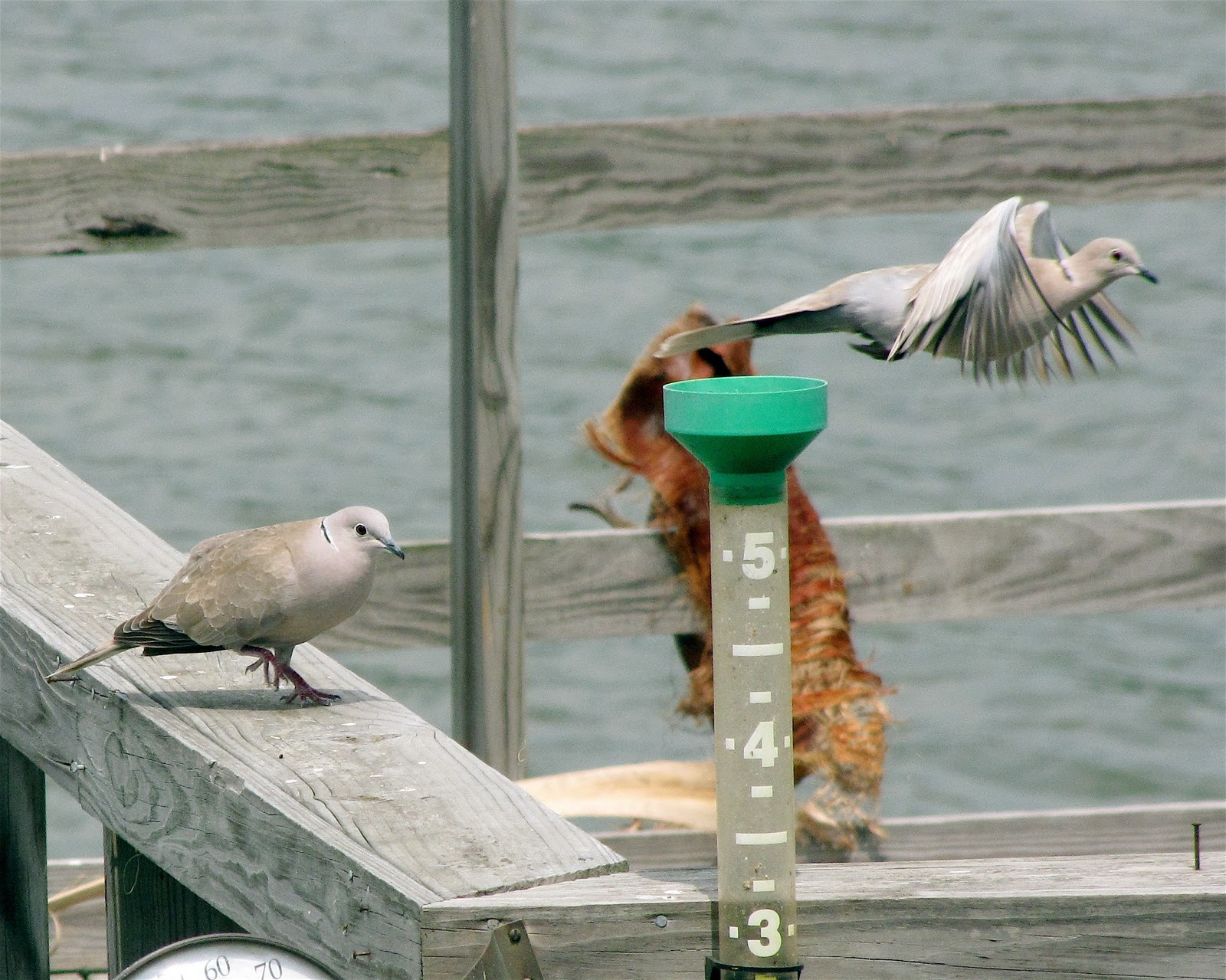
Here's a series of photos of Eurasian Collared Doves getting to know each other on top of the boat dock.  At least the male would like to get acquainted.  That's him in the back (I presume), pursuing the lovely lady in the lead. She is keeping an eye on him though she continues stepping out.


She walks on--- but knowing she's aware of him behind her, he begins a kind of nodding, bowing dance.  


Maybe he gets just too forward for her sense of propriety---and she flies away.

Eurasian Collared-doves are, as the name implies, not native to the United States, having been introduced from Europe---but their range here in South Texas is rapidly expanding.  I had never seen one before 2002 when I saw three near the high school parking lot where I taught in Rio Hondo (about 12 miles from here).  Since then, they have spread to Arroyo City and are now nesting in the neighborhood.  I will keep an eye on this couple and hope to find a nest.  This is just one of several species of doves that frequent the yard:  Inca Doves, Common Ground Doves, White-winged Doves, Mourning Doves, and White-tipped Doves are also common and year-round residents.

One more "couple" piqued my paparazzi-like interest today.  I put a few orange halves on the front deck this afternoon and immediately attracted a pair of  Golden-fronted Woodpeckers.  The male is on the left, distinguished by the red patch on his crown as well as gold on the nape and forehead.  The female on the right lacks the red on the crown.  They are similar to the Red-bellied Woodpeckers I remember from my Oklahoma childhood.


Golden-fronted Woodpeckers nest in the yard every year.  They are the excavators of about a dozen holes in two dead cottonwood trees that the former next-door neighbor cut down to about fifteen-twenty feet, forming condominiums for starlings, woodpeckers, and titmice.  Until the dead trees proved so enticing, the woodpeckers used to make holes in our house, pull out the insulation, and build nests in the walls.  We tried to discourage this, of course, but they were persistent.  For a few years we lured them to nest boxes.  Finally,  we patched the holes in our house, beat on the walls when we heard the birds, and hoped that they would stick to the cottonwoods.  So far it has worked.  Last week, for insurance,  we also put up a new nest box in the back yard where an old one had, like the owl box, been taken over by bees.

Now that I am retired, I can spend all the time I wish exploring the nature in  our yard and writing about what I see.  The yard is not really very big, just about a third of an acre,  deeper than it is wide, but it's a fascinating place.    Blogging gives me a chance to keep records of my observations.  Today, reading Thoreau's journals, I found this entry for April 7, 1853.  It says just what I've been thinking:

"If you make the least correct observation of nature this year, you will have occasion to repeat it with illustrations the next, and the season and life itself is prolonged."

I wonder what Thoreau would think of nature blogging.  He could take a laptop to his cabin at Walden pond, but I don't know where he'd plug it in.