Welcome to my world!

Backyard Birding in the Rio Grande Valley of South Texas:
Surrounded by great birding destinations, our favorite patch is still the backyard (or the front), where we've seen more than 270 species of birds. Sit awhile, and watch the river and yard with us!


Sunday, October 3, 2010

Color an Osprey Sky

Finally, it is autumn on the Arroyo Colorado.

We really do have four seasons, though first-time visitors sometimes think it's just one long summer.  (I thought so, too, that first disorienting year we were here, twenty-one years ago.)  The leaves of only a few trees change color. Our Rio Grande Ash, for example, sheds yellow leaves sometime after Thanksgiving and is budding by Valentines' day, and Mesquites sprinkle leaves on the ground in a windy cold front--here one day and gone the next. Many of the trees keep leaves all year; flowering shrubs and wildflowers bloom almost continually.

But small things mean a lot here, and for that reason I like the subtly changing seasons, and especially autumn when that first "cool" day is such a relief.  


That first hint of coolness crept in this week.  Tuesday morning we awoke to low humidity and temperatures in the 60's!  One step onto the back porch reminded me that it was autumn indeed, not just on the calendar.  A familiar bird call made me look up:  against the clear cool blue sky, an osprey glided over the river, home from his northern summer.  Our autumn and winter skies are seldom without an osprey and his loud whistle as he soared was musical and welcome. 
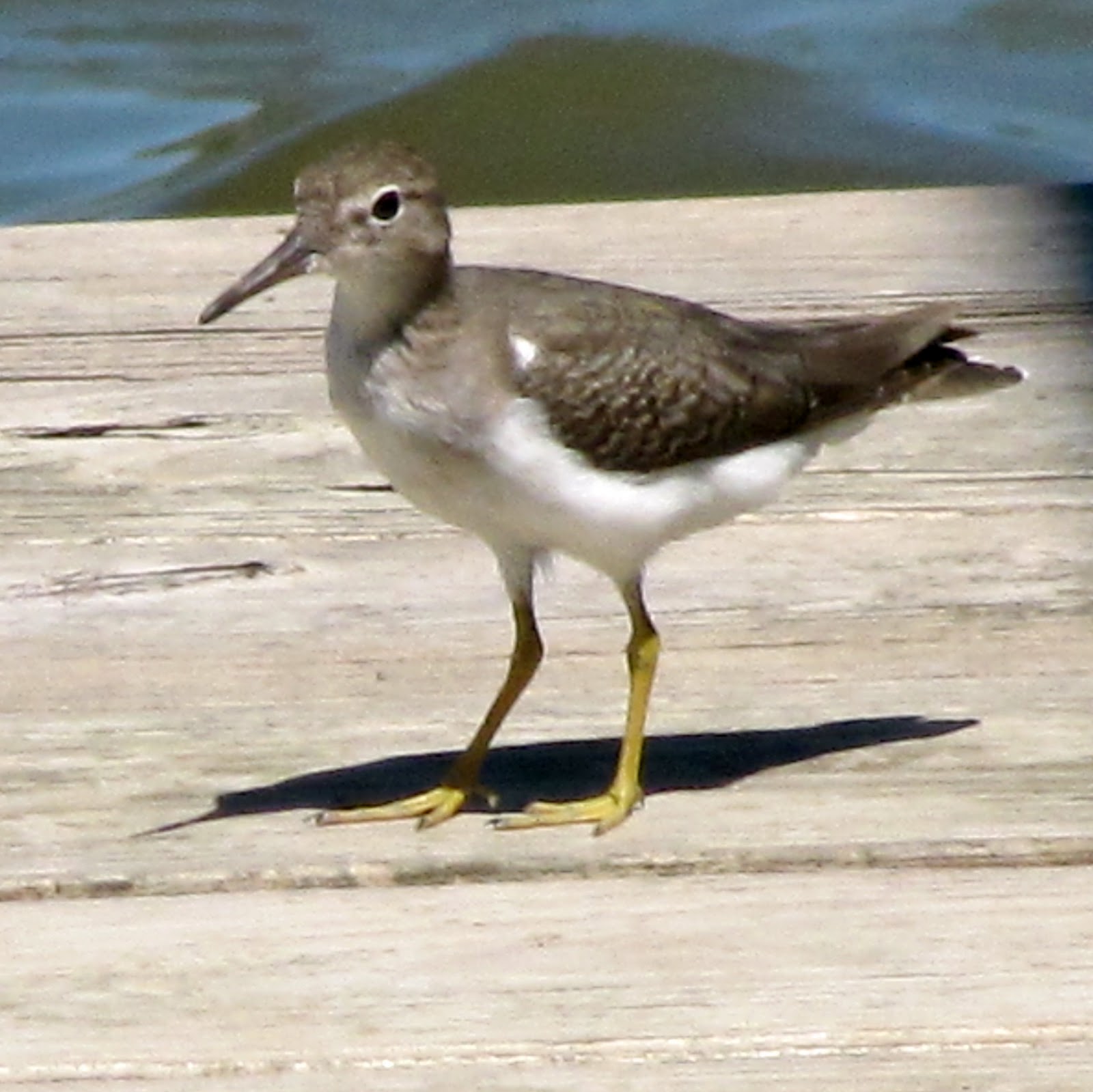
Ospreys are not the only birds above the river these days.  Cattle Egrets fly low over the water, especially in the evenings;  small shore birds fly with short direct wing beats,  moving too quickly to identify.   (An occasional Spotted Sandpiper stops to teeter-totter along the dock, the slower movement making him just about the only sandpiper I can ID for sure.  Here's one that stopped by yesterday. His spots are gone, another sign that autumn is here.)


Long lines of larger shore birds are also a sign of fall.  I haven't seen returning ducks or geese yet, and the White Pelicans are still up north, but today a line of dark ibises flew by, silhouetted against another blue blue sky. 


White-faced Ibises fly in groups of all-dark birds, not the mixed dark and light of the White Ibises with their darker juveniles.  The sky in this picture is lovely. When I saw this photo, and the Osprey sky above,  I  starting wondering just what shade of blue "Sky Blue" would be on one of those little  wheels or cards that paint companies display at building supply stores. I can't pass by that aisle in Lowe's without browsing through the color palettes.

Because color intrigues me,  one of my favorite  Iphone apps is Sherwin-Williams'  "Color Snap."  You can snap a picture with your Iphone, or use a photo you have already saved, and learn what Sherwin-Williams paint color a certain area of the photo matches.  Now, of course, I know that photos vary from printer to printer and the world has many more colors than a computer or camera has, but let's forget all that and pretend that a sky really can be matched through a photo to a paint chip.  According to my Iphone app, the Osprey sky and Ibis sky are both Danube, color # 6803.  Or at least the upper right part of the Osprey sky is Danube.  The bottom left is Jacaranda, #6802 and the part that is covered with wispy clouds just above the Osprey is Notable Hue, #6521.  Certainly it is notable as well as beautiful.  I may just paint the ceiling of  my porch Danube or Jacaranda or Notable Hue.

Okay, this is getting fun.  I'm sending photos via email from my computer to my phone and color-snapping away.  I tried this photo of a Tropical Kingbird that perched on a palm tree in the yard.  Yesterday I snapped a dozen pictures, marveling at the clear colors in the cool morning, and now I am curious about labels for those colors.  (In another life maybe I'll be one of those people who make up color names for paint companies.)

 Again, the sky is Jacaranda.  The lovely shade of yellow on the  kingbird's breast is part Jonquil and part Daisy.


Here's another colorful photo.  The butterfly is a Two-banded Flasher, its back appropriately labeled Flyway on the color chart.  The butterfly is like one my neighbor  carried over from the Esperanza shrub between our houses.  It flew away before I answered the door, but when we returned to the Esperanza, others were there along with  three different species of long-tailed butterflies.


This Flasher looks stunning on the yellow petals of the Turnera diffusa (Mexican Damiana), a small shrub  that blooms randomly along the walkway, wherever it can find a patch of sun, and folds its petals as dusk approaches.

Below is a  Long-tailed Skipper sporting a lovely shade of green (Rook Wood Dark Green) that nicely complements its brown wings (Rock Garden).


My handy Color-Snap app would identify complementary colors for any color in my palette, but I think Nature does the best job of that.  What could be more complementary than the yellow hues of the kingbird's breast against the blue of the sky,  or the blue of the flasher against the bright blossoms of the Turnera?  I'm inspired to paint my porch ceiling Jacaranda and my porch swing Daisy--a lovely combination.  Nature is a pretty good exterior decorator.


My last post (a month ago! I apologize for being lazy about writing) chronicled the abundance of late summer in the yard.  I thought then the hummers were thick around our feeders and nectar plants, but this first week in October seems the height of their migration. We have mostly Ruby-throated with a few Black-chinned and the resident Buff-bellied Hummingbirds. 


The colors of these hummers look washed out in the photo because it was late in the day, and I used a flash, which disturbed the hungry little birds not a bit.  They ravenously drink the feeder dry in just a day and a half.  All of these are female or immature Ruby-throated Hummingbirds.  I haven't seen an adult male for a couple of weeks.  I'm reminded of Emily Dickinson's description of the fleeting brilliance of a hummingbird: 

 A Route of Evanescence
 With a revolving Wheel --
 A Resonance of Emerald --
A Rush of Cochineal --


 I just checked Color Snap to see if Sherwin-Williams uses Emily's labels for their colors (by chance, of course).  But no, the hummer's throat is Vermillion, not Cochineal. (Another wonderful color, vermillion:  I'm anxiously awaiting the return of our winter Vermillion Flycatchers. I'll let you know if a photo of the male matches S-W's vermillion.)

Out of curiosity, I just looked up cochineal on the web.  I knew it denoted red, another word for carmine.  What I didn't know is that it is a red made from natural dyes created from smashed up cochineal bugs!   The tiny bugs live on nopal prickly pear cacti.  In the fifteenth century the dye was extremely valuable, second only to silver as the most valuable export from Mexico. (I'm pretty sure we have those little bugs here in the Rio Grande Valley.  I'll have to check with a bug expert.)

Once again, Emily Dickinson has chosen a perfect word to describe the ruby throat of the hummingbird, accurate in color and connoting a sense of treasure as well.  The photo here does not begin to show the glittering iridescence of its ruby throat, but Dickinson's poem almost does.

Finally, here's a photo that I think captures the color of one tiny bit of the yard.  I won't even try to label its colors with Sherwin-Williams' clever marketing tool.  Indeed, the colors may exist only in my mind. You may not see them as I do.  What I'm trying to say, as I look at this perfect bee, is what I think Emily Dickinson means in another brief but memorable poem:

To make a prairie it takes a clover and one bee,---
One clover, and a bee,
And revery.
The revery alone will do
If bees are few.

This bee and fiddlewood are not of the prairie, but are a small corner of  what botanists call the Arroyo Colorado brush.  Like Emily's prairie,  I can "make" the brush in my mind by evoking the colors of the golden-winged honey bee and the green/white petals of the native fiddlewood.  I can snap photos and look at the brush from my deck if I'm here--but if I'm away from home, I can make a little patch of South Texas brushland and the Arroyo Colorado with the colors in my mind.  Reverie will do.

*********************

I wrote this entry a week ago and then forgot to post it, but  I'll go ahead and date it as though I posted it then.  The weather continues to be lovely and the skies are just as blue. Hummers have decreased in number but still swarm the nectar a dozen or so at a time, competing with bees and each other. 


The Arroyo Colorado Audubon Society had its "Big Sit!" here on Sunday and counted 86 species of birds, including some I hadn't yet seen this fall--Merlins, Kestrels, Gray Catbird, White Pelicans to name a few.  I'll write about the Big Sit later.  Right now I hear  the unmistakable call of an osprey.  I am going right out to sit in a lawn chair under the blue (Jacaranda or perhaps Danube) Osprey sky!

Wednesday, September 1, 2010

Increase

Late summer is a time of abundance.  Where there were two or three Green Jays at the feeders, there are now six.  Where there were a few butterflies basking in the sun or flitting from lantana to plumbago,  there are now dozens.  Four Kiskadees have become eight; eight White-winged Doves have become sixteen. One or two Buff-bellied Hummingbirds at a feeder have become a swarm of Ruby-throated migrants buzzing like bees around any available nectar.


A few days ago I heard a distinctive Green Jay racket. Out on the fishing dock, a family of six of these bright, cheerful, and noisy natives of South Texas lined up on the railing. Four of them were probably newly fledged; all were excited.  Ruffling their feathers and bobbing up and down in a funny dance, they were belting out the  strangest clicks and whistles.

I love these birds and never tire of watching their noisy antics.  When they fly into a tree, they alight on a low branch and hop their way to the top.  Though I don't put out their seed at regular times, they always discover it within about five minutes. With the sudden increase from two to six jays, I'll have to increase my supply of corn, peanuts, and bird seed.

Migrants  that disappeared in late spring are back as fall migrants, bookending summer with bright color and enlivening what had become a very lazy time in the yard.


Black and White Warblers, Yellow Warblers, Prothonatary Warblers, Hooded Warblers, and Canada Warblers began visiting oak trees and bird baths last week.  Summer Tanagers and Indigo Buntings added a splash of color as did migrant Baltimore and Bullock's Orioles that joined the summering Hooded Orioles and native Altamira Orioles. Though not as brightly colored in fall as in spring, these are still pretty spectacular birds. 

A little empidonax flycatcher entertained me all one afternoon catching small insects above the driveway.  I usually don't presume to distinguish between Willow and Alder Flycatchers, identifying them all as just Traill's Flycatchers, the name these two almost identical birds used to be called, but this guy sang and called a number of times, giving me a definitive clue.  Consulting the voice recordings on the Ibird Explorer Pro app of my Iphone, I'm pretty sure this was a Willow Flycatcher.  Its mostly three-syllable song and whit call  was convincing to me, anyway.  For a while earlier in the day, I had wanted to say Yellow-bellied Flycatcher, but the lack of distinct eye ring made me decide this was a Traill's with a lot of color. 


Tropical Kingbirds have been singing in the backyard.  They fly from across the arroyo in the early mornings and announce their identity with song.  The otherwise identical Couch's Kingbirds are more often in the front yard where they nested earlier in the summer.  These look-alikes are native residents unlike the Eastern and Western Kingbirds that have been migrating through.  Great Crested Flycatchers (right) are similar to the Couch's/Tropical Kingbirds and in some ways to the  Brown-crested Flycatchers but with a deeper yellow belly and more rusty color on their tails.  There's an abundance of the latter this week, probably birds that nested farther north as well as our yard nesters.


Meanwhile, a little  Screech-owl sat unperturbed in the pine tree, enduring constant scolding by what seemed like a treeful of wrens and titmice.
I think even the person least inclined to anthropomorphism would call this a "wise old owl."  Or at least a curious and patient one.

Birds and bird activity are not the only increase in the yard.  Butterflies are thick among trees, shrubs and flowers; and blooms are abundant even as rain diminishes.  These three Giant Swallowtails were in a lineup of ten on a  fiddlewood shrub.  I would have needed a wide lens to get all the rest of them in the picture!


Another illustration of burgeoning life around the yard can be seen in the photos above of a Queen butterfly and a Queen caterpillar, both on milkweed plants.  Look closely--do you see what I am talking about? It's not the butterfly or the caterpillar.   That's right--the tiny round white specks are eggs! Click on the photos to enlarge them if you can't find the eggs. 

 I've cropped and enlarged this photo so that you can see the egg better.   The eggs are actually ridged, something my maturing eyes can't tell,  but the photo shows.  This one was on a yellow milkweed (butterfly weed) that is not native to south Texas but it grows well here and spreads easily from seeds that burst out of pods, and with the help of silky white filaments, float on the wind until they lodge in another garden or roadside. 

I have taken many, many butterfly photos in the last couple of weeks and then spent hours looking over guide books trying to identify them.  I used to classify butterflies in such categories as "yellow ones" "white ones" and "little skipperly things."  Now with the help of my camera and guide book (I like Kaufman's because of the maps and indication of size) I'm doing a better job, but my learning curve is slow.  A camera really helps me identify these guys, as it does with other insects and dragonflies.  I think my next blog will be devoted to the various butterflies and dragonflies I've been able to put a label on.


Speaking of increase (and also of insects), I have more photos of the spider I blogged about yesterday.  In the late afternoon sun, it is obvious why this spider is called a Silver Argiope. Notice that the little mate I worried about yesterday was back today, snuggled closer.  I laugh whenever I see this unlikely pair.   There I go anthropomorphizing again. 

Our population of Silver Argiopes has doubled:  today I found another one not far from the first.  Its web is also on the side of the house but separated from the other by a bump-out for the water heater.  This spider is only about half the size of the first one and not so spectacular.

But isn't the shadow cast by this smaller Argiope amazing?  Though the web's stabilimentum (zigzaggy web things) can't be seen well on the web, they are obvious in the shadow.

I'll keep watching these fascinating spiders and learning more about them.  And about the other creatures around the yard.  What's really increasing is my attention.   I'm sure the spiders have always been here.

Tuesday, August 31, 2010

August Web

If I don't post this within the next twenty minutes or so, there will be no yard report for August.  I resolved on January 1 to keep track of what's in the yard by keeping up with this blog, but here in the midst of summer  I am way behind.

Luckily (or not) there hasn't been much that's new going on in the yard this month.  That is, until about a week ago.  A cool front changed the wind from south to north and dropped high temperatures from 100 to 95 (that is a cool front in Texas in August), bringing migrant birds to feeders and drippers and sending me outside with my camera.  Tomorrow I'll describe the bird life and post some photos.  (Or maybe I shouldn't be too quick to say I'll do it tomorrow! A month ago I would not have said I'd be lazy all month. Or that my computer would crash again.)

For tonight, I'll post just one of the photographs I've snapped this week.  It's not even of a bird, but it may be one of my all-time favorites.

Just outside my bedroom window lives this magnificent spider.  What catches my attention first is not only the size (at least two inches) and coloring and pattern of this spider, but  the really cool web.  See those zigzags radiating from the exact spot where she places each leg?  I think the spider must think positioning herself right in the center of this pattern of four zigzags makes her look even bigger! The white zigzags are called stabilimentum, I've found out, and there are several theories as to their function.  Catching my attention (if I were a bird that might fly right through) and looking scary are two of them.


Not knowing much about spiders, I looked this one up on the web.  I googled "zigzag web spider" and immediately learned it was in the genus argiope.  Some call it the St. Andrew's Cross Spider because of the zigzags forming a St. Andrews Cross (an X like on the flag of Scotland)  in the center of the web.

I'm not absolutely sure what species this is, but I think it is argiope argentata, the Silver Garden Spider.  Looking at the photos I can find on the web (pun!) I also think it could be argiope blanda, another spider found in deep south Texas.  I have only one photo of his flip side, taken with my iphone and not real clear but it doesn't really look like the pictures I found of the Silver spider.  I'm still investigating.  If anyone out there knows, please let me know!

(That little guy just above her in the photo is the male--she doesn't have to do much to scare him, I'll bet!  He disappeared yesterday.  I fear for him. Is it true that the female sometimes eats the male after mating?)

Two minutes before September!  I'll post this web to the web and wait until tomorrow for a more comprehensive report.

Thursday, July 29, 2010

Dog Days of Summer


Our neighbor's metal roof looks way too hot for a perch, but this Black-crowned Night Heron doesn't seem to mind.  He perched there this morning, resting lazily on one foot,  as the sun crept higher and higher, hotter and hotter,  in the late July sky.  Taken through the window that overlooks the Arroyo, this photo of the night heron is one of the few I've snapped lately.  It's just too hot to wander around the yard.  If I go out early, camera in hand, the lens fogs up.  If I wait a while, the heat is stifling, the humidity is oppressive, and the mosquitoes are unbearable.

Looking out the window from an air conditioned house, though, the weather is just fine.  I've arranged furniture so that the most comfy seats face the views of the river and the bank beyond. Binoculars and scope are within reach.  A rocking chair sits right next to one of the two six-by-six windows.  From it I can peer down on feeders and baths and the butterfly garden.

Six tiny Black-crested Titmice (maybe the family that lived in the cow-skull nest cavity?) and three Carolina Wrens twitter in the Live Oak tree outside the window. Energetic and active, they flitter among leaves lit by the the sun, making me feel especially lazy and lethargic by contrast.  If I step out on the porch, I can hear a Chachalaca chorus, reminding me always of summer days, and two Inca Doves calling whirlpool! whirlpool! from opposite sides of the Arroyo.  (If I step outside on the porch, I remember the heat and return to my rocking chair!)
No wonder July has passed without my posting to my blog since the first day of the month--I have scarcely moved from the rocking chair!


These are indeed the Dog Days of Summer, those days so long and languorous.

The ancient Greeks called these long hot summer days "Dog Days," because that was when Sirius, the "Dog Star," rose in the sky each day just as the sun rose. Of course, we can't see Sirius presiding over the hours after sunrise, but the ancients felt the dog star influenced the days from July through August, bringing the scorching  weather.

Sirius, the brightest star we see in the sky (other than the sun), is part of one of the few constellations I can actually identify: Canis Majoris, the Big Dog.   It's near (well, in relative terms) my favorite constellation, the hunter Orion whose  three aligned stars form a very recognizable "belt."  Canis Major is the group of stars that  the belt of Orion seems to "point" to.  The photo at left above (not taken by me, borrowed from the the internet) is of Canis Majoris. Can you see a dog there?  I really can't either (the ancients had a better imagination, I guess) but I can certainly see Sirius. In the winter months, the dog constellations (there's also a Little Dog hunting with Orion) will be  in the night sky and can be seen easily.


Dog Days have arrived at the Arroyo Colorado in more than one way:   we've just adopted two canis minor of our own.  Rescued from puppy mills in Missouri and Arkansas, they needed a good home -- so we brought them home to Texas a couple of weeks ago.  We think they are perfectly adorable. 

That's where our July has gone, to the dogs!

Really, we've been out of town for at least half of the month. We visited our Missouri granddaughters who turned seven years old early in the month.  Then our five Texas grandchildren came here for a visit.  The three boys spent lots of time fishing. The girls, their mother, and I stayed inside, trying to stay cool.

The river was still quite muddy from upriver flooding caused by the hurricane rains in Mexico, so fishing from the dock was not successful.  But they caught lots of redfish in the bay.  Here's the group leaving from our dock early one morning. Notice how high the water is--no walking space for herons and egrets along the banks--and how green the unusually large amount of moisture has caused the bankside to be. 

Here's a very happy fisherman with his grandpop. Mitchell is the youngest of the three boys, but on this trip he was the champion fisherman. This is the smallest of the redfish he caught out in the bay.

The guys had a great time fishing in the Laguna Madre where water was deep (four feet is deep for the bay!) but relatively clear. One day they caught 172.5 inches of reds and a couple of small trout as well!

At high tide, wakes from boats splashed water over the dock or pushed it up from below so that it looked like the fountains of Bellagio!  Four weeks after the hurricane, we are still feeling its effects as flood water drains from a dam far upriver on the Rio Grande.

Here the fishermen jump over the fountains of water pushed up from beneath the dock. Water is still being released from Falcon dam on the Rio Grande, and as it makes its way to us (the arroyo is a floodway of the Rio Grande) it is very muddy and filled with debris--but fun for boys on vacation at Grammy and Papa's house. 

A birding highlight was a Great Horned Owl that flew from a palm tree at dusk after Grammy called "hoo hoo hu hoo." (A favorite children's book of my grandchildren is Jane Yolen's Owl Moon in which a child goes "owling" at night with his dad.)  During the day Green Jays and Cardinals brightened the window feeders. Out in the bay Roseate Spoonbills and Reddish Egrets winged their way from rookeries to feeding flats and back to rookeries again.

An eating highlight was Pirate's Landing in Port Isabel, with windows that overlook the causeway to South Padre Island.  Sadie and her siblings looked jaunty in their pirate hats.  Caleb, Spencer, and Mitchell ate fish that was good, but not as good as the redfish their dad would cook for them later, a delicious reminder of a great fishing day. 


We always have a great time with our family, but this visit may have been the best ever.

 Dog Days of summer on the Arroyo Colorado are days to remember.


Or to dream about for the rest of the year.

Thursday, July 1, 2010

After the Storm

I'll start out with the good news:  the storm is over and bird-watching along the river is good.   The storm surge made the river itself very full, especially at high tide.  With nowhere to stand,  wading birds flew by in a steady parade: Roseate Spoonbills, Green Herons, Great Blue Herons, White and Snowy Egrets, Tri-colored Herons, Reddish Egrets.  Black-crowned Night Herons perched in trees. Several kinds of terns cruised the river and sometimes swooped low to scoop up a fish:  Least, Caspian, Royal, Forster's, even a Black Tern or two. Brown Pelicans fished and Laughing Gulls stole their catch.    
But the Star of the day was a bird I had never seen from our yard--one I  see infrequently in the bay:  the magnificent Magnificent Frigate Bird. An adult female flew fairly low (for a frigate bird) over the river as I watched from the porch.  Strangely, I was expecting it.  I told myself I wanted to see one today, went out on the back porch, and twenty minutes later there it was!  (I've had these intuitions before:  see the post "No Sooner Said..." for one example.) 
The photo I managed was from far away (I was looking the other way when it first passed the yard and I had to run down the stairs for a clear shot), but it is clearly a magnificent bird, number 262 on our Yard List!

Hurricane Alex, after drawing a bull's-eye on us for a few hours Tuesday, moved its course to the south and went into Mexico instead of South Texas.  Outer bands of rain and wind hit us yesterday, but the wind never blew here stronger than 60 mph and the rain in our area was less than four inches.  I was relieved that there was no damage to our "nest"--but some of the birds were not so lucky.

The Brown-crested Flycatchers may have lost their chicks.  Early this morning I saw them near the nest site in the cottonwood stump, just sitting.  Not rushing in and out of the nest with bugs.  Not singing as they do when waiting for their mate to vacate the nest. Later I walked over to the old cottonwood and for the first time could see nest material hanging out of the stump as though they had pulled some of it out.  Though "hope is the thing with feathers," as Emily Dickinson says, I'm not too hopeful about the nestlings.

A neighbor told me that she found a Great-tailed Grackle's nest with two dead nestlings in her driveway.  This morning I looked at the retama tree where I had photographed a grackle nest a couple of weeks ago, but the nest was gone.  It was probably the one that blew into the driveway next door.

The Kiskadees were also unlucky. In the last post is a photo I took a few days ago of the nest in an ebony tree.  Today, it looks like this. The main part of the nest is half the size it was and the blown-away part is lodged in a fork of the tree a couple of feet below it.

The wind blew all day yesterday, first from the north as we were catching bands of the storm circling counterclockwise around the center of the hurricane, and then from the east as the outer bands north of the storm accompanied it to land.


The good news from the yard is that the little mockingbird I talked about in the last post apparently survived the gale.  I saw two juveniles near the nest today. I was so glad to see the survivors that  I snapped a picture though the light was not good enough to get a good photo.  Notice the speckled breast:  that's how I know this bird is a juvenile.

Watching the young mockingbird battle the storm as the hurricane's winds began on Tuesday, I kept thinking of Emily Dickinson's poem about hope and the storm.  (I didn't quote it in the last post because I suspected I might do too much of that, but now I'm thinking, why not?  I taught literature for over thirty years and old habits are hard to break!)

"Hope" is the thing with feathers—
That perches in the soul—
And sings the tune without the words—
And never stops—at all—

And sweetest—in the Gale—is heard—
And sore must be the storm—
That could abash the little Bird
That kept so many warm—

I've heard it in the chillest land—
And on the strangest Sea—
Yet, never, in Extremity,
It asked a crumb—of Me.

I keep disagreeing (at least in part) with Emily Dickinson even though I love her poetry.   She seems to say that hope doesn't ask anything of us.  If she means that hope exists in the world despite all the things we humans seem to do to defeat it, I guess she's got a point there.  But at the same time I think we need to sprinkle a few crumbs for that bird to eat!

I keep thinking of those birds in the eye of the man-made storm in the Gulf of Mexico.  We can't do anything about hurricanes but we can take care, as best we can, of the natural world. If hope is the thing with feathers what are we doing to deserve hope?