Welcome to my world!

Backyard Birding in the Rio Grande Valley of South Texas:
Surrounded by great birding destinations, our favorite patch is still the backyard (or the front), where we've seen more than 270 species of birds. Sit awhile, and watch the river and yard with us!


Thursday, December 1, 2011

Good Morning, December!


Sometimes I'm lucky enough to get a photo that captures a special moment just right.  This morning I was up at dawn doing a little window birding.  As the sun rose, bathing the river in a pinkish-golden glow, a gull  landed right in front of the dock and quickly scooped up a mullet. As it struggled to eat its prey,  captured sunlight gleamed from the underside of the gull's wings, reflecting the morning's light onto the ripples of its landing.

I didn't post to the blog during all of November, not because there wasn't fabulous birding here in the yard and elsewhere.  In fact, it was probably because there was.  We've added new yard birds for the year and for the life of the yard.  We experienced another great Rio Grande Birding Festival.  We saw life birds on short trips up the Valley.

I'll blog about all those this weekend in a November retrospective. But for now, enjoy this December morning's photos that capture sunrise on the Arroyo Colorado as viewed from my window.

Tuesday, October 25, 2011

Autumn in South Texas

Sometimes I take a picture that isn't really good photographically-speaking, but that I like so much I keep looking at it.  This is one of those.  It's of a late-season warbler--Yellow, I suppose, but in autumn Peterson's references to "Confusing Fall Warblers" still paralyze me.

I was adjusting a hose that dripped into a new water feature I had pieced together out of spare parts when this little guy flittered into the water about six feet from me.  I sat down and watched, snapping pictures.

What I like about the photo above is what makes it less than perfect--the focus is fuzzy, especially on the wings.  But when the bird was in the water, my eyes certainly couldn't focus on such fast-moving, flittery wings.  One foot is focused and one is not: he was shifting his weight like an excited child playing in a fountain.  So that is the wallpaper on my laptop right now:  a warbler looking precisely like it did for a while to my aging eyes on a really nice autumn afternoon.


Although it is still hot in the afternoons, temperatures usually reaching 90 or above, the birds finally know it's autumn even if we have trouble remembering this far south what autumn means to most of the country.
Wintering warblers such as Yellow-throated, Orange-crowned, and Black-throated Green (above) have arrived.  An early (and rarer) Townsend's spent a couple of days.
Ruby-crowned Kinglets (cheerfully busy little winter birds that, like warblers, don't generally pose for  pictures) seemed to fill the oak trees after a mild front blew in last week.
Indigo Buntings (which have been a little late showing up, not even appearing for the Big Sit) are here in fairly large numbers.  Some will stay the winter but most are already moving on.

Wintering sparrows have returned as well. 


 A Lincoln's sparrow enjoyed the new solar fountain.

Another sign of autumn here in the Rio Grande Valley are migrating Monarch butterflies, a few of which are passing through now on their way to Mexico.  This picture, like the one of the Yellow Warbler in the bath, shows unfocused wings that are fluttering too fast for my point-and-shoot camera.  I like the way the motion shows in the photographs. 


But the surest sign of autumn is the music that filled the air early yesterday morning, and again today, a rolling, liquid sound that I could hear even inside, even when the windows were shut and the air-conditioner was on--Sandhill Cranes in the hundreds calling as they returned to the warmth of south Texas, calling me outside to enjoy our version of autumn.


 This photo is also less than perfect--much less--but that's okay. The sun was just lighting a perfect fall morning, south Texas style, and hundreds of Sandhills filled the skies in waves of V's that just kept coming.   We may not have autumn leaves or even cool temperatures, but we do have subtle changes that are just as cherished.

Postscript:  Next Morning-- Again the waves of Sandhills called me outside. This time I made a video.

Friday, October 14, 2011

Sitting Pretty in the Rio Grande Valley

Midnight on the Arroyo:  night-hawks swooping,  pauraques calling, 
Eastern Screech-owls,  Barn Owls, and Great Horned Owls
can be heard and sometimes seen in the night yard. 
skimmers skimming; three species of owls, two of night-herons.  Our Big Sit day was still night when I started tallying species from the upstairs back porch that was within our 17-foot circle.  The river glowed from full-moonlight and fishing lights focused on its almost-still surface,  providing just enough illumination to begin the count.

Every October, teams of birders gather at favorite birding spots to count the number of species seen or heard from a 17-foot circle in a 24-hour period, midnight to midnight. Most wait for daylight, but I always like to get a headstart since I'm sitting at my own window.

Rules for a Big Sit are easy:  sit or stand in a 17-foot circle and count the different bird species you see. You can leave the circle and come back, but you count only those birds you see from the circle.  The trick to a high count is to draw your circle near a variety of habitats, where you have clear view of sky, brush, and water and where man-made or natural habitats draw birds close enough to identify and mark on your list.
The Arroyo Colorado Audubon Society team tallied species again this year in my favorite place, our yard on the Arroyo Colorado.  We were hoping to beat last year’s count of 86 species.  (I know the Sit, sponsored by Birder's Digest,  is billed as “noncompetitive,” but you really can’t take the competition out of birding, even if you’re only competing with yourself.  Or with the birding group 40 miles upriver at Estero Llano Grande State Park—who beat us last year by one bird.)

I like to start a Big Sit at midnight, not just because I’m competitive (really, I’m not) but also because it’s one of the loveliest times for birding along the Arroyo. As soon as I step onto the porch, I hear Great Horned Owls hoo hoo-ing from one side of the yard to the other.  I hear Screech Owls trill and Pauraques pu-wheeer!-- a circle of sound that seems visible.

As I watched the night river,  Black Skimmers flew buoyantly just over the water’s surface, wingbeats steady, dipping down  to skim the surface with a long lower mandible.  The glow of the river illuminated the birds' silver-white breasts and underwing while the dark back and upper wings faded into the dark. 

Across the river, barely visible unless I use binoculars to gather what light there is, a juvenile Yellow-crowned Night-heron peered from a low branch at the river’s edge. Longish legs and neck stretched toward the water, distinguishing it from  the more numerous juvenile Black-crowned Night Herons that fished nearby. The crisp black and white of  adult Black-crowned Night Herons stood out starkly against the shades of gray that blurred the river and bank.

Black-crowned Night Heron
Not far from a wading Great Blue Heron, a small white heron fished alone, a juvenile Little Blue: its feet not the gold of a Snowy Egret’s (which even in this gray world of the nighttime river bank would appear a lighter shade against the dark legs), but the same grayish green as its legs.  Its beak was slim and pointed. I'd been looking for this  Little Blue Heron, which for a week had been fishing right there, usually just before and just after dark. I never know if the birds I see everyday before a Big Sit will appear on Big Sit day, but right on schedule this one showed.


By dawn, several other Arroyo Colorado Audubon Society members had arrived to join the Big Sit at the house, parking on the road and walking up the driveway past the bird baths and feeders that could be seen from the circle  through the open garage door. (No, I didn't stay up all night watching and listening, but I was up by 6:30 to greet more sitters and morning birds.)

Looking opposite the drive to the back yard, some of the Big Sitters kept an eye on the fence line across the river, a favorite perching place for many kinds of birds. Among the avian sitters were a Blue Grosbeak,  Lark Sparrow, Groove-billed Anis, Red-Shouldered Hawk, Turkey Vultures, and a Ringed Kingfisher.


Getting a good count on Big Sit day sometimes depends on the weather, both on that day and for the previous week or so.  For example, last year ducks, geese,  Sandhill Cranes, and White Pelicans were already flying over the yard by the 2nd week of October.  This year the hot weather seems to have delayed them a bit.  Only the resident Black-bellied Whistling Ducks and a small group of Blue-winged Teal showed up. (A week later, however,  I can hear geese flying over as I write this blog.)

On the day of  this year's Big Sit  the weather was varied, to say the least. It started out clear, but by mid-morning brief rain showers began alternating with sunny skies.   Despite intermittent rain, afternoon temps climbed into the mid 90's, where the thermometer had been every afternoon for weeks.  We were a little discouraged by then that our bird count was not climbing as well. 


Rain didn't keep migrating hummingbirds away from the feeder that hung just inside the circle.  Ruby-throated Hummingbirds (as well as a Rufous and Black-chinned) found the feeders even when it was raining. When skies turned blue again, the swarm just increased.  
  Buff-bellied hummers preferred native Turk's Cap. 


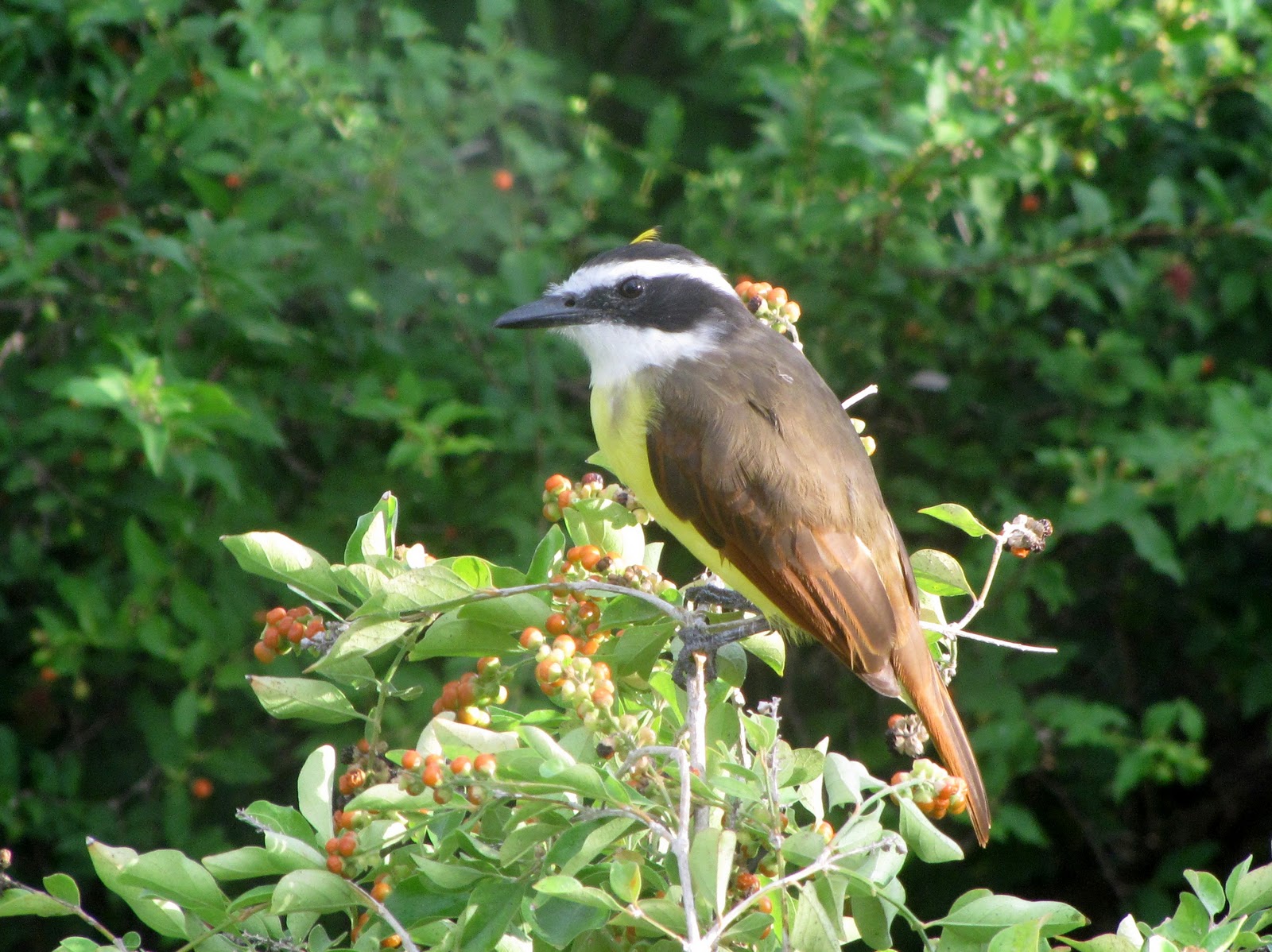
A berrying Fiddlewood just outside the circle was a magnet for warring Northern Kiskadees, mockingbirds, and kingbirds. (These birds have not learned to share.)  Both Long-billed and Curve-billed thrashers thrashed in the underbrush and sang from the trees.
Our most cooperative bird of the day was a Yellow-billed Cuckoo that posed and preened in a backyard Ash tree, spreading wings out to dry after a shower. (photo by Cheryle Beck)


A mid-afternoon thunderstorm cooled us down, but made it a little harder to see from the windows. By the time skies were blue again, the wind from the north, and temperatures in the high 70's, most sitters had gone home or on to another Big Sit.

Sitters left, but even more birds came out to enjoy the sun. This Ringed Kingfisher, sitting in a tree across the Arroyo, is just one of the three species of kingfishers that fished the river in the late afternoon after everyone else had gone home. Though this isn't a good photograph it is representative of the views we have on a big sit--far away but still exciting as we chase and twitch in the confines of a 17-foot circle.


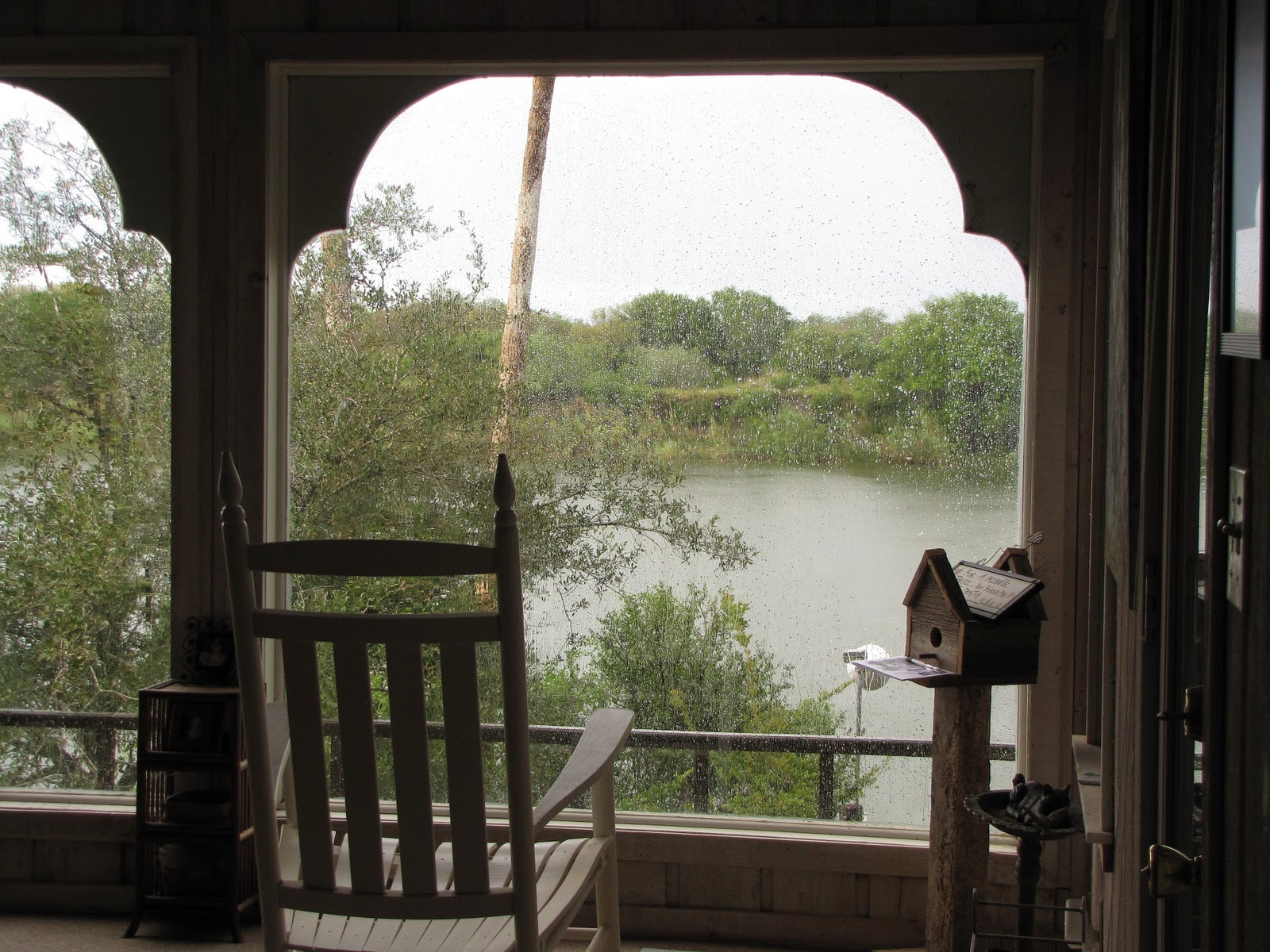
  I sat in the rocking chair and watched the river and sky til dark and beyond. What had started out a slow day ended with a higher count than any of our other years.  At the stroke of midnight our list had 91 species of birds.  The results are not all posted, but I think we'll be in the top ten again. Even without a Roseate Spoonbill or a Painted Bunting or some of the other birds we missed for the first time, we had a great time and ended with a good list.  If I'd never seen or heard another bird after the owls at midnight, those would be enough for me. 

The Arroyo Colorado Audubon Society birders have had our Big Sit in our yard three times previously:  in 2001 (82 species); 2002 (89 species); and last year (86).  All three years we have been among  the top ten sites in the nation.  We keep hoping to exceed 100 species--I know on a perfect day we could.  Some years we have ducks and shorebirds; some years more warblers.  Some years we have birders who are good at swallows or far-away fast-moving shorebirds headed for the bay; some years those seem to be nobody's specialties.   This year we ended with 91 species even without some common ones like Indigo Buntings or Tri-colored Herons or Pyrrhuloxias (all of those were here on the following day, of course). Next year I'll brush up on far away ducks and faster-than-the-eye-can-see swallows.  100 species isn't impossible.

The "Weslaco Red Crowns" team of  Big Sitters who were sitting up the Valley at Estero Llano Grande State Park (a World Birding Center site in Weslaco, Texas),  are our friendly rivals. In fact, our teams overlap as birders take part in both counts.  This year they beat us (in this noncompetitive competition) by eight for  99 species. 100 eluded them, too, but not by much.  Way to go, Red Crowns! If we could combine our lists, we'd beat 100 by at least a couple of dozen.

To me this proves what I already think:  the Lower Rio Grande Valley in Texas is the place to be if you love birds, birding, birders.  Whether you are at Estero Llano Grande or another state park, a city park, a national wildlife refuge, a World Birding Center satellite site, or someone's backyard--whether you are here in the morning, at noon, or at midnight--you will have a memorable trip if you come to the Valley.

Harlingen's Rio Grande Valley Birding Festival is now less than a month away. Chair Marci Fuller, President Danny Hoehne, and all the other leaders and workers of the RGV Bird Fest are working hard to make this 18th Annual event the best ever.  At this week's festival meeting we learned that registrations already exceed those of last year.   That's not surprising--the field trips, the seminars, the trade show, the speakers are almost as great as our birds.

 I attended the very first RGVBF eighteen ago and can't wait for this one. (The theme for this year's festival is The Big Year.  You'll see why if you scope out the website here. ) 


It's  not too late to register for the festival or to make travel arrangements. Anyone who loves birds or nature (or just great Tex-Mex food for that matter!) would love the Rio Grande Valley.  Day or night, standing or sitting, the birding is great and the listing is easy. If the weather is not sunny just wait awhile--and in the meanwhile you could sit by my window by the Arroyo Colorado. 

Monday, September 5, 2011

Fall Migration, Summer Heat

A hot south wind ruffled the feathers of the Osprey that perched on the rail of our dock yesterday morning.  The day started out hot and just got hotter, 106.9 degrees by mid afternoon. 

Still, it was a lovely day for yard birding. Determined to get out there and find some  birds despite the heat, I moved my lawn chair to the shade under a cedar elm and waited to see what would show up at the water drippers.

 I was rewarded with a two-vireo, four-warbler day, not bad for the hottest day of the summer.  This bright yellow beauty is a migrating Prothonotary Warbler.  We also had a couple of Kentucky Warblers, several Black and White Warblers, and one or two Canada Warblers.
This Red-eyed Vireo is probably a migrant, too.  I almost called it a Yellow-Green Vireo but the dark line at the edge of the gray cap made me say red-eyed though its eye didn't appear red.  Yellow-Greens do nest in the Valley, but although this is a bright one, with quite a bit of yellow, I still think that dark edge on the cap is distinctive. I could be wrong.
I heard the White-eyed Vireo several times before this one came to the oak tree just above the bath. It could be a migrant, but I am pretty sure they nest in the area.  I had one late in the spring and I have found small nests after breeding season that I am pretty sure are WEVI nests though I haven't seen any birds near them.

Butterflies are still a star attraction in the yard.  Yesterday morning I took a photo of this Pipevine Swallowtail visiting a milkweed vine.
Less than a minute after I took the photo above, a Couch's Kingbird alit on a wire overhead. I quickly focused my binocs on his prize.  A closer look let me know what he was having for breakfast.
The yard is filled with drama, even early in the morning.  Some of its inhabitants are not as lucky as others.  I don't know why this kingbird is not repelled by the reported bitter taste of the butterfly, but if you click to enlarge the picture, you can see that it is indeed the swallowtail.  I missed a picture of the capture by a few seconds--but the before-and-after photos tell the story.

A cool front this morning changed the wind from south to north and brought in relief from humidity. Today's temperature was a "cool" 95.  It's still hot but our autumn birds seem to pay more attention to the calendar than the thermometer. Migration has indeed started. 

Sunday, September 4, 2011

Slow

Blogging has slowed down here on the Arroyo Colorado.  I'm not taking as many photos. I'm not seeing as many birds.  Maybe it's the heat. 

This morning I thought I detected a milder morning.  The humidity seemed lower.  But by about 2:00 this afternoon, I looked at the thermometer and saw it was 101 degrees again.  Going outside for awhile to check for migrants, I found a waterthrush that tottered under the brush and then out of sight before I had decided whether it was a Northern or a Louisiana Waterthrush. 

Several Eastern Kingbirds, also migrants,   perched in the top of  a live oak tree next door. 

Kingbirds are among my favorite species, especially the Couch's and Tropicals that are here all year. I can't reliably tell them apart unless I hear them -- though the really bright yellow ones seem to be the Couch's which I see most frequently. The crisp black and white of the Eastern Kingbird makes it distinctive and cool-looking even in the heat.


Doves are always numerous at this time of year, but I think perhap  this year there are fewer than usual.  The drought has probably taken its toll.  Today I heard gunshot and the driveway was sprinkled with hunter's pellets when I was out. I hate that.  The houses are close together here along the river, and when a neighbor several houses to our east shoots doves from his yard, it rains birdshot here. I can hear it bouncing off our pickup and the next door neighbor's carport.  I've even felt it on my arms and legs as I sit on the deck. (If you are thinking this sounds really strange, remember we live in Texas. One year at the start of dove season I complained to the sheriff, but he just told me to stay inside my house until sunset when the shooting would stop.)
White-winged Doves, the hunter's favorite, is also mine--for very different reasons, of course.  I love the blue orbital ring and bright pink legs.  This photo was taken in the spring when the white-wing's colors are especially bright. At least two pairs nested in our yard this year. Perhaps more as they seem to nest close together in groups.

 Inca Doves are also common in the yard.  Their soft whirl-pool! whirl-pool! call is the music of summer.  My granddaughter Sadie took this photo of an Inca Dove for me to use in my blog.  I think she did an especially good job of capturing its soft beauty.

Mourning doves are  hunted here as well as the white-wings. Their soft cooing is a haunted, sad song, thus their name.  (Some in the area also call the Inca dove a "mourning dove" because they think its song is mournful as well.)  I'm always glad, on days when guns mar the natural sounds of a summer afternoon, to see these gentle birds enjoying the water saucers under our live oaks.

The large dove seen frequently waddling up the driveway is the White-tipped dove, another of my favorite yard birds.  Its call sounds like the hollow whistling made when you blow over the top of a soda pop bottle.  (I realize youngsters like my grandchildren seldom have a chance to make "music" in this way, but I remember the sound from my childhood.)

The sounds of doves, a slow sad song, punctuates the heat of a summer afternoon in a somehow fitting way, but not everything about a summer afternoon is slow-paced.  Butterflies abound, flittering with agility and  speed that belie the otherwise lazy day.
The blooms of butterfly weed and other milkweed plants attract many kinds of butterflies such as the Black Swallowtail above.  Its attraction to the plant is for the nectar, not for its use as a host plant, for this butterfly lays its eggs on parsley or fennel or native wildflowers in that family. 


A Black Swallowtail caterpillar munching on parsley

Milkweed is host plant, though,  for migrating Monarchs and resident Queen butterflies who lay their eggs on the plants.  We had so many Queens this year that a virtual veil of them hovered over the flower beds and fluttered in front of me when I walked by.  Caterpillars were so thick on the plants that they stripped the leaves at an alarming rate. (See if you can spot the "hungry, hungry caterpillar" in the photo below, and notice the nubs where leaves used to be.  If you look very closely you can see a few eggs on one of the leaves--eggs that never had a chance to hatch.  For a better look at a pearly-white, grooved Queen egg, see this post from last year.)


I bought several new large milkweed plants to accommodate the hungry critters,  but even those new plants were leafless in a couple of days.  Fortunately the leaves grew back quicklyafter I watered several times a day.  Now there are fewer caterpillars and butterflies, more of a normal quantity I'd say, and the supply is keeping up with demand, if just barely. 

Queen butterflies feed on the nectar of native mistflower.  The pink tropical sage is also a favorite food.

I'm wondering if the increase in butterflies corresponds with the increase in mist flower.  It certainly seems to be a favorite nectar plant of the Queens.  I planted several more of a small native blue mistflower this spring, a kind that blooms all summer.  A taller kind is fall-blooming.  Though it is already about four feet tall, it is not yet blooming.  I never plant it specifically,  but there is plenty around. Its tiny seeds are easily scattered by the wind.  One waist-high patch has completely taken over a new flower bed that I planted with herbs and perennials this spring. It's now a messy jumble, but I don't mind.  Butterflies and birds seem to like my gardens the way they are, though they would probably get me kicked out of any respectable garden club.  


I leave the mistflower seed to be scattered about by the wind.


It's dark outside now--and still hot.  A heavy humid hot that makes us move slowly even after dark.  We just watched snook and catfish slowly circling the underwater fishing lights by the dock.  A large shrimp swam by and they didn't even look at it.  Even underwater it must feel too hot for moving around much!

I'm hoping for  migration activity to pick up soon.  I'm not sure if the birds are really slow to come back through on their way south this year or if it's just me being too lazy to go outside.  I did start a part-time job last week, teaching a couple of classes at a nearby university, so I'm not getting out there to look at the yard quite as much.  Yesterday as I pulled out of the driveway, a flash of gold near the bird baths --a year-round Lesser Goldfinch? A migrating Prothonotary or Yellow Warbler?--made me wish I could stay and watch.  But then I got to campus and a small flock of Green Parakeets flying overhead made me glad I was there to hear them. 

No matter where you are in the Rio Grande Valley, you'll find the birds--or they'll find you.  Slow is relative.