Welcome to my world!

Backyard Birding in the Rio Grande Valley of South Texas:
Surrounded by great birding destinations, our favorite patch is still the backyard (or the front), where we've seen more than 270 species of birds. Sit awhile, and watch the river and yard with us!


Thursday, March 17, 2011

On Catching Up (and Looking Back)

Sometimes I feel like the osprey in this photo--not the one with the fish, but the one chasing ineffectually.  I'm not flying as gracefully as this bird, of course, but I'm trying to catch up. The last time I posted was the day before St. Valentine's Day and here it is St. Patrick's Day!  This post won't have a real theme--it'll just be catch-up time.

When I started blogging at the beginning of 2010, my objective was to write something that would help me keep track of a year in the life of the yard.  I had already tried that with various journals and lists, but found they were too easy to misplace--and you can't keep track of details if the list you keep them on is lost.    Even though I don't post as often as I had intended, my blog is always "there" (somewhere in cyberspace) and  I'm finding it really fun to look  back over last year's posts.  Today, as I read over last year's posts for February and March, I was reminded of some interesting observations and found myself comparing them to this year's.

For example, a couple of weeks ago, I took a photo of pelicans  fishing out back in the Arroyo. One of them was the red-pouched form of the Brown Pelican, a subspecies usually found in California.  As I browsed the blog's posts from  a year ago,  I  saw that I was speculating then about how many of our Texas pelicans are this form,  but I couldn't find an answer anywhere.  Trying to figure it out for myself, I counted pelicans as we took a boat trip up the river.  Today I read in the TOS Handbook of Texas Birds (a book I didn't have last year) that about 10-15 percent have the red gular pouch.  I think that's an overestimation as far as the birds here on the South Texas coast--or at least in the Arroyo--are concerned.  Last year's effort to count pelicans and note the ones with the red rather than the grayish pouch made me conclude that more like 2% were the California subspecies. 

Another  thing I noticed after looking at last year's posts (see the links here and here) is that there are not nearly as many Brown Pelicans on the river as there were a year ago.  I hope that has nothing to do with the oil spill in the gulf.  The TOS handbook says Brown Pelicans are not known to breed along the lower Texas Coast.  I think they actually do breed on some of the spoil banks in the Laguna Madre.  If it's not windy tomorrow maybe we can retrace the boat trip we took looking for and counting pelicans last March.  It isn't scientific, but  it is interesting to compare one year's observations with another, and thanks to my Arroyo Colorado Riverblog, it's easy to do that.

Continuing with my catch-up post:  I'm on the lookout for our migrant Hooded Orioles.  Checking the blog for the date of last year's first appearance, I see it's March 18--that's tomorrow.  I can't wait!  The bottlebrush tree is starting to bloom, ready for the nectar-loving birds.  Today three Altamira Orioles flew across the yard and into the tree. For a second I thought maybe the Hoodeds were back.  By non-scientific observation, I know that the same birds migrate back to our yard year-after-year: we once had a male Hooded Oriole with a deformed beak, easy to recognize as it returned for at least three summers.  (I was especially glad to see it each spring, as I feared the deformity would make survival difficult-- but apparently it didn't, or at least not for those three years.)  

A Fuertes's Oriole ( formerly Ochre Oriole) also returned to the yard two summers.  I'm sure it was the same bird since it had  been seen in the United States only once before (late 1800s)--and what are the chances two different Fuertes Orioles would show up in the same yard two years in a row?    Every spring I look for the beautiful Ochre Oriole, but it did not return for a third year and hasn't been seen north of the Mexican border since.  This year, though, I have something almost as good--a lovely watercolor by bird artist F.P. (Tony) Bennett, who  saw it in our yard and has painted it for us. We just got the watercolor back from the framer's today.  Tony's depiction does the bird justice--a really beautiful creature. (To see some of Tony's other paintings, see this link: http://www.fpbennett.com/ )
Speaking of orioles, I'm  looking forward to the Altamira Oriole's yearly magnificent feat of nest-building. Looking back over the blog, I see  it was mid April of last year that they built their first nest.  Unfortunately, they abandoned that one in our Oak tree and built another in a Tepeguahee tree three doors to the west of us.  That nesting was apparently successful--two first-year Altamiras joined two adults all winter in the yard, eating oranges, sipping hummingbird nectar, feeding on aloe blooms, and even eating seeds from the feeders.  Above is one of the young birds.  Note the pale back and tail, and contrast it with the black of the adult below.  Male and female look similar in this species of oriole, unlike the Hooded Orioles whose female is much like the female Ochre Oriole in Tony's watercolor.  

Since I'm trying to catch up with a whole month of yard activities, I've got lots more to show and tell. I also want to tell about a couple of really neat experiences I had away from the yard.  But for now I'll close this post and continue writing tomorrow.  I want to get up early in the morning for some backyard birding.

Will the Hooded Orioles show up tomorrow?  I'll be watching.  

Sunday, February 13, 2011

Backyard Birds: This Week's "Camera Critters"


The first half of February has been great for watching birds in the yard. Since a picture's worth a thousand words, I'll post photos and forgo the words for this posting of "Camera Critters."  (Well, most of the words.)


I'm pretty sure that just one round blue-black berry in the Cedar Waxwing's mouth is worth 900 words.


The other hundred would be dedicated to describing the exquisiteness of feathers that look as if the ends were dipped in pots of brightly colored wax.   Or the sleekness of a black mask outlined in white.


Altamira Orioles can be enthusiastic and somewhat messy eaters when slurping nectar from a hummingbird feeder (click to enlarge if you can't see the sugar water he's slinging about)

or gobbling pulp from orange halves on an icy morning.


If you think this Northern Cardinal was enjoying his dip in the saucer bath, 


you should have seen this one!


And if you think the cardinals splashed a little water out of the tub, 
you should have seen the Green Jays!


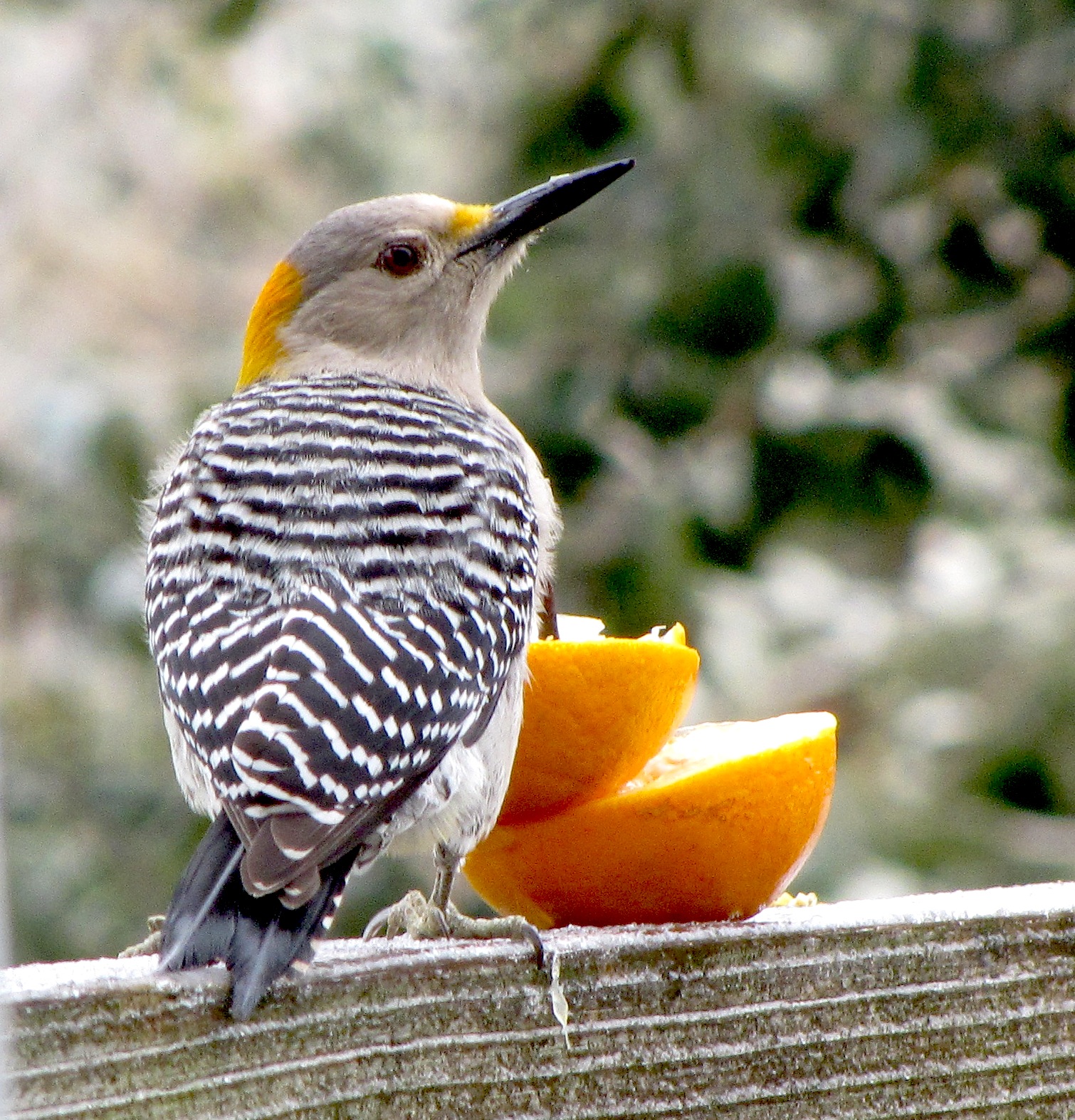
Before this Golden Fronted Woodpecker found two fresh orange halves on the south deck,


she had passed up the frozen ones on the north side of the house!
A year-round resident of our back yard, it's safe to say she had never before seen an ice storm in Arroyo City--and neither had we!


I'm sure this Northern Mockingbird appreciated the oranges we put out for him, 
but he sure looks angry about the ice on his tail!


I'm just an amateur photographer with a point and shoot camera, but the subjects of my photographs more than makeup for my lack of professional skill. If you  focus on the birds and not my fuzzy focus, I think you'll like the critters I share a yard with here on the banks of the Arroyo Colorado.


 To see other "Camera Critters," check out this blog where some really fine photographers have posted their photos.

Thursday, February 10, 2011

Weather is Changing--and so are the birds


I just talked with my sister who still lives in our Oklahoma hometown.  Last week winter slammed them with a whopping 15 inches of snow--definitely unusual weather.  When we were kids we hoped for even a few inches of winter snow.  But as it turns out, last week was just a beginning of their amazing winter weather.  Yesterday it snowed another 15 or so inches. And this morning the thermometer at their place showed negative 29.7 degrees fahrenheit!

Texas Baby's Bonnet, one of our loveliest native 
plants, had just begun to bloom before the storm.
That makes it seem downright balmy here.  Our thermometer says 32.  Actually, this is our second freeze for the month.  February blew in with south winds and a 70 degree day--about the normal for Feb. 1--but the groundhog and a strong norther brought us real winter by Groundhog Day. Although the little furry guy didn't see his shadow, we never pay attention to his winter predictions anyway. The last week of January had seemed like spring already according to our birds and all the blooming wildflowers and flowering shrubs.

Our neighbor's  mix of native and tropical
plants was beautiful before the freeze.


Kiskadees had been calling and flirting and lifting their crests.  Tanagers and buntings suddenly appeared at feeders.  One of our Altamira Orioles was even inspecting the nest they had built and abandoned last spring.  A Curve-billed Thrasher was singing its little "whisper song" from the hackberry tree every day, a prelude perhaps to its full-throated song during courtship.

The Summer Tanager and Indigo Buntings, uncommon winter visitors, were beautiful reminders that summer was not so far off and spring migrants would be arriving before we know it.  We were getting huge flocks of Red-winged Blackbirds and cowbirds that emptied feeders at a budget-breaking rate.


This female Summer Tanager apparently didn't get the memo that winter was on its way.
But here she is after the ice storm, just as lovely as before.


Then came the frigid air mass that had already slammed the rest of the country.  Since we have mostly native plants, I didn't cover them.  I had brought in a potted milkweed, not because it would freeze, but because of the Monarch butterfly caterpillars that were just getting fat and would need leaves of the host plant to survive.  Other plants will be ugly for a while, but it won't take too long to return to normal.  I'm hoping it's a very temporary setback. At least this one caterpillar stayed unfrozen, if not warm, in our garage. [I have edited this paragraph since first posting it.  I originally said the caterpillar was a Queen.  Now I've decided it's a Monarch.  It had only two sets of antennae, not three.  I read about the difference on this very good butterfly blog.]


What surprised us most was not the four nights of freezing temperatures but the ice that coated the trees, shrubs, and grass.  The photo at the top of this post shows the beauty of the ice as it  decorated palm trees and the river bank.  All day long on Thursday, a week ago, strong winds blew down sheets of ice that looked like crystal palm fronds as the freezing drizzle coated the fronds, turned them to ice, and then were dashed to the ground by the wind.  I've always loved the way moonlight can brush the palms with silver; this was a similar beauty.

On the day the wind was scattering ice on everything, I covered my head with cold arms (protected not by my winter coat which  I had left in Missouri, but by layers of hoodies and sweaters) and ran out to refill the feeders.  Just as I reached one of them, a Pine Warbler landed about a foot from me.  I think I could have touched it if I'd wanted to.

Surprisingly, we've had several Pine Warblers here this winter.  I've written about discovering the first one a couple of months ago, a new bird for our life yard list, and I also posted another photo in early January.  Both of these were pale birds, possibly first winter or females.  The one that almost landed on my hand was a brighter male.  I have been wondering how the changes we are seeing in our climate all over the world will change our wildlife.  That's impossible to know for sure but I am speculating.  Will weather change bring permanent changes in bird populations?  Will populations be in danger or will they merely rearrange?  Of course I know that there will be permanent disastrous changes if we don't heed the warnings.  But for now I am eager to see what will show up in my yard.

Here's the Pine Warbler on a warmer day last week, dining from our Oklahoma State University (ride 'em cowboys!) feeder.  I was glad to see it again after that cold day when nature was hurling ice from the trees.  Pine Warblers are the only warblers I've observed eating seed.  Several help devour the orange slices I put out (Orange-crowned and Yellow-rumped Warblers) and regularly sip from the hummingbird feeders (Yellow-throated Warblers as well as Orange-crowned), but until this little guy all but pleaded with me on the icy day I had not seen warblers at a seed feeder.

The next two pictures are not good photographs, but I am posting them because they are also new birds for the Yard List (not just for this year but for the 15 years we have lived here). Whether because of changing weather patterns in the nation or just because birds--especially winter birds--seem to irrupt in different places in different years, these are species I haven't observed here before.


Isn't this an amazing little bird?  I know it's not a good photo--I had zoomed in as far as I could, and I took the picture through a not-so-clean window that looks out on the backyard.  It's an Anna's Hummingbird which I had seen before only once in California. So you can imagine my excitement.  At first I thought I was seeing a Ruby-throated Hummingbird when I saw it perched in the oak tree above this patch of shrimp plant.  I thought it unusual to see a male in the winter with a bright gorget. Most are young or female and can't reliably be even distinguished from the Black-chinned which are also common.  Then the morning sun lit up this guy and its brilliant rosy crown and gorget were clear.  What a spectacular bird!  I saw it several mornings, always in the shrimp plant, but have not seen it since the freeze.

Here's what the shrimp plant looked like encrusted with ice.  Hopefully the Anna's Hummingbird found another place to feed.  Or maybe it'll come back.  Surprisingly, the shrimp plant doesn't seem to have been too negatively affected by its days in the deep freeze.  This morning's freeze redux probably wasn't enough to hurt it any further.


This next bird is just as beautiful as the hummer.  My first glimpse of it was also in the live oak tree.  At first glance, I thought it was the Black-throated Green Warbler I had been seeing for a few days. Then I noticed how very bright its yellow color was and how the yellow extended down to the breast.  A Townsend's Warbler!  What a beauty.  This photo is the only one I was able to take, moving quickly to snap a shot before it flew.


I'll keep trying to get this bird in a good picture.  It showed off one sunny morning  quite close to the deck where I was sitting, and stayed there for a long time as if posing.  But, of course,  it was one of those mornings when my point-and-shoot camera and lens had frozen as it sometimes does on balmy days when the early morning humidity is so high.

So our weather is indeed a little unusual.  I never thought we'd have an ice storm.  But if weather change is at all responsible for new birds, I'll take a cold day now and then.  That is, a morning briefly at 30 degrees--not  minus 30 as they had in my hometown this morning!


Monday, January 31, 2011

May be...a Phoebe


In the bird world, things are not always what they seem.  Or maybe I mean that some seem what they aren’t.

The bird above is a perfect example.  It’s an Eastern Phoebe.  I see that clearly now. 

But when I first encountered it, I wasn’t so sure.  I had gone out to the mailbox by the road to pick up the mail.  My camera was slung around my neck because I wanted to get a photo of the caterpillar I’d seen on the milkweed.  But I didn’t have my binoculars—I was, as they say, “birding naked.” (That means without binocs:  I assure you I was fully clothed!)  As I turned to carry my junkmail back up the drive, I spotted a bird perched on a neighbor’s gray-green century plant. 

True, it was just where a phoebe was likely to be, but it was most definitely not pumping its tail as phoebes “always” do.  I know they do that, and every field guide says the same.  Furthermore, it was not a dark brown bird but rather a lightish brown one.  The phoebes I see around here always seem pretty dark.  At least that was my impression.

I downloaded the day’s photos to my computer but didn’t look at the one of my bird on the century plant until late that night.    When I finally did, I had no idea what it was.  I still didn’t think “phoebe” since I had (too) quickly ruled that out.  Its head looked kind of big, and the crown was flat.  I considered some kind of flycatcher.  The photos did show those little rictal bristles around the bill.  There was no crest visible.  It seemed too big for a Willow flycatcher or some other empid.  The more I looked at the photos, the more I thought it was something I hadn’t seen before.  Remember it was late at night.  Flipping through field guides, I started looking for flycatchers but nothing looked right.  Finally I saw Peterson’s illustration of a female Rose-throated Becard.  My sleepy brain (it was after midnight) thought that was a match! Oh happy day (or night, or wee hour of the morning)!

Of course it wasn’t.  In the light of day I looked at the illustrations in other guides and saw that the color was all wrong and the cap wasn’t dark enough.  My lovely becard faded with the morning light.  And with a friend who said, what about Willow Flycatcher, size is the key. I replied that it was bigger than a Willow; it was the size of a phoebe. 

That’s when it hit me.  Of course it was the size of a phoebe.  It was a phoebe!   I googled images of phoebes and saw several that were almost identical to mine.  A flat-headed phoebe that didn’t pump its tail even once.  An ordinary, everyday Eastern Phoebe.  Not a new yard bird or a visitor from Mexico.  


Still, it’s beautiful, isn’t it?  Clinging to the sharp thorny end of the century plant leaf, it was motionless, perhaps posing just for me. 

A few hours later my friend emailed me to say she “didn’t want to burst my bubble” but my photo was of a phoebe.  I didn’t tell her I had already figured that out. Bursting bubbles is what good friends are for.

I saw a phoebe today perched in a tree in the back yard.  It was dark brown and pumped its tail ferociously.  I laughed.  The Eastern Phoebe is beginning to be one of my favorite birds. 

Saturday, January 29, 2011

Camera Critters: Green Jays


If I were not already a Back Yard Bird Watcher, I'd be one after seeing a Green Jay. I never tire of watching them, listening to them, or taking their pictures.

I started writing a post a couple of days ago that I have not finished. I know, I do that a lot--which you know if you follow this blog. I am wordy, perhaps too much so. Sometimes I just want to put a few of my favorite photos out there without the words, and that's what I'm doing here. I've decided to participate in a meme called "Camera Critters" to share some of my backyard visitors -- without so many words. Watch for backyard bird shots every Saturday.

This week, enjoy the Green Jays who, with a few friends, are enjoying the orange slices I put on a feeder. (If you must have words to go with the birds, I've written about the colorful birds several times. Just click the labels list in the sidebar to find other posts about them.)


The flashy Altamira Oriole is almost as lovely as the Green Jay. Behind them is a House Sparrow.

Whenever the bigger guys aren't around, Orange-crowned Warblers fly in for a bite.

I've had fun posting my "critters." Be sure to check out other bloggers' backyard visitors at the Camera Critter blog and the links there.